
This report is shown as scanned pages until a volunteer types it up. Skip to the machine-read text (unproofread), which a screen reader can read.
Machine-read text (unproofread)
Read from the scans by software, so it contains mistakes. Typing it up properly would help blind readers: use Suggest an edit.
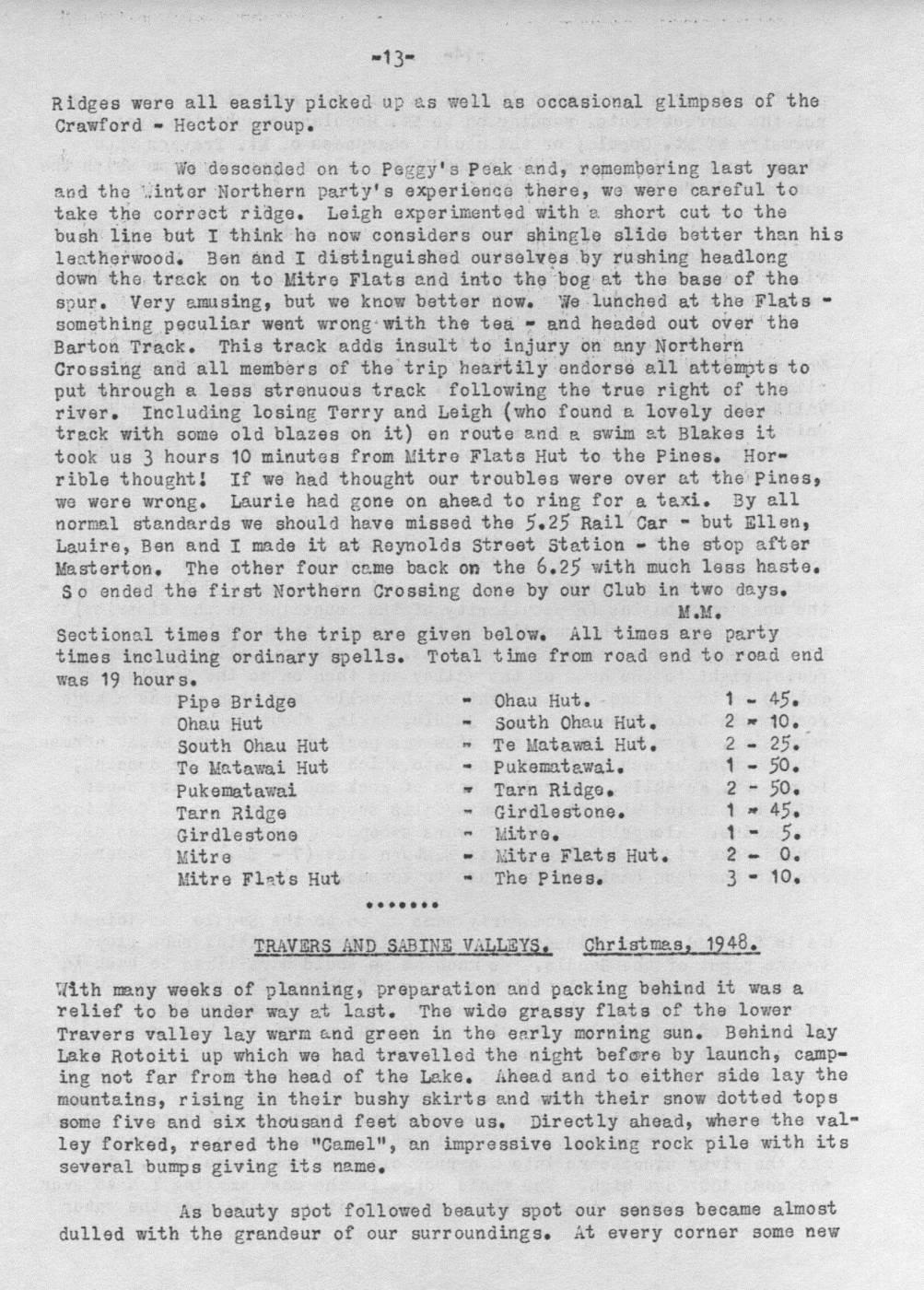
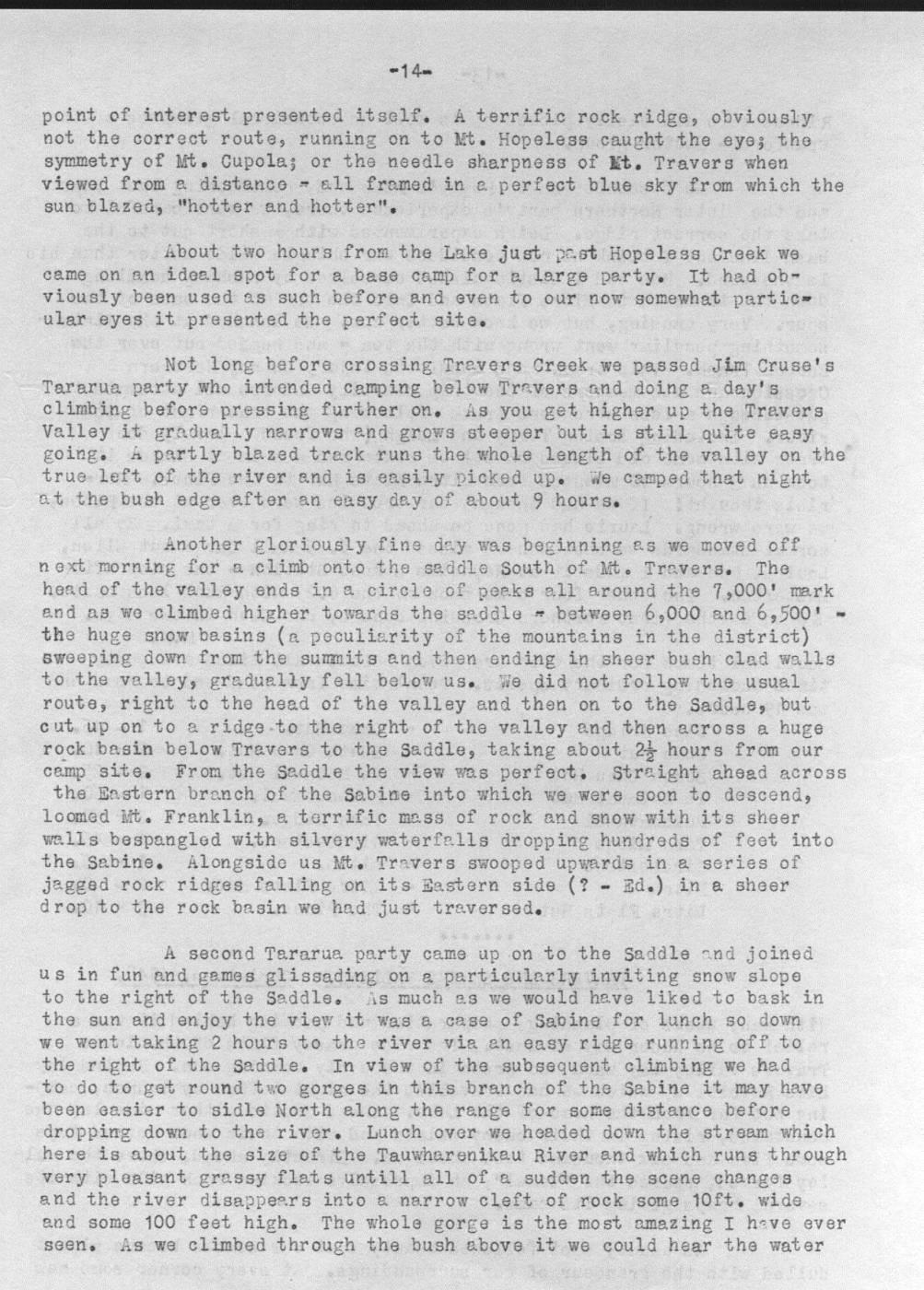
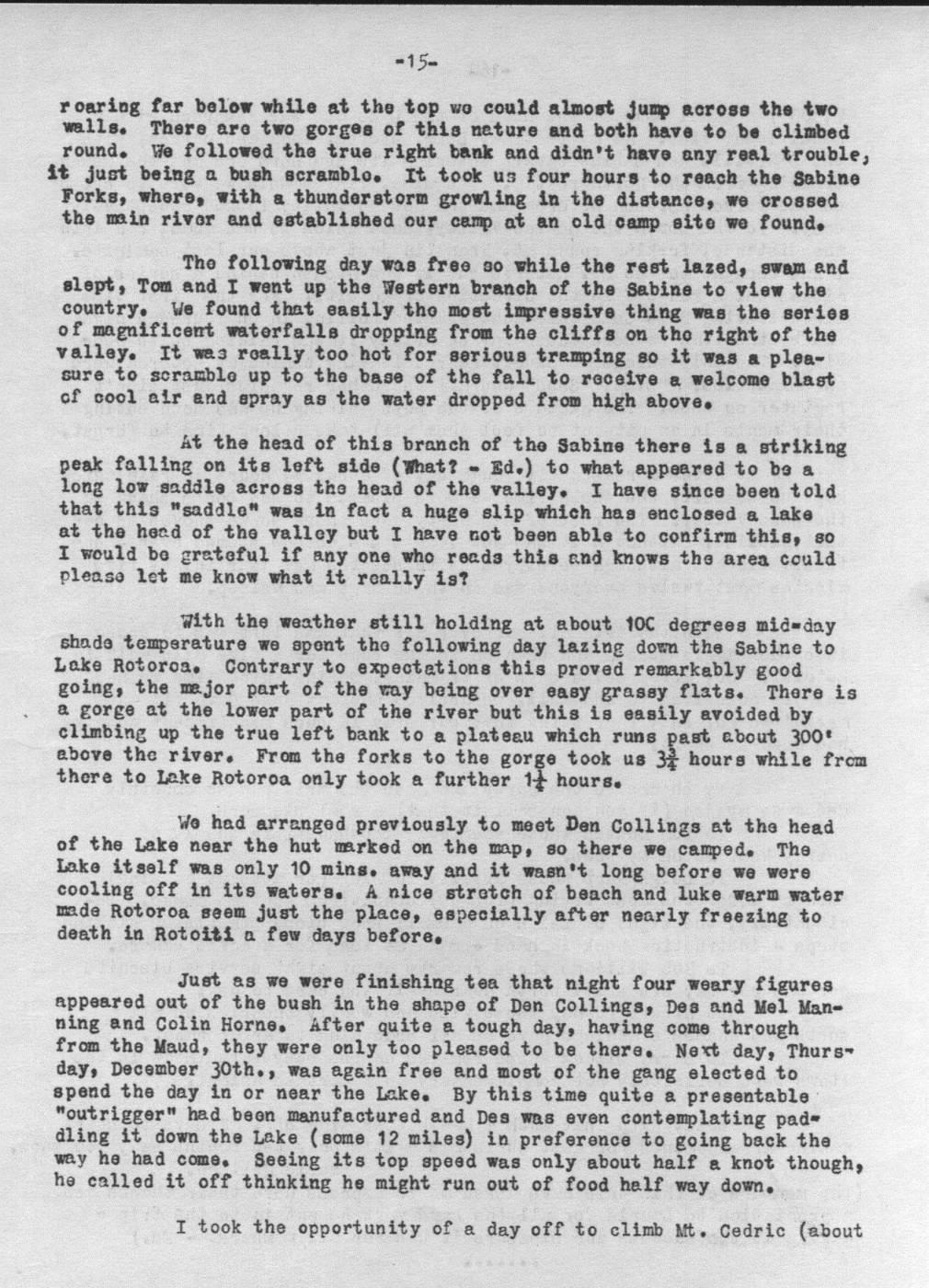
TRAVERS AND SABINE VALLEYS. Christmas, 1948. With many weeks of planning, preparation and packing behind it was a relief to be under way at last. The wide grassy flats of the lower Travers valley lay warm and green in the early morning sun. Behind lay Lake Rotoiti up which we had travelled the night before by launch, camping not far from the head of the Lake. Ahead and to either side lay the mountains, rising in their bushy skirts and with their snow dotted tops some five and six thousand feet above us. Directly ahead, where the valley forked, reared the "Camel", an impressive looking rock pile with its several bumps giving its name. As beauty spot followed beauty spot our senses became almost dulled with the grandeur of our surroundings. At every corner some new point of interest presented itself. A terrific rock ridge, obviously not the correct route, running on to Mt. Hopeless caught the eyes the symmetry of Mt. Cupola; or the needle sharpness of kt. Travers when viewed from a distance = all framed in a perfect blue sky from which the sun blazed, "hotter and hotter". About two hours from the Lake just past Hopeless Creek we came on an ideal spot for a base camp for a large party. It had obviously been used as such before and even to our now somewhat particular eyes it presented the perfect site. Not long before crossing Travers Creek we passed Jim Cruse's Tararua party who intended Camping below Travers and doing a day's climbing before pressing further on. As you get higher up the Travers Valley it gradually narrows and grows steeper but is still quite easy going. A partly blazed track runs the whole length of the valley on the true left of the river and is easily picked upo We camped that night at the bush edge after an easy day of about 9 hours. Another gloriously fine day was beginning as we moved off next morning for a climb onto the saddle South of Mto Travers. The head of the valley ends in a circle of peeks all around the 7,000' mark and as we climbed higher towards the saddle i between 6,000 and 6,500' a the huge snow basins (a peculiarity of the mountains in the district) sweeping down from the summits and then ending in sheer bush clad walls to the valley, gradually fell below us. We did not follow the usual route, right to the head of the valley and then on to the Saddle, but cut. up on to a ridge.to the right of the valley and then across a huge rock basin below Travers to the Saddle, taking about 21 hours from our cemp site. From the Saddle the view was perfect. Straight ahead across the Eastern branch of the Sabine into which we were soon to descend, loomed Mt. Franklin, a terrific mass of rock and snow with its sheer walls bespangled with silvery waterfalls dropping hundreds of feet into the Sabine. Alongside us Mto Travers swooped upwards in a series of jagged rock ridges falling on its Eastern side (? - Ed.) in a. sheer drop to the rock basin we had just traversed. A second Terarua party came up on to the Saddle and joined us in fun and games glissading on a particularly inviting snow slope to the right of the Saddle. As much as we would have liked to bask in the sun and enjoy the view it was a case of Sabine for lunch so down we went taking 2 hours to the river via an easy ridge running off to the right of the Saddle. In view of the subsequent climbing we had to do to get round two gorges in this branch of the Sabine it may have been easier to sidle North along the range for some distance before dropping down to the river. Lunch over we headed down the stream which here is about the size of the Tauwharenikeu River and which runs through very pleasant grassy flats untill all of a sudden the scene changes and the river disappears into a narrow cleft of rock some 10ft. wide and some 100 feet high. The whole gorge is the most amazing I have ever seen. As we climbed through the bush above it we could hear the water roaring far below while at the top wo could almost jump across the two walls. There are two gorges of this neture and both have to be climbed round. We followed the true right bank and didn't have any real trouble, it just being a bush scramblo. It took us four hours to reach the Sabine Forks, where, with a thunderstorm growling in the distance, we crossed the main river and established our camp at an old camp site we founde The following day was free 3o while the rest lazed, swam and slept, Tom and I went up the Western branch of the Sabine to view the country. We found that easily tho most impressive thing was the series of magnificent waterfalls dropping from the cliffs on tho right of the valley. It was roally too hot for serious tremping 80 it was a pleasure to scramble up to the base of the fall to receive a welcome blast of cool air and apray as the water dropped from high above. At the head of this branch of the Sabine there is a striking peak falling on its left side (What? - Ed.) to what appeared to be a long low saddle across the head of the valley. I have since been told that this "saddle" was in fact a huge slip which has enclosed a lake at the head of the valley but I have not been able to confirm this, 80 I would be grateful if any one who reads this and knows the area could please let me know what it really is? With the weather still holding at about 10C degrees mid-day shade temperature we spent the following day lazing down the Sabine to Lake Rotoroa. Contrary to expectations this proved remarkably good going, the me.jor part of the vay being over easy grassy flats. There is a gorge at the lower part of the river but this is easily avoided by climbing up the true left bank to a plateau which runs past about 300* above the river. From the forks to the gorge took us 34 hours while from there to Lake Rotoroa only took a further 1+ hours. Wo had arranged previously to meet Den Collings at the head of the Lake near the hut marked on the map, so there we camped. The Lake itself was only 10 mins. away and it wasn't long before we were cooling off in its waters. A nice stretch of beach and luke warm water made Rotoroa seem just the place, especially after nearly freezing to death in Rotoiti a few days before. Just as we were finishing tea that night four weary figures appeared out of the bush in the shape of Den Collings, Des and Mel Manning and Colin Horne. After quite a tough day, having come through from the Maud, they were only too pleased to be there. Next day, Thursday, December 30th., was again free and most of the gang elected to spend the day in or near the Lake. By this time quite a presentable "outrigger" had been manufactured and Des was even contemplating paddling it down the Lake (some 12 miles) in preference to going back the way he had come. Seeing its top speed was only about half a knot though, he called it off thinking he might run out of food half way down. I took the opportunity of a day off to climb Mt. Cedric (about
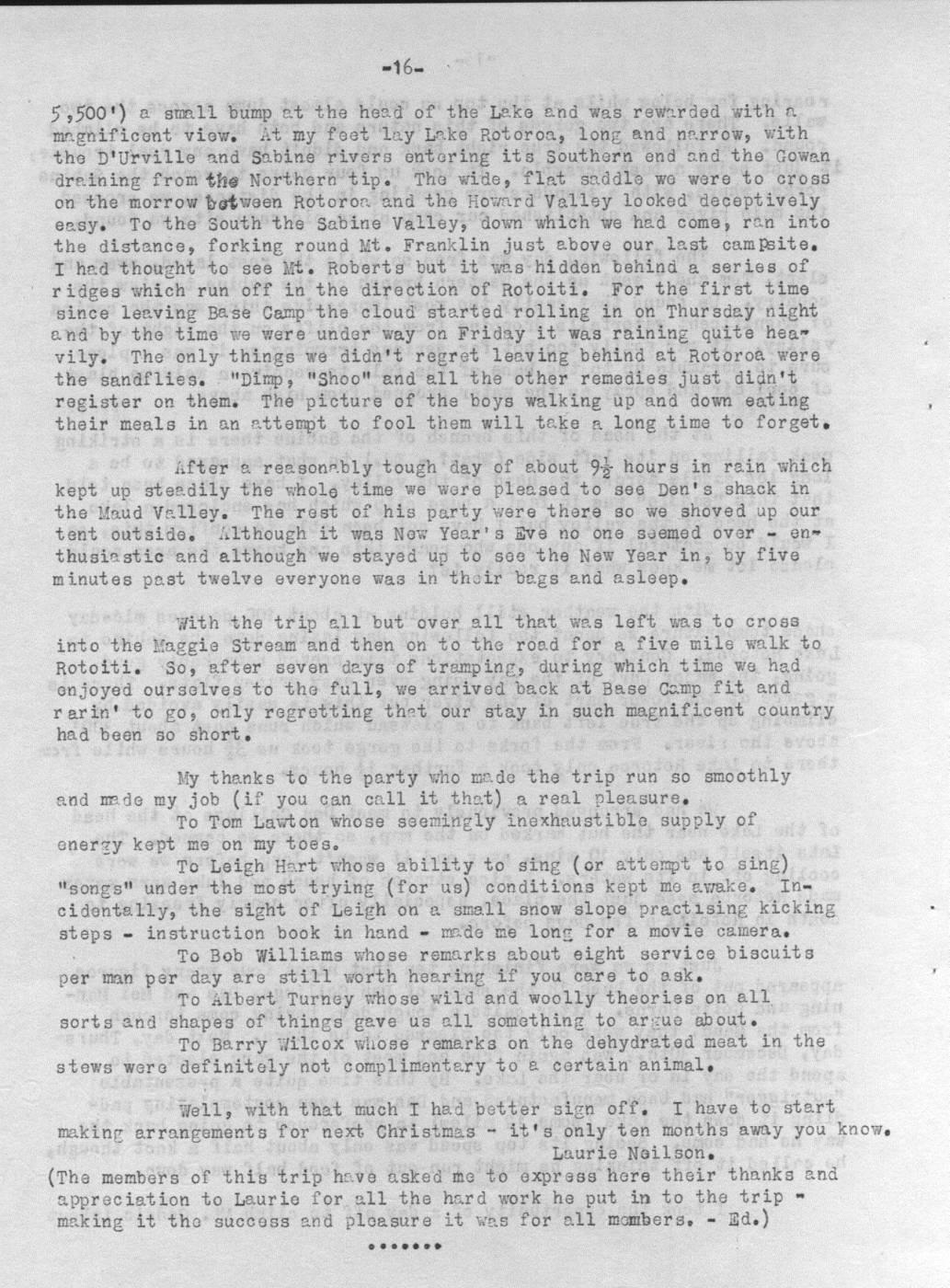
5,500') a small bump at the head of the Lake and was rewarded with a mn.gnificent view. At my feet lay Lake Rotoroa, long and narrow, with the D'Urville and Sabine rivers entering its Southern end and the Gowan dreining from the Northern tipo The wide, flat saddle we were to cross on the morrow botween Rotoroa and the Howard Valley looked deceptively easy. To the South the Sabine Valley, down which we had come, ran into the distance, forking round Mt. Franklin just above our last campsite. I had thought to see Mt. Roberts but it was hidden behind a series of ridges which run off in the direction of Rotoiti. For the first time since leaving Base Camp the cloud started rolling in on Thursday night and'by the time we were under way on Friday it was raining quite heavily. The only things we didn't regret leaving behind at Rotoroa were the sandflies. "Dimp, "Shoo" and all the other remedies just didn't register on them. The picture of the boys walking up and down eating their meals in an attempt to fool them will take a long time to forget. After a reasonably tough day of about 92 hours in rain which kept up steadily the whole time we were pleased to see Den's shack in the Maud Valley. The rest of his party were there so we shoved up our tent outside. Although it was New Year's Eve no one seemed over - enthusiastic and although we stayed up to see the New Year in, by five m inutes past twelve everyone was in their bags and asleep. With the trip ell but over all that was left was to cross into the Maggie Stream and then on to the road for a five mile walk to Rotoiti. So, after seven days of tramping, during which time we had enjoyed ourselves to the full, we arrived back at Base Camp fit and rarin' to go, only regretting thet our stay in such magnificent country had been so short. My thanks to the party who made the trip run so smoothly and made my job (if you can call it that) a real pleasure. To Tom Lawton whose seemingly inexhaustible supply of energy kept me on my toeso To Leigh Hart whose ability to sing (or attempt to sing) "songs" under the most trying (for us) conditions kept me awake. Incidentally, the sight of Leigh on a small snow slope practising kicking steps - instruction book in hand - made me long for a movie camera. To Bob Williams whose remarks about eight service biscuits per man per day are still worth hearing if you care to ask. To Albert Turney whose wild and woolly theories on all sorts and shapes of things gave us all something to argue ebo out. To Barry Wilcox whose remarks on the dehydrated meat in the stews were definitely not complimentary to a certain animal. Well, with that much I had better sign off. I have to start making arrangements for next Christmas - it's only ten months away you know. Laurie Neilson. (The members of this trip have asked me to express here their thanks and appreciation to Laurie for all the hard work he put in to the trip i making it the success and pleasure it was for all mombers. - Ed.) :
Comments
Comments are not open yet.