
This report is shown as scanned pages until a volunteer types it up. Skip to the machine-read text (unproofread), which a screen reader can read.
Machine-read text (unproofread)
Read from the scans by software, so it contains mistakes. Typing it up properly would help blind readers: use Suggest an edit.
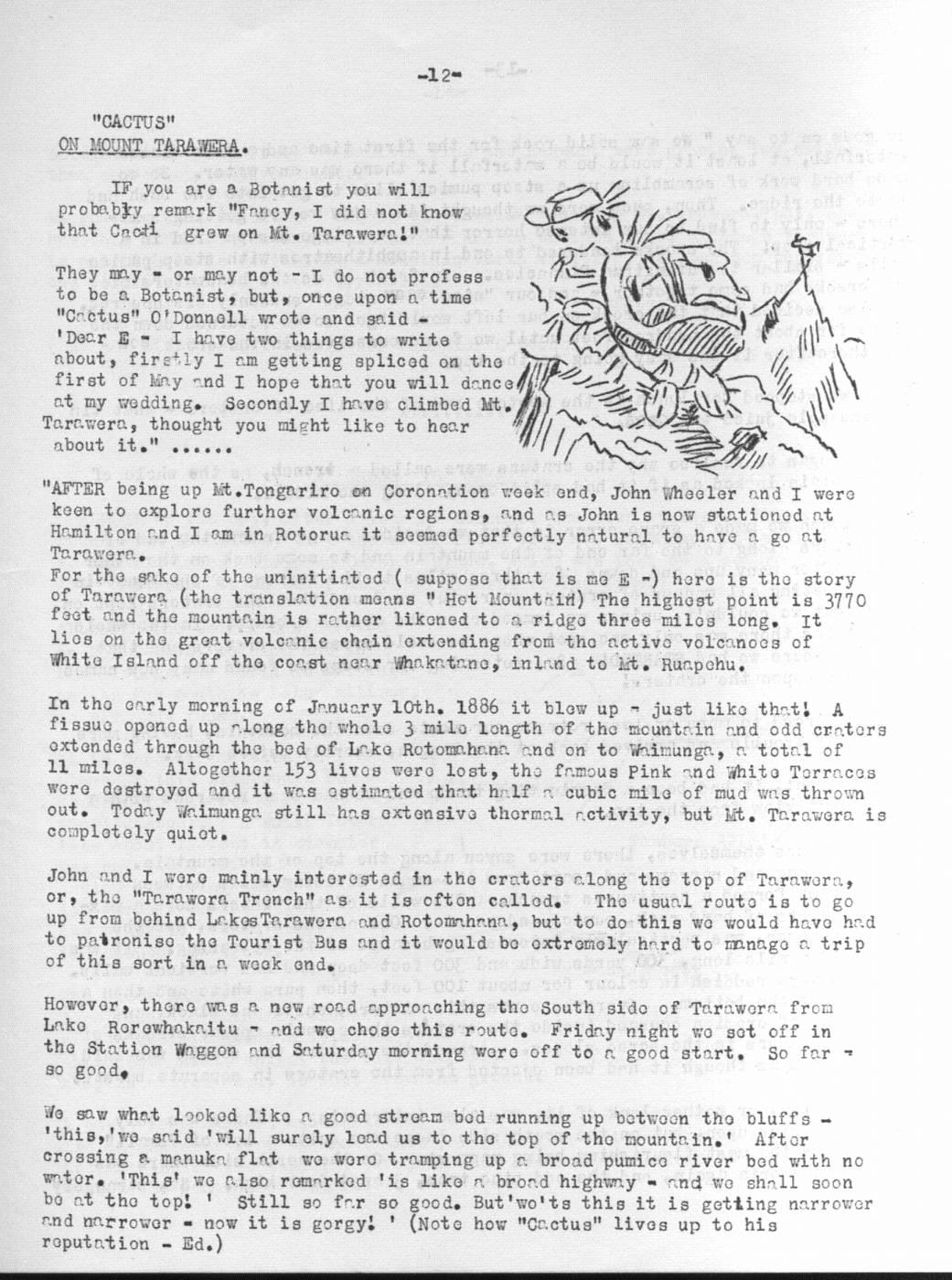
"CACTUS" ON MOUNT TARAWERA. IF you are a Botanist you will probabky remrk "Fancy, I did not know that Cacti grew on Mt. Tarawera!" They may a or may not - I do not profess. to be a Botanist, but, once upon a time "Cactus" O'Donnell wrote and said - 'Decr E à I have two things to write about, firetly I am getting spliced on the first of Mny nnd I hope that you will dancel at my wedding. Secondly I have climbed Mt. Tarawera, thought you might like to hear about it." "AFTER being up Mt.Tongariro on Coronation week end, John Wheeler and I were keen to explore further volcanic regions, and as John is now stationed at Hamilton and I am in Rotorus it seemed perfectly natural to have a go at Tarawera. For the sako of the uninitintod ( suppose that is me E -) here is the story of Tarawera (the translation means I Hot Mountain) The highest point is 3770 feet and the mountain is rather likened to a ridgo three miles long. It lios on the great volcanic chain extending from tho active volcanoes of White Island off the coast near Whakntane, inlnnd to it. Ruapehu. In tho carly morning of Jnnuary 10th. 1886 it blew up - just liko that! A fissue oponed up nlong tho whole 3 milo longth of the mountain and odd crators oxtended through the bed of Loke Rotomhena. and on to Whimunga, a total of 11 miles. Altogether 153 livos were lost, tho famous Pink and White Torraces were destroyed and it was ostimated that half n cubic mile of mud was thrown out. Today Waimunga. still has extensive thormal nctivity, but Mt. Tarawera is completely quict. John and I were mainly interosted in the craters along the top of Tarawora, or, the "Tarawora Trench" as it is ofton callod. The usual routo is to go up from behind LekosTarawera and Rotomnhena, but to do- this wO would have had to patroniso the Tourist Bus and it would be extrenely hard to mnago a trip of this sort in a weck ond. Howevor, there was a new road approaching the South sido of Tarawora from Lako Rorewhaknitu - and wO chose this routo. Friday night WO sot off in the Station Woggon and Saturday morning were off to a good start. So far - so good, Wo saw what looked liko a good stream bod running up betwoen tho bluffs 1 'this,'we snid 'will suroly load us to tho top of the mountain.' Aftor crossing a manukn flat we wero tramping up a broad pumico river bed with no wator. 'Thist we also remnrked 'is like a brond highwny - nnd we shall soon bo at the top: 1 Still so fnr so good. But'wo'ts this it is getting narrower and narrower - now it is gorgy! I (Note how "Cactus" lives up to his reputation - Ed.)
He goes on to say' n We saw solid rock for the first time and a fair dinkum waterfall, nt least it would be a waterfell if there was any wator. So we mdo hard work of scrembling up a steep pumice slide to got into the bush and on to the ridgo. Then, once more wo thought 'Ah - NOW wO aro getting somewhoro a only to find to our intense horror that our ridge disappo arod in a vertical drop! The crecks tondored to end in amphithontros with stecp pumice walls - similar to Putangirun Pinnacles. In front of us tho headwaters of two crecks had come together - nnd our "nice casy ridgo" suddenly disappoared, We nlso decided that the creck on our left would "go" so WG roturned down the ridge for about two hundred foet until WG found ourselvos in the creck bod - and thereafter it was casy going to the top. First WG stopped for lunch at the western ond of the line of craters * that tin of Pineapple juice was GOOD. We now began to realise why the craters were called a trench, as the whole of the mountain looked as if it had split open, along tho middle. After lunch we made a grave error in that we decided to go around the end of the craters nlong to the far ond of the mountrin and to como back on tho other side. After many ups and downs for three miles to the far end of the mountain and inspecting all mannor of craters en route, we found that the craters kopt on going, but WG couldn't, unless we jumped ovor the end of a bluff. In tho whole three miles there was only one spot where we could cross the craters and that was back where we had STARTED! So, retracing our steps we found many new names and curses upon the craters! We were forced to more or less retrace our route down the mountain, having more "waterfall" trouble and arrived back nt the Waggon, shortly before dark. In retrospect, it had been a fnscinnting tromp and we had been rewarded with a magnificent view from the top. Of the craters theméelves, there were seven along the top of the mountain. They were long and narrow, and apart from the small dividing walls between craters they formed a continuous tronch. The walls of the craters were a mixturo of lnyers of hard rock, pumice and scoria. One of the craters, not the largest however, was particularly interesting because of the colouring. It was about half a mile long, 300 yards wide and 300 feet deep and had vertical walls. The walls were reddish in colour for about 100 feet, then pure white and then a dark grey at the bottom. Everywhere was this mixture, white and black, and where signs of erosion ocurred inside the craters there would appear strenks of all three colours in the'scree slopes. Around the craters the scoria was laid back in waves as though it had been ejected from the crnters in separate bursts. The vegotation, or rather lack of it, was also intoresting. There was only scoria to thrive upon, but on the south sido there was quite a lot of "smell" vegetation - the most flourishing being ragwort. On the north side there was nothing but scoria again, nnd the odd pino tree, 3 or 4 feet high. so, strangely
-14= enough - two I importeds" a Radiata Pine end Ragwort were growing far better than any of our nintive plants. iie realise that we did not choose the casiest route up Mit.Tarawero, but, somehow this added to the day's pleasure 1 and we decided that, although Tarawora. is not high it is definitely a mountain worth visiting. We can now understand the terrific nature of the orruption. # Barric. - I Wo now bid farewell to B e for Bachelor O'Donnell )
Comments
Comments are not open yet.