
This report is shown as scanned pages until a volunteer types it up. Skip to the machine-read text (unproofread), which a screen reader can read.
Machine-read text (unproofread)
Read from the scans by software, so it contains mistakes. Typing it up properly would help blind readers: use Suggest an edit.
FOUR IN A FRIGIDAIRE, Xmas 1954. "Those who follow the ways of the hills are often objects of some astonishment. This is no doubt because there is a marked difference between mountaineering and most other forms of activity pursued by man in his leisure moments. Mountaineering is a sport and not a game, governed by no man made rules, but rather by certain precepts which it is dangerous, if not fatal, to ignore. It is this.absence of regulations that gives it half its charms." Douglas Busk. Three of our members along with a fellow tramper from Auckland spent part of their Xmas trip living in "deep freeze" : here is a record of this new mode of pleasure? To many, Christmas means eating sumptious food. To we four, Murray Bolt, Otto Johanson, Brian Timmings and the writer, it meant the same - at the Hermitage Mt.Cook, a Before arriving at the Hermitage we were suitably "mellowed" at the Lake Pukaki "Pub" - treating ourselves to a few beers and a marvellous view of Cook across the. Lake. We did justice to everything, absolutely everything at the Hermitage. We came down to earth on the 26th.December as the Ball Hut Bus dumped us at the turnabout. After four hours travelling up the Tasman Glacier we. scrambled up the 200' ft. morraine wall to the De-la-Beche Hut at the junction of the Rudolph and Tasman Glaciers, Herc we dumped food and fuel for 8 days. After a short spell we left for the head of the Tasman. . In three hours we were opposite Mt,Darwin, which offered good. slopes for a snaw cave, We started digging 200 ft. above the glacier on asteep slope, at 8 p.m. By 2.30 next morning we had a comfortable cave, well back in the slope, so as to withstand any thaw. As we retired we observed's. flicker of light as a party-moved up the Haast Ridge for a climb on Mt.Tasman. We slépt for three hours, then made preparations for an attempt on Mt.Darwin, 9,700 ft. above us. Leaving late ( 9. O'clock) we were soon involved in technicalities that cost us valuable time, By 3 p.m. we were 1,500 ft. below the South Summit, the true Summit being another half mile back. Our cave digging episode on top of the"carrying up" began to take toll, so we decided to about turn and called the day a "training climb." However it was early to bed first of all tucking away a'good tea. Four thirty am next day we left for the Green-Walter Plateau, and in an hour were really cramponing steeply in and around the crevasses. on the ridge. Above us we espied two tiny figures cutting steps, flat out; catching up to them we found them to be Phil Gardiner and Graham McCallum. We. increased their steps, to keep warm, a - the same time abusing them for showering us with debris. As we gained height the ridge fell away on either side, leaving a slender ridge of snow that was most spectacular. et On the Plateau, we chose Mt. Green as our first climb. The usual face climb was out, the snow being too soft. We took to the ridge. Steep rock turned us into a gully, here we met soft snow on holdless slabs with no visible means of making our way out. Regaining the Plateau we observed "dirty" weather approaching from the South and realised that we would have just enough time to climb Walter. An hour's steep cramponing saw us on top of Walter, A to immediately "about turn" and face a strong rising South winds the sky above ominious. We hurried and regained the ridge only to find what had been hard ice was now knee deep snow. We started down, belaying carefully. Suddenly. we met the storm - rain - snow and sleet driving into our faces - being at 9,000 feet we were rather worried. After a while the weather slackened and only snft snow troubled us - we rea alised-how fortunate we were. Phil and Mac followed our ploughed tracks down an hour behind us. They had- abandoned their climb on West Peak. After an early tea we crawled into our sacks, very snug indeed 10 feet under the snow. At daybreak I let my Li-Lô down and folded my gear. Upon venturing outside I was amazed to find what I had thought was going to be a beautiful day was instead extremely bad weather, heavy rain and a high wind greeted me. We slept and ate ALL day. That night vivid lightening and peals of thunder suggested that a storm was raging outside. Next day, with the weather still doubtful, we left our cosy cave and back pedalled to the De-la-Beche Hut. Here we sorted gear and prepared for our crossing of Graham's Saddle ( 8,700'). Gardiner and Co. were in residence at the Hut and they clattered out and away at 2.00 next morning. We rose and breakfasted, léaving at 3.300 a.m. The previous night we had a "recce" and marked the steep 300 feet descent to the Rudolph Glacier. By torchlight we had no trouble and daylight found us well up towards the clear ice. The Rudolph Glacier giving access to the Graham Saddle consists of a large neve basin, with two feeders to the Glacier proper. One and icefall, the other a long broken glacial shelf. The key to the Upper Rudolph Glacier is 1,500 feet of rock slope hard under Mt,De-la-Beche alongside the ice-fall. We had no difficulty getting through the breaks to the rock. By 8.30 am we were in the sunshine clear of any falls and the Saddle a thousand feet above us, a mere dip in the ridge. The day was fine and the prospect of what lay across the divide intrigued us immensely. We taped the Main Divide at 10.00. Below us lay the vast expanse of the Franz Josef neve, a tremendous area of snow. In the distance we caught a glimpse of the sea through layers of low cloud above the forests of the "Coast." The high peak on the famed Linden Ridge attracted our attention - it was truly beautiful - in the distance rolled range upon range of peaks. With a last look at the Tasman Valley we descended the steep snow faces in and out the crevasses. Below the saddle we met the heat of the basin and we hurried to avoid:the softening snow ever mindful of the crevasses, some of which were concealed. We chose a leading ridge of Mt.Rudolph as a'sito for our cave. Low clouds rolled in from the Coast turning the Franz Basin into a humid oven_heat. It turned the snow into slush and the heat sapped our energy. We were unable to settle down to digging until the late afternoon. Our cave here was of a different pattern to the Tasman one - stratas of ice gae us considerable trouble making the depth of penetration more shallow than we wished.
For the sake of expediency we used a strata of ice as a roof, instead of a dome as in the orthodox manner. Our sleeping bench was a long affair that would take two, the usual idea however is to sleep four in a row for warmth, We retired with an indifferent sky above us. Next morning the weather was poor, a high ceiling and the threatening clouds hang ing above the Franz Icefall. We abandoned our ideas to climb on the Minarets from the Graham Saddle, and decided instead to try the peak of Matanga on the Linden Ridge, being a little over 9,000 feet. Should the weather cut up rough we would be close to home - home being a hole in the snow 1 indeed a hole in a vast expanse of snow, to us our cave meant shelter, warmth and life - at 8,000 feet, Leaving the cave we travelled across the neve behind the Linden Ridge above the Spencer Glacier, our Rock Ridge was steep and slatey, but very safe. Gaining the main Linden Ridge a long snow arete led us to the summit and the weather showed signs of improvement. Our view point from Matanga gave us a very impressive sight of West Peak (of Elie de Beaumont) and the spectacular tributary glaciers draining into the Spencer. Leaving the top we returned by our line of ascent, picked up our crampons and slugged back to the cave. A feature of much of the West Coast is tha cloud that comes in regularly every day at 10,a.m, It increases the temperature of the air and the snow fields turn to slush. Travelling, unless on Ski becomes difficult by midday. Back at the Cave we spent the rest of the day on a rock outcrop, drying gear and absorbing the view. "Our Cave" was centred in a line above the start of the ice-fall, which in turn is the centre of the glacier system of the Franz Josef Glacier. To our right ran mile after mile of snow fields to the Baird Range, whilst on the left were the Giebe Snowfields running out to the Fritz Range in the distance. Whilst sitting in the late afternoon sun amidst these surroundings we discussed our route for the next day. We planned to cross the Fritz Range by, as we thought, Newton Pass, our map later we found, was wrong. Keeping high above the Tusk in order not to lose height we could swing in a big arc under Mt. Halcombe, then cross near Mt, Von Bulow. This route would leave us with only 800 feet to climb to the pass and we would avoid some very broken areas. We watched the sun set until the - coolness of the evening drove us down the slope back to.our cave. Away at the first rays of light noxt morning the hard frost gave us perfect conditions for cramponing, the day was fine but there was a cold wind blowing. In three and a half hours we were on the saddle - dropping our packs we ascended Mt.Von Bulow's Twin Peaks. At our feet, on one side lay the great white expanse of the Franz and on the other the high peaks of the Fox stood above an equal expanse of snow. To cover this area, by camera , took 8 consecutive photos. We did not linger as the snow would soon begin to soften and left the top at 8.30 a.m. to regain our packs on the saddle. The descent to the Fox Glacier was stcep and huge crevasses yawned at us, but the way was open. The breaks in the Fox were etren larger than those of the Franz. After plugging across the snow fields, an extremely hot operation, we gained the Pioneer Ridge just in time - already we were starting to break through the crust.
Perched at an eerie 300 feet abové us was the Bivy, we used the fixed ropes to reach this and were welcomed there by many friends. After a spell we crossed out onto the upper snow fields in the direction of Pioneer Pass and put in another cave, with the idea of a climb on Ledenfeldt. That night the weather really broke and we were unable to leave the cave for 36 hours. Murray Bolt spent the day of the storm feeding us - the cave rapidly becoming larger as he hewed ice from its sides to make room for his culinary efforts. We entertained ourselves by picturing was was happening in the 16 man Bivy when we knew of at least 23 people in occupation! The next day damned not very promising, but fine, so we left early. Our time was almost up, there being one day in hand which we decided to use in getting out a day early. Our route to the "Coast" road was to be made by retracing our steps to under Mt,Halcombe, thence by the standard route under the Chancellor Dome and down the Chancellor Ridge to the hut named after the ridge. On the way down we had an inspiration - why not cross into the Victoria Glacier and climb the Bismark Peaks? Dumping our packs high above the glacier floor we crossed a col into the Victoria and on to the Fritz Range again. An ice wall proved that hand holds cut were definitely an asset. With energy expended in hard step cutting we were high on the final face when the cold wind and a difficult snow and ice ridge made things unpleasant, as well as dangerous, So .we .turned and headed back to our packs. Recommencing our journey at mid-day we moved down through some very broken. areas towards Chancellor Ridge. We were shortly enveloped in low cloud and a high ceiling rolled in, For four hours we groped our way around the glacier searching for an outlet, finally, with the aneroid and compass we positioned ourselves on the Victoria Col, and sat down to wait. A temporary lifting of the mist showed us the ridge and we could not refrain from cheering whilst we made a bee line for it. Late in the afternoon we stepped onto rock and later onto vegetation - our first for a week. We reached the Chancellor Hut well before dark. We welcomed the heavy rain next day - it gave us a chance to rest. The following day we were out of our sacks early - on what was to be the last leg of our journey. I dashed up the ridge for an hour to photograph the.upper ice-fall. It was a beautiful day. From an outcrop I could see back up the glacier, a tortured mass of broken blue ice. Tasman and Douglas Peaks glistened in the bright morning sun. We had passed through there and seen it all. Our desires were now satisfied I and we knew that in having attained our desire it was no longer there. Next year we would look for new worlds to conquor. Leaving the Hut we dropped down a thousand feet to the glacier. Crossing from side to side and with devious wandering we threaded our way over a maze of broken ice. Upon reaching the terminal of the Glacier we skirted the Fox River by the tourist track to meet the main "Coast" road. A short walk and our journey was over. The Fox Glacier Hotel was to be our haven. Next morning we allowed our selves to be talked into visiting Lake Matheson to view Mts.Cook and Tasman - reflected in the still lake.
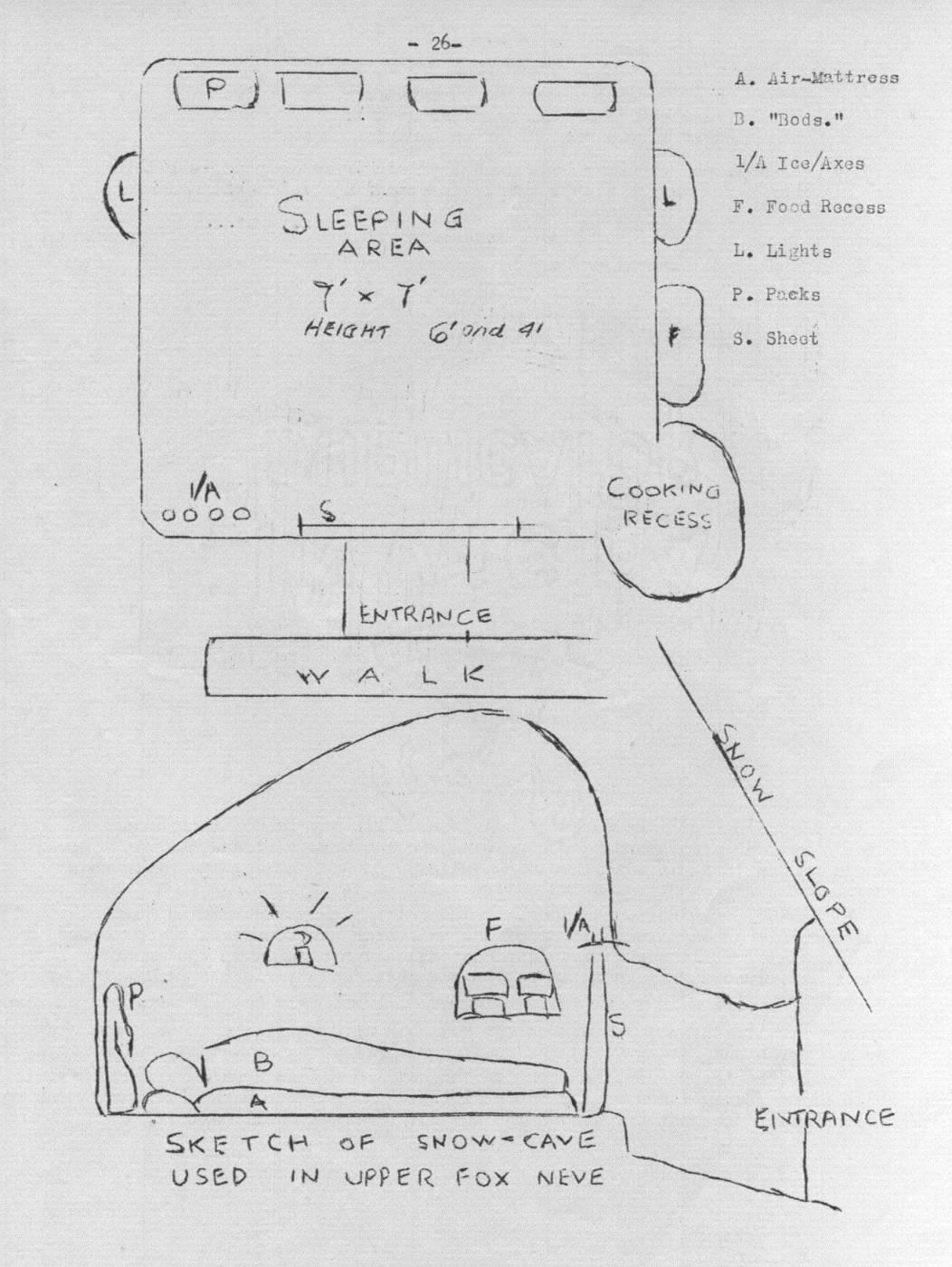
The cost of this trip was six shillings, and we thought that in comparason our trip would be worth about a thousand pounds! We were ceratinly back in civilisation - and thawing out! Yes we recommend the deep freeze. The feature of this cave ( see illustration) is the entrance. A six by four feet oiled japara sheet was used to provide insulation (from the outside air) instead of the orthodox way of placing the sleeping area above the level of the entrance. This gave adequate protection and also provided extra warmth inside. The height of the cover could also be adjusted, to provide ventelation, by shifting the two ice axes pinning it to the wall. The main use of the cover however was to sledge the snow outside for disposal down the slope. We took five hours to build this cave, but with less height and a little speeding up it could be accomplished in three and a half to four hours, If the snow is hewn out in blocks they can then be thrown outside and thus cutting down the time of construction. Thirty six hours were spent in this cave and, although a storm raged out'ide we were oblivious of this fact until we ventured out to the entrance. G.Thompson, Ed. Note About five years ago George led a Xmas trip into the Waimakariri area and upon reading this verse the other day I was. prompted to. reprint it, as a comparison to the foregoing write up - especially as we gather by a showing of George's slides that everything was organised to a T I even to the carrying of fuel in a frame pack! WOT! NO SINK? Twelve enthusiastic members of a famous tramping club, Took the "Hine" down to Christchurch, and a bus to Bealy Pub. Packed their food and gear with gusto ( carrying it was not such fun) Headed up the Waimak. River, bound for base at Carrington, "What the heck is in this pack, to make it weigh a ton?" each thought Reached the camp, begin unpacking and discovered what they'd brought! Rice and sugar, tea and cocoa, Candles, marmite, honey, cheese, Dehyd. milk and meat and veges, Chocolate, apples, beans and peas. Pepper, salt, Ryvita Biscuits, Jellies, oat tmeal, butter ham, Apricots and barley sugar, Nuts and raisins, prunes and jam. Wooden spoon and lots of lotions, Insect (bottled) sun ( in tubes) Baking dish, vanilla essence, Curry powder, Oxo cubes. Epsoms, soup, and custard powders, Dishmop, ladle, nails and twine, Pot mits, tea towels, milkshake mixer, Egg beater and groper line.
P A. Air-Mattress B. "Bods." 1/A Ice/Axes SLEEPING F. Food Recess AREA L. Lights 7'xT P. Packs HEIGHT 6'ond 41 S. Sheet A COOKING 0000 tS RECESS ENTRANCE Y A L K E I F / A R R9 S B A EINTRANCE SKETCH OF SNOW-CAVE USED IN UPPER Fox NEVE
Billics, primises and fuel, Christmas cake, bottles of brandy, Pills and tweezers, needles, catgut! Never know - just MIGHT be handy! In fact, when looking back upon the trip in retrospect, - I think The only thing we didn't take, was - Mrs.Thompson's kitchen sink! Pat : a - - a
LT E linm
Comments
Comments are not open yet.