
Text taken from the club newsletter.
GIPPSLAND EXPRESS by HARRY SMITH
A cycle tour of the rail trails and beaches of southern Victoria
Day 1 I am caught up in a confusing nightmare of busy traffic-filled streets, all of which seem to turn into freeways. Somewhere out to my left, I know from a previous trip, there is a pleasant cycleway leading into downtown Melbourne, but I can’t find my way onto it. I don’t have a map—I couldn’t find my maps of Melbourne yesterday when I packed for the trip but I thought I’d remember it ok. Now I am lost and confused! I decide to turn around, go back to the airport and start again, sure I’ll recognise the turn-off this time, but now I can’t find my way back to the airport! I must have taken a wrong turn. I turn around again, deciding to forget the cycleway, to ride in through the city on the roads, but I am soon hopelessly lost again. I stop and ask someone and they tell me to follow the tram tracks, and now I make better progress—until the tram tracks diverge! There is more confusion, more stopping and asking directions, more wrong turns. Eventually I find my way into downtown Melbourne. It has taken me all morning to go 20 kilometres from the airport—not a good start to the trip!
It is mid-January 2010 and I am on a two and a half week Australian cycle-touring trip. The plan is to go down through Gippsland to Wilson’s Promontory National Park and do some bush-walking, then head westwards around southern Victoria following a mix of roads and rail trails, scenic coastlines, islands and ferries. At Geelong I will catch the train down to Warrnambool at the western end of the Great Ocean Road and meet up with Stuart Douce, who is doing his own three-week trip around the southern coast of Australia from Adelaide to Melbourne, and spend the last week cycling with Stuart up the Great Ocean Road and back into Melbourne. I have done the Great Ocean Road before but it is a spectacular road to cycle and I am happy to do it again.
I catch the train out to Warragul to the east of Melbourne and set out southwards across the flat farmland towards the distant hills. It is swelteringly hot and I am pouring with sweat. I have caught the tail end of a heat wave—a few days ago Melbourne experienced its highest ever overnight low temperature—35 degrees! I camp for the night in the grounds of a derelict old schoolhouse at Seaview, halfway up into the hills. I am completely out of water but fortunately I am able to get some from a nearby farmhouse.
Day 2 I continue up into the hills and onto the Grand Ridge Road, the scenic route which follows the crest of the hills eastwards. The road flattens out and runs through a forest of huge tall eucalypt trees, with pretty ferns and tree ferns below. It is really beautiful, but unfortunately it doesn’t last very long and after a few kilometres I emerge out into farmland. Sadly, the Aussies, like their New Zealand counterparts, seem to have cleared most of their native forests.
I continue through a landscape of rolling farmland and small patches of bush when suddenly, going down a hill, I have the worst moment of the whole trip. My back wheel starts to wobble and rub badly. Damn! I’ve broken a spoke! What a pain! Fortunately I have some spares and should be able to fix it. But when I stop to look at it I find it’s worse than I thought. The spoke hasn’t actually broken; it has ripped right out of the wheel, leaving a jagged hole in the middle of the rim. There is no way I can fix this!
Damn! Damn! Damn! Damn! Damn! I am unsure what to do. I really should turn around, go back and find a bike shop and get it fixed, but that would probably mean going all the way back into Melbourne and I really don’t want to do that at this stage of the trip, so instead
I adjust the other spokes and straighten out the wheel as best I can and carry on, praying the wheel will hold together for the rest of the trip. In the afternoon I turn off the Grand Ridge Road and drop down out of the hills, out onto the plains to the south. I camp for the night in a pleasant recreational reserve in the small rural town of Meeniyan.
Day 3 Meeniyan marks the point where I join the first rail trail of the trip—the Great Southern Rail Trail. This is great—flat and smooth, off the roads, out of the traffic! And even though I am going through farmland there is often 20 or 30 metres of bushland on the old rail corridor on either side of me, so I am often almost unaware of the farmland beyond. It is like following a long narrow linear strip of parkland.
At lunchtime I turn off the rail trail at the little settlement of Fish Creek and head south towards Wilson’s Prom. I like Fish Creek—it has a different feel from all the other small towns I have been through. They have been very much your typical small rural service towns, but Fish Creek has a funky cafe, a small second-hand bookshop, and hand-crafted fish-themed seats along the street. It has an alternative feel, as if a whole lot of artists and craftspeople have all come and settled here.
That afternoon I experience a series of torrential downpours. I try waiting them out under an overhanging tree at the side of the road but eventually give up and carry on, resigned to getting intermittently drenched.
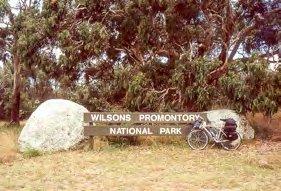
I arrive at the toll-gate at the boundary of the national park. You have to pay to enter the park and to camp down at Tidal River, the main park centre. It is holiday season and the campground is booked up, but fortunately they set aside a few campsites every night for overseas visitors like me who just turn up.
Entering the park, I soon find myself in a scene of devastation. For kilometres after kilometre I ride though burnt out shrublands, stark and blackened. There was a huge bush fire through here not long ago and it has burnt out the whole northern half of the park. They closed the park down and fought it for a week before they finally got it under control. The scale of the devastation is just mind-boggling to someone from New Zealand where everything is always so damp and wet, but every year Victoria experiences bush fires like this.
Eventually I leave the flat northern part of the park and the blackened remains of the bush fire behind and enter the main hilly southern part. This probably used to be an island before being joined to the mainland sometime in the geological past. I reach Tidal River, the main centre of the park. This is a huge campground, almost a small town with hundreds of campsites, a shop and cafe, and even an outdoor movie theatre. That evening there is another torrential downpour.
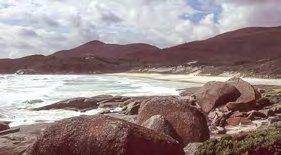
Day 4 The weather has cleared up. I get up early and go for a wander down the river and out along the beach. There are interesting granite rock formations beside the river. The beach is superb—wide and sandy, sloping gently out to sea, with white waves rolling in. Up behind the bay rise rounded bush-covered granite hills. The place feels like a tropical island paradise.
Later I go for a bush walk up Mt Oberon, which overlooks the south side of the bay. From the summit there are superb views out over the bays and beaches and granite domes of the park. In the afternoon I go for another walk over the headland to the north of Tidal River to the beach beyond—Squeaky Beach, so named because the sand makes a squeaky sound as you walk along it. It feels remote and wild, and there are interesting rock formations at either end of the beach. That evening I go to a movie under the stars at the outdoor movie theatre— you can’t do that in the Tararuas!
Day 5 Wilson’s Promontory is a beautiful place and I wish I could spend more time here. I had originally planned to spend a couple of days doing an overnight bushwalk further down the peninsula but I now decide to head back north today. You are supposed to get a permit to stay at the campsites further south and this is peak holiday time so it seems unlikely that any permits will be available. Also, I have received an email from Stuart saying he is making good progress and will probably be in Warrnambool a few days earlier that expected, so if I am going to meet him there I need to get moving. And I am worried about the bike—cracks have now developed in the outer flanges of the wheel and are spreading inwards, and you don’t need to be a rocket scientist to see that when these cracks meet up with the hole in the middle of the rim where the spoke pulled through the whole wheel will break in two! I need to get back into Melbourne and find a bike shop and get it repaired. I set off back up the road and I can hear the wheel creaking and groaning alarmingly beneath me. God knows how much longer it will hold together! I cycle rather gingerly back north, out of the hills, back through the burnt-out area, back up to Fish Creek, back up the rail trail. That night I camp in the same recreational reserve I camped in on the way down three days ago.
Day 6 I intend checking out buses back into Melbourne but somebody tells me something that changes everything— apparently there is a bike shop in the next town up the rail trail! This is completely unexpected—like finding a bike shop in Featherston or Eketahuna! I set off up the rail trail and sure enough, in the next town I find a great little bike shop. An hour later—and my wallet a hundred and something dollars lighter—I have a new wheel and am back on the road again, my worries over.
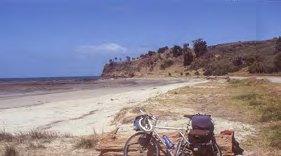
I head south-west, down to Inverloch and the Cape Patterson coast. This is a beautiful stretch of coastline where the plain meets the sea and deserted beaches are tucked into bays at the foot of cliffs down below the road. I camp for the night at Eagle Nest Point and go down the steps to my own private beach for a swim.
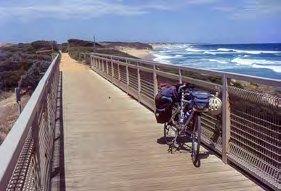
Day 7 Inland to Wonthaggi and the start of the next rail trail—the Bass Coast Rail Trail. This crosses farmland before running back out to the coast, where it runs right along the back of the sandhills and crosses an impressive trestle bridge. White waves roll in onto a superb deserted sandy beach. Time for lunch and another swim!
In the afternoon I head out to Phillip Island, across the road bridge over the narrow channel which separates the island from the mainland. Phillip Island is a popular holiday destination and there is heaps of traffic up and down the main road and lots of people down on the beach at Cowes, the main centre of the island. It’s all a bit too busy and touristy for my liking. The big attraction on the island is the daily Penguin Parade, and I had originally planned to spend a night here and go to it. Every evening at dusk hundreds of little blue penguins come ashore at one of the beaches down the far end of the island and waddle up to their nests. But when I enquire about it at the visitors’ centre, it rapidly loses its appeal. Hundreds of tourists turn up every night, you have to pay a lot to get in, and there is tiered seating around the back of the beach. Apparently you can even have your own private box seat if you pay enough! It hardly seems like seeing penguins in their natural environment! God knows where they actually find room to nest with all the tourists stomping around! It’s not my scene, and I decide to give it a miss and take the ferry that afternoon across to French Island, the next island to the north.
Coming ashore at French Island is a complete contrast. I am the only person getting on or off the ferry and there is nobody on the wharf. The ferry takes off over to the mainland and I am left alone. All is quiet. I wheel my bike ashore along the jetty—nobody is about. At the base of the jetty is a line of old, dusty, beaten- up four-wheel-drives and farm vehicles - not a BMW or campervan or mobile home in sight. A corrugated dirt road leads off into the distance, up into the island.
I set off up the road, 6 or 7 kilometres up the coast to where there is a small Victoria Parks Service campsite. On the way I am passed by a ute and the driver slows down, leans out the window and gives me a big wave and a cheery gidday. Yeah! This is great! This is my kind of island! A bit later the road deteriorates and turns to sand, impossible to ride through. I am off laboriously pushing my bike when the same ute comes back, slows down and stops. ‘Are you going up to the campsite’? asks the driver. ‘Throw your bike in the back and I’ll give you a lift’. ‘Nah’, I reply, ‘I’ll be right. I’m enjoying this’! The driver gives me a look over. ‘Yeah, you’ll be right’ he says, and takes off. And again I think, Yeah! This is my kind of island! Eventually I reach the campsite—a nice spot under tall manuka-like scrub at the back of a sandy beach, nothing but some ground to camp on, a pit toilet, and a water tank. I have the place completely to myself.
Day 8 I originally intended to just spend one night here and get the morning ferry over to the Mornington Peninsula because I am supposed to be getting off down the Great Ocean Road to meet up with Stuart. But I decide that is silly—I have been down the Great Ocean Road before but I have never been to French Island and it looks like a great place. I decide to spend an extra night here and spend the day exploring the island.
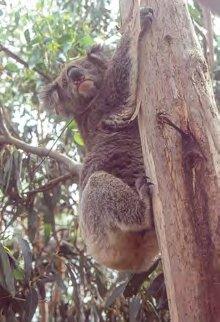
This is a great island! 25 kilometre from end to end and 10 or 12 kilometres from north to south, about two- thirds of it is a national park, the rest is private farmland. There is a small general store and cafe, a tiny school, a ranger’s station, one or two private accommodation places, and a few private farmhouses. About a hundred people in total live on the island—a greater contrast to Phillip Island would be hard to imagine. There is a network of dirt roads and four-wheel-drive tracks and I spend a superb day tiki-touring around, exploring. I ride through a mixture of bush and scrublands and walk along some interesting stretches of coastline. I see koalas in the gum trees and my only snake of the trip, an old historic chicory kiln and an old prison farm. In the whole day I only see two motor vehicles! I arrive back at the campsite in the evening dehydrated and exhausted after travelling 60 or 70 kilometres on tiring dirt roads and go in for a swim followed by a superb sunset. It has been an excellent day!
Day 9 I catch the morning ferry over to the mainland and set off southwards down the eastern side of the Mornington Peninsula. I pass through small towns and stop for lunch on a nice beach. As I head south the road becomes hillier with lots of ups and downs—not really big climbs but relentless and tiring. I’m not really sure where I’m heading for today—all I know is I’m supposed to be getting off down the Great Ocean Road to meet up with Stuart! Going up a hill I suddenly come across lot of parked cars. It turns out there is a walkway here out to the coast, with a nice camping area at the start. It is only mid-afternoon but I decide this is where I’ll stop.
I hide my bike in the bushes and set off down the walkway. After a few kilometres I emerge out at Bushranger Bay, a beautiful isolated spot backed by bush and farmland, then follow a walking track south along the clifftops for 3 or 4 kilometres to Cape Schanck. This is a spectacular landscape of wave-beaten cliffs, with a lighthouse perched up on the headland above. That evening as I walk back up the track to my bike in the fading twilight a herd of kangaroos bound across the track right in front on me. Magic.
Day 10 I continue up and over the crest of the peninsula. I am descending a hill down the other side when I suddenly come to a screaming, screeching stop. Out of the corner of my eye I have caught sight of a sign: Peninsula Hot Springs! This is a complete surprise—I didn’t know there were hot springs here! I am supposed to be getting off down the coast to meet Stuart, but to hell with Stuart! Stuart can wait! After more than a week on the road I’m not missing this! I head up a side road and soon come to the entrance to the hot springs. They are man-made— there is natural thermal water underground but it doesn’t naturally come to the surface so they have put a borehole down to tap it and have created an excellent thermal complex. There are various pools of different shapes and sizes and temperatures to soak in, and a thermal stream trickling down a small valley. I spend several hours relaxing in the pools with a completely clear conscious— completely oblivious of the fact that I am supposed to be getting off down the coast to meet up with Stuart!
Eventually I reluctantly drag myself out of the pools and set off down the coast. This side of the peninsula is much more developed than the other side—it’s more or less continuous suburbia and resort towns spreading all the way down from Melbourne. Right at the very tip of the peninsula is Point Nepean, where old military bunkers and gun emplacements used to guard the narrow entrance to Port Phillip Bay. This is now a reserve open to the public and I spend a few hours exploring here before returning to Sorrento to catch the ferry across to Queenscliff on the other side of the bay. I spend that night out at Point Lonsdale, camping in the middle of the local cemetery!
Day 11 Back into Queenscliff for a look around. This was a fashionable seaside holiday resort in Victorian times and there are some grand old historic buildings. I spend a couple of hours in the fascinating maritime museum, worried that I really should be getting off down the coast to meet up with Stuart! That afternoon I head west through a number of crowded holiday resort towns and spend a couple of hours lounging in the sun on a beautiful deserted beach.
Late in the afternoon I approach the resort town of Torquay. Torquay is a popular surfing town and marks the point where the main highway comes down from Geelong and continues on southwards down the coast as the Great Ocean Road. I am coming in on a back road— the main road runs further inland while I am on a narrow corrugated dirt road running along the coast at the back of the sandhills behind the beach. I have just reached the edge of town and am entering a roundabout when I notice a cyclist approaching from the other direction. Suddenly this cyclist starts going the wrong way around the roundabout and charging straight towards me. Oh no! Who is this mad, deranged, homicidal Aussie nutter? Then I recognise him—it’s Stuart!
This is a complete surprise. I had more or less given up on meeting up with Stuart at this point—I hadn’t had an email from him for nearly a week and I had no idea where he was. We’d agreed we wouldn’t hang around wasting time waiting for each other if we failed to meet up. Now, by an amazing coincidence, here he is! Just as I was coming into town on the back road, Stuart was heading out of town on exactly the same back road looking for somewhere to camp! If I had been an hour earlier or an hour later I probably would have missed him completely!
Day 12 The original plan had been to meet Stuart in Warrnambool at the western end of the Great Ocean Road and spend a week cycling together into Melbourne. I have ended up meeting up with him here at the eastern end of the Great Ocean Road and spent just one night camping together, but it has still given a nice sense of completion to the trip. We spent last night camping in the sandhills at the back of the beach, a couple of kilometres out of town. This morning we spend swimming at the beach before heading off in our own separate directions in the afternoon. Stuart is heading north to Queenscliff, across on the ferry to Sorrento and up the Mornington peninsula to Melbourne, while I set of southwards along the Great Ocean Road.
I don’t get very far this day. About 15 kilometres south of Torquay a side road leads down to Point Addis. When I did the Great Ocean Road a few years ago I didn’t bother coming down here so this time I decide to check it out. It turns out to be a superb spot with a lookout on the headland and a long wild beach backed by bushland. I decide to stop here for the night. Stuart came down here on his way through and reckoned there was nowhere decent to camp but I find an excellent spot down in a broad open gully in the bush. Obviously Stuart is a mere amateur in the art of finding free camping spots! I spend the rest of the afternoon lazing on the beach and swimming in the surf.
Day 13 Continuing south along the Great Ocean Road. This is a stunning road to cycle, carved into the cliffs with the deep blue sea down on one side and the bush-covered Otway ranges rising up on the other. I pass through a series of settlements and resort towns, and sandy beaches tucked into bays and rocky coves. That evening I find another excellent campsite in a grassy clearing, with my own private beach below me.
Day 14 The great Ocean Road continues all the way to Warrnambool where I was originally going to meet Stuart, but that is still two or three days cycling away and I am running out of time, so I turn off and head inland, up into the Otway Ranges. This is a big climb— over 500 vertical metres—but the road I am following is nicely graded and I just get down in bottom gear and cruise slowly up without stopping. At the top the road levels off and runs along the crest of the ranges through a stretch of beautiful eucalypt forest, with a canopy of huge mountain ashes towering over a dense understorey of tree ferns. In the afternoon I stop at a campsite in the forest and go for a bush walk down to a pretty waterfall in the valley below.
Day 15 The small settlement of Beech Forest marks the start of the last rail trail of the trip—the Old Beechy Rail Trail. This was a little narrow-gauge mountain railway that brought settlers up into the ranges in the early decades of the 20th century and took timber out. It descends steeply down the northern side of the ranges through a mixture of farmland and bush, before flattening out onto the plains beyond. I spend the night in the small provincial city of Colac, camping behind the hedge in the far corner of the grounds of the Colac Gun Club, hoping like hell that they are not going to hold a shooting meet this evening!
Day 16 I catch the morning train back into Melbourne. The trip is over.
Over the last couple of weeks I’ve cycled on roads and rail trails, through forests and farmland. I’ve passed through crowded resort towns and deserted scenic coastlines. I’ve caught trains and ferries, and visited islands and peninsulas and national parks. I’ve gone for walks in the bush and along rugged beaches and headlands. I’ve lazed in the sun on stunning sandy beaches, swum in the surf, and soaked in some superb hot-springs. It’s been a great trip!
Comments
Comments are not open yet.