
Text taken from the club newsletter.
THE PASS THAT DIDN’T
Wandering the Ahuriri Valleys by TONY GAZLEY
We had air tickets to Christchurch late May and an extra days leave to add to the weekend. So all we had to do now was to decide where to go. We had thought of a few possibilities but after pouring over our maps while waiting for the flight south we eventually decided on a pass hopping trip from the Ahuriri Valley— an area that neither Jackie or I had been to before.
So it was a late Friday night camp under the trees on the shore of Lake Ohau, and then next morning a short drive to the Ahuriri road-end. We ate a quick breakfast before shouldering our packs and heading off up the valley. The sun was shining from a clear blue sky and there wasn’t a breath of wind. The higher peaks and ridges were gleaming white with their covering of new snow that had fallen over the last few days. But we were not worried that we hadn’t brought any alpine gear— after all our chosen passes were not very high and any snow should be manageable. Or so we thought. The walking was easy up the flats beside the Ahuriri River and even after we turned off the main valley and headed up Watson Creek we had no troubles picking an easy route. There were pleasantly shaded patches of open beech forest to find our way through before the valley finally opened out to wide grassy flats. We sidled high to the topmost terrace to enjoy a lunch stop leaning back against a giant sun-warmed bolder.
Our first pass lay at the head of an unmanned valley from Watson Stream. This wide side-stream gradually steepened and became rocky then finally snow covered. The easy walking gave way to slow plodding as the snow deepened and it was late afternoon when we started up the last steep climb to the unmanned pass that would take us to the South Temple Valley. The winter sun had already dipped below the peaks and it was cold in the deepening shadows. Our boots that had been soaked from numerous river crossings were beginning to freeze on our feet as we plugged steps in the deep powder snow up the last few hundred metres towards the pass.
Our progress slowed further as the slope steepened again and the snow became deeper still. Daylight was fading fast when we stopped to decide what to do. We both had very cold feet, the depth of new snow and our slow progress had taken us by surprise, and the thought of camping where we were was not particularly inviting. We also reminded ourselves that our second pass back to the Ahuriri planned for the next day was even higher and we would probably have bigger problems than here. So it was a fairly easy decision to give up on this crossing, to simply turn around and head back down to get out of the deepest snow. We would then think of another plan for the next two days.
It was well after dark before we pitched our tent on a small area of flat ground fairly free of snow. We collected water from a nearby stream that had a thick coating of ice covering the nearby rocks, and then later when we finally warmed up a bit in our bags we cooked tea in the tent and with the map spread out we looked for a possible alternative trip.
We decided that it seemed possible to climb straight up behind our camp and cross the range to the Maitland Valley. From there we could get back to the Ahuriri Valley via a low saddle that led to Snowy Gorge Creek. There was even a hut in Snowy Gorge that we should be able to reach in a long day—it actually seemed like a plan at least as good as our original idea.
That night was as cold as either of us could remember and by the morning our water bottles next to us in the tent had frozen. It took us over half an hour to thaw our feet back into our frozen boots before we could get underway and it was later than we planned before we started up the 600 metre high scree slope to the top of the range. But again it was a perfect day and we were soon warmed especially when we had climbed high enough to be out of the shaded valley and into the sunshine.
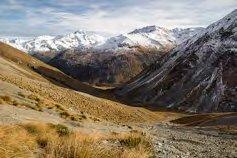
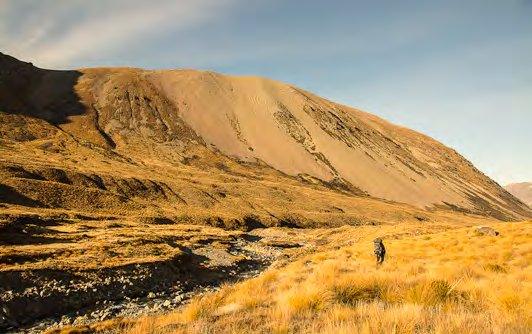
ABOVE: Our last camp was just around the corner to the right at the bottom of the scree. Watson Stream in the sun centre. Mt Barth the highest peak left centre.
But once again our progress was slower than we had hoped—for the loose surface of the scree was lying on a frozen under-layer which made it very like trying to climb up a slope of ball bearings. It was two steps up and one sliding back down. But thankfully nearer the top we could kick steps in the snow and we moved faster again.
When we reached the crest of the range we stopped to take in the stunning view around us. To the north and west were the highest peaks in the area—Mt Barth and Mt Huxley standing head and shoulders above the rest. Below were wide grassy valleys with their patches of beech forest, and above a blue sky with a few wispy high clouds. We would have liked to have stayed longer but we still had a way to go. We decided to descend straight down the long snow slopes directly to the valley of a stream leading to the Maitland rather than traversing along the nearby ridge. It proved to be a good choice and we were soon down in the bush and travelling along the crest of a broad spur that took us easily to the river and the marked track to Maitland Hut.
We stopped only briefly here before heading off up the valley, at first along an easy track through the beech forest before emerging late afternoon into the wide open grassy slopes leading to the saddle with the Snowy. We were part way to the saddle when the sun set and the sky gradually darkened and the first bright stars appeared. We knew we still had about 3 hours to get to the hut but it was such a pleasant night and the walking so easy (apart from the occasional barricade of spaniards) we were happy to be out and wandering about.
We crossed the saddle and started down the Snowy. At first the going was tricky with plenty of very healthy spaniards lurking in the long snow-grass and the loose rocky gullies. But once in the main riverbed there was the easiest walking imaginable—wide open river terraces and not a spaniard anywhere. We raced down the river and just after 9 pm we opened the door to the hut.
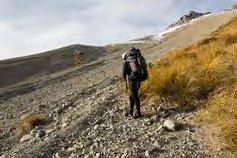
ABOVE: Still about 500 m of scree to climb to the ridge.
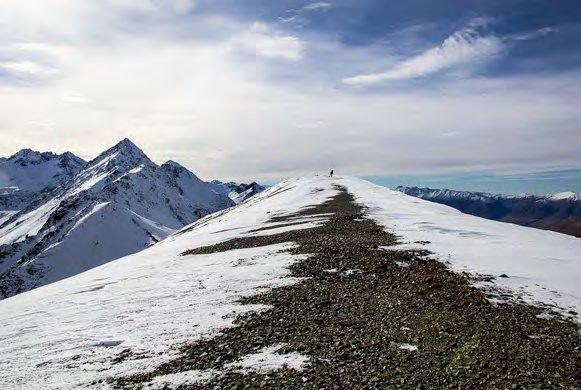
PREVIOUS: Heading along the ridge to the saddle.
The Maitland Valley is to the right.
We cooked a special meal of homemade dehy stew and followed that with steamed Xmas pudding. We read in the hut book that there was at least one resident mouse so we hung spare food from a long wire hook under the rafters before settling in for the night.
It was not to be a totally quiet night though—before long there was the scratching and squeaking of at least a towards the Ahuriri Valley.
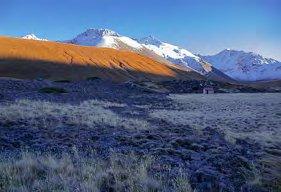
ABOVE: Snowy Gorge Hut.
BELOW: Wandering down Snowy Gorge Creek
couple of other occupants. At one point I shone my torch across to the cooking bench to see a very small mouse scuttling about—and then as I went to lie back down again was suddenly face to face with another sitting casually beside my pillow. But we were too comfortable and warm to worry and left them to their business.
Next morning was fine, calm and frosty again. And once more our sox and boots had frozen and there were the usual antics of thawing complaining feet back into them before we could get out the door. The sun was almost to the valley floor as we started down the long Snowy Gorge back to the Ahuriri. But it was delightful travel—easy open snowgrass terraces, and all the while a clear blue sky and the warm sunshine on our backs. Then later we stopped for lunch in the long grass of the Ahuriri Valley before starting our walk back towards the road-end.
But now our easy travel suddenly changed to an energy sapping struggle with clumps of tall tussock in swampy ground with rivulets running invisibly between that we fell into every few steps. We were now going so agonisingly slowly it was obvious we wouldn’t get to the car before dark. So we decided to head directly across the valley to the road. Once there we left our packs in the farmer’s paddock and as the shadows lengthened across the valley jogged the 9 km back to the carpark.
All that remained now was to get back to work on time Tuesday morning. So as far as three-day weekend tramps go it had been about as good as it gets—even if we had wimpped out on our first half a pass.
Comments
Comments are not open yet.