
Text taken from the club newsletter.
MOUNTAIN MAGIC
Hiking through Peru’s Cordillera Huayhuash by KATY GLENIE
Arriving early morning off the over-night bus from Lima, Huaraz is an explosion of sights and sounds. Taxis honking expectantly for customers, walking towers of Peruvian-style Disney balloons, mountain guides touting their wares, collectivos bursting at the seams with locals heading out of town. At 3,000 m above sea level the air is noticeably thinner and it’s tough making the three-block climb to Olaza’s hostel.
Olazas will be our base camp for the next few weeks in Peru. The roof terrace looks out over the small mountain town of Huaraz and down the valley to the towering peaks of Huascaran National Park.
Mike and I spend the next three days acclimatizing to the altitude, testing our broken Spanish out on the street vendors. Huaraz is a maze of cobbled side-streets and small plazas. The alleyways are well-stocked with plucked chickens, roasted guinea pigs, gigantic wheels of cheese, and knitted alpaca. Stocking up on supplies for our 12 day trek is an expedition in itself, and it doesn’t take long to convince Mike of the absolute ‘necessity’ of hiring a chef for the trip.
In Peru your chef comes with a donkey to carry the cookware, and the donkey comes with a donkey-driver (who knew donkey management could be a legitimate career choice?).
So on May 10 we meet our new best friend Jacquiem at the bus station, and watch him load crate after crate of cookware, food, and other provisions into the luggage compartment. Upon arrival at Llamac we meet our second-best friend Samuel, who proceeds to load the crates and bags onto four fine-looking donkeys. The crowning touch is a wriggling box tied with twine, carefully added to the pile. It seems that we are to be accompanied by a third-best friend—a rather scrawny free-range chicken. Our first day trekking the Cordillera Huay- huash circuit is long and hot. We struggle over the 4,300 m pass, arriving at camp after nightfall to a beaming Jacquiem and a very welcome hot meal.
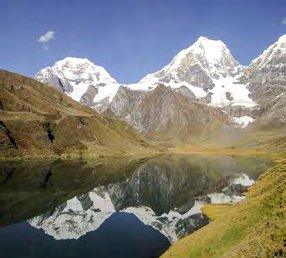
The vista greeting us the next morning is spec- tacular. Laguna Jahuaco- cha stretches away to the east, lying beneath some of the highest peaks in the valley. The snow glistens under a perfect blue sky. But the weather doesn’t last for long, and soon we are laboring up a 4,750 m pass under gath- ering storm clouds. We make it to the high point just as snow begins to fall. Further down the valley this turns into sheeting rain, with thunder and lightning adding to the drama. We arrive in to camp thoroughly drenched, once again thankful for Jacquiem’s culinary expertise and the cook tent.
Day three dawns fine and clear, and we head straight up 600 m from camp to the high point. Jacquiem gestures wildly up ahead, so we look skywards to see a condor. At 3½ m the condor’s wing-span is second only to the Wandering Albatross. The bird can live for over 100 years, but its numbers have been in sharp decline due primarily to habitat loss. So it’s a very special moment to see this majestic bird soaring above.
The following day gives us our first glimpse of Siula Grande—the mountain made famous through
Jo Simpson’s book and movie Touching the Void. At 6,344 m it towers majestically above its neighbours and forms a perfect backdrop to our campground at Laguna Carhuacocha. That night we realise we’re too late to say our goodbyes to third-best friend. It’s a real mystery where she’s disappeared to, so we console ourselves with a delicious meal of pollo.
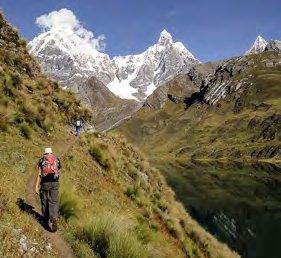
We choose the high pass route the next day, taking in views of the Tres Lagunas formed from nearby glaciers. A short scramble through volcanic rocks takes us to our highest point yet at 4,800 m. I’m starting to feel the effects of altitude.
A good night’s sleep puts things right, and we set off for another day in the mountains. Disconcertingly we’re trailed by a couple of gun-wielding locals. The pass is commonly frequented by banditos trafficking drugs from the north, so the locals act as protection for unsuspecting tourists like us. The guns seem to be more for show, straight from a 1960s military display.
We arrive mid-afternoon to a welcome sight—hot springs! My first wash in six days feels amazing. It prepares me for the following day, when we climb the highest pass of the hike. Punta Cuyoc is 5,000 m, and my head pounds from lack of oxygen. In the Cordillera Huayhuash each campground is managed by members of the local community. Camp fees are distributed directly to the families, who choose how to spend the income. Some use it to buy a nice pair of sunnies and a new donkey, but most put it straight back into campground facilities and maintenance. Amazingly in the Guanacpatay, our next campground and miles from the nearest road, we are treated to flush toilets and running water.
TOP LEFT: Condor Photos: KATY GLENIE
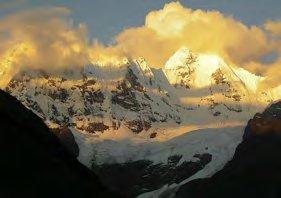
ABOVE: Siula Grande and Sarapo
LEFT: On the path to Tres Lagunas
OVERLEAF TOP: Diablo Mundo
OVERLEAF BOTTOM: Rondoy and Jirishanca
Our next day is supposed to be an easy 6 hours, with no high passes to climb. The landscape kindly continues to provide enough lumps and bumps to keep the heart- rate up (who would want a nice steady downhill at this stage in the hike!). At around mid-day we turn up a side valley, through a gate that’s been unlocked at our request. We’re right in the heart of the mountain range now, and are almost completely surrounded by peaks. The valley is a riot of flowering lupins.
We arrive at camp mid-afternoon. The site nestles into the side of a glacial moraine, at the base of Sarapo and Siula Grande. This spot was the start-point for Joe Simpson and Simon Yate’s legendary climb that almost ended in a fatality. Joe was left for dead at the bottom of a crevasse with a broken leg and severe frostbite. Through sheer willpower Joe made it back to camp by crawling out along the base of the crevasse, over the glacier and through the moraine field. It took him three days and nights. Simon was packing up camp to leave, thinking Joe must be dead, when he appeared out of the gloom. Simon took some time to realise Joe was not a ghost that had come to haunt him. Joe survived to tell the tale, and is now mountain guiding in the Peru and the Himalaya.
We take a walk up to the edge of the glacier lake, watching a series of avalanches crack and crumble from the surrounding jagged peaks.
It’s back on the mountain pass treadmill the following day. We head back down the valley and up to another pass. The campground is pretty basic, with a single doorless long drop sagging dejectedly over the other side of the valley.
The next day dawns bright and sunny, and we cruise over the pass in just a few hours. This gives us time to analyse a route up Diablo Mudo—the peak we are hoping to climb the next day. We also fit in a short Inca history lesson. Jacquiem shows us around an ancient site, pointing out the ruler-straight line of stones marking the old road. It seems the Incans were very like the Romans—they loved a good road and couldn’t abide corners.
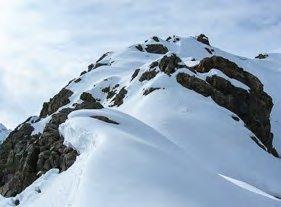
The following morning we dive headlong into an alpine start—up at 2 am to navigate Diablo Mudo’s glacial moraine in the dark. Following thinly spread cairns we make it to the snow-line just on sunrise. There’s nothing quite like the sensation of warming rays of sun on your back after hours scrabbling around in the dark, and the panorama of mountain-tops is breathtaking. Due to a heavy snow-fall we can’t quite make the top, but get within spitting distance. This means a quick re-planning of the exit route. We spend several hours making our way down through an un-tracked valley, arriving at camp as dusk is falling. Jacquiem is grinning from ear to ear and Samuel is uncharacteristically animated, giving us each a high-five. They thought we’d fallen into the clutches of Diablo Mudo, which is sometimes known to live up to its name (the Silent Devil).
After a very sound sleep we wake for our last morning in the Huayhuash. The sun is rising over the mountain tops as we set off for our last pass. It’s a doddle at 4,300 m, and we arrive back in Llamac with enough time to fit in a bracing Coca Cola. We say a fond farewell to Samuel, our donkey troupe, and middle-of-the-night freezing pee-stops before jumping on the bus with Jacquiem back to Huaraz.
Comments
Comments are not open yet.