
Text taken from the club newsletter.
ISLANDS AND ICECAPS IN
ICELAND by SUE WALSH
When I left Iceland and Greenland five years ago I knew that no matter what, I had to go back. So, one sunny afternoon in July of this year I found myself getting off a plane in Keflavik at the international airport in Iceland. Eamonn was already in the country having completed a trek with some mates and would be meeting me that evening.
The next day, after picking up Eamonn and the rental car, we set off for six days of adventure along the south coast. We were heading to Hella and ended up by taking a rather circuitous route as a friend of Eamonn’s joined us for the afternoon.
The next morning we went to the Vestmannaeyjar Islands which number around a dozen, however, the only one you can actually get to is Heimaey. The people of Heimaey got a rude shock early one morning in late 1973 when a volcano decided to erupt almost literally on their back doorstep. The images were shown around the world and as a young girl I watched them wondering how you could have fire and ice at the same time. Those images stayed with me over the years so it was quite exciting to finally get there. The other exciting part of going to Hei- maey was to see the puffins that nest in the cliffs around the islands.
The ferry trip was quick – just 45 minutes from the
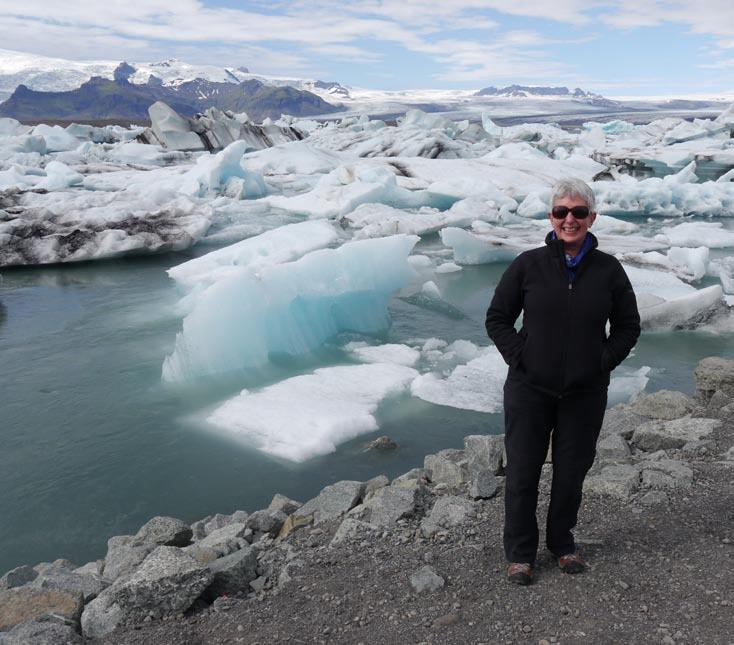
Sue at the Jokulsarlon glacial lagoon new terminal. It was interesting watching the different islands come into view with their weird and wonderful volcanic shapes. Once in Heimaey, I booked a boat trip to go around the island bird-watching while Eamonn went off to walk up a number of small peaks.
The boat trip started and I found myself a place to stand that was as protected as possible from the elements, without being inside. The harbour of Heimaey is dis- tinctly unattractive with fish factories on the waterfront. However, these soon disappeared from sight as did the houses. Due to a lack of trees you could clearly see the shape of the island with the different colours of volcanic rock – red being a dominant colour. Soaring black cliffs were capped with emerald green grass on seemingly impos- sibly steep angles with sheep dotted all over them. Birds soared through the air and sat on nests. The smell of the sea was at times overpowered by the smell of guano. As we worked our way around the main island the other islands came into sight. One had sheer cliffs going up for what seemed a good hundred metres ending in a basin with what looked like mown lawn with a farm house in the middle. Access up to the house was not obvious. As we carried on our journey we slowed down near an area that again had soaring cliffs, but this time something man- made showed up. Bolts had been put into the rock to form an artificial staircase leading up to the grassed area. That must have been how the isolated farm house was reached.
We went past a puffin breeding colony, but they were so far away they were only white dots on the hillside; then the boat was surrounded by small fast flying birds. Just as I caught a glimpse of a colourful beak and recognised it as a puffin, we were told we were surrounded by puffins. It was so exciting!
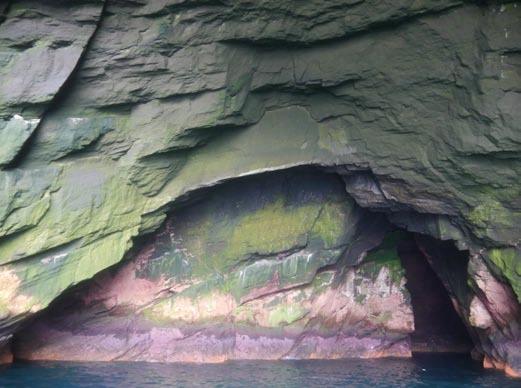
As we progressed around the island we stopped at three different caves and gently floated into each. The caves were quite sizable and colourful with red and green tinges in the rock. In the last cave the engines were turned off and one of the crew came up on deck with a saxophone and played “Amazing Grace” – the acoustics were wonder- ful and he got a great reception.
One of the caves on Heimaey Island
Back at the port, I met up with Eamonn and we de- cided to call it quits as the weather wasn’t improving and everything seemed shut. My reading had failed to say that on Sundays, Heimaey is closed. We changed our return tickets and left on the next sailing. It was disappointing to have to cut our visit short.
The next day we made our way to Skaftafell National Park. We stopped at some places of interest along the way and eventually pulled into the campsite in the early after- noon. Before leaving for Iceland I’d been trying to find hostel accommodation but everything was booked out. Eamonn wasn’t too concerned and was happy to camp, but I was set up for hostel accommodation; not camp- ing. Eamonn was able to secure some extra gear from one of his mates which was helpful. Once the tents were up,
Eamonn shot off to do a circular track and I meandered up to Svaitifoss (a waterfall) where I wanted to get a shot I’d missed last time. The track, like the camping ground, was packed with tourists. I found it quite overwhelming as there was no getting away from people. The south coast of Iceland is always the more popular place but the sheer number was a bit much. I got to the waterfall, got my shots and then went back down. Eamonn wasn’t due back for some hours so I decided to have an early dinner as I hadn’t had lunch. I couldn’t find my sharp knife anywhere so had to resort to using the spork to cut my veges. Then I realised Eamonn had the tin can opener, so my nice meal of tuna pasta with veges quickly became a dull meal with pasta and badly cut veges with huge chunks of garlic – not really the best. I was writing up my diary when Eamonn returned. For some reason he’d decided to run the bulk of the track so did it in around three hours rather than the usual six hours. He was quite amused by my dinner.
Due to the problems with finding accommodation, the plans I’d had for our time on the south coast went to the winds and the next day found us travelling to the Eastern Fjords to stay in a small village called Djupivogur. On the way we stopped at the Jokulsarlon which is a large glacial lagoon on the edge of Vatnajokull National Park. It’s an amazing place with small icebergs that have calved off the Breidamerkurjokull. A channel goes down to the sea which some of the icebergs eventually take, some of them making it out to sea while others come to rest on the beach. I didn’t have much time here five years ago so was looking forward to a longer visit. After a quick look around Eamonn didn’t seem too interested so went back to wait in the car. I strolled along the top of an old moraine wall until I left the bulk of people behind and found a place to sit, watch and take photos. It was quiet and very peaceful. Distance is very deceptive in Iceland and the lagoon, on first looking at it, didn’t seem that big, however it is around 4 kms long by 1.5 kms wide and it was packed with icebergs of all shapes and sizes. Seals were swimming in the water and seabirds were flying around, sitting on icebergs and paddling on the water. Off to one side were some guides in kayaks and further in the distance was a yellow boat full of tourists chugging about.
I went down to the shoreline and slowly meandered back, stopping by some small pieces of ice that had washed onto the shore. I threw a couple back in the water then looked closely at another. The ice was crystal clear and must have been hundreds of years old. As is happening in New Zealand, so the glaciers in Iceland are also reced- ing and bit by bit the lagoon is getting wider. It’s picture perfect for tourists but of huge concern to others. I
By this time we had both spoken with a number of tourists, and I’d had a long chat with the hostel owner who was talking about the number of tourists coming to Iceland. The Ice- landic population is around 350,000 and in 2013 they had over one mil- Iceland
Travelling to Skalafellsjokull wanted a photo of me by the lagoon and soon found someone approach- able to take my photo. With a record of me being there it was back to the car and onto Hofn, then through a long tunnel to emerge into the realm of the fjords and eventually along the long windswept desolate shores until we reached Djupivogur. Here we separated – Eamonn to his tent and me to a hostel. We met for dinner at the hostel and planned our next day; which was to go for a drive further around the coast.
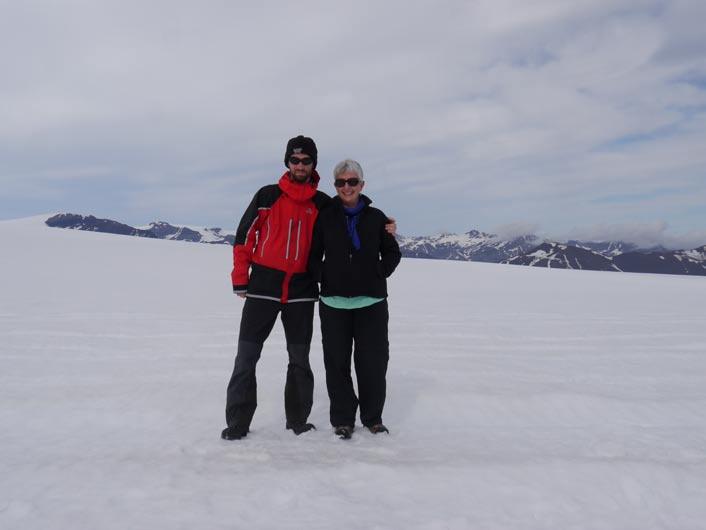
Sue and Eamonn on the Skalafellsjokull icecap lion visitors. My impression that things were somewhat different wasn’t wrong. Speed was higher on the roads with drivers being less tolerant, it was more expensive as Iceland was coming out of its recession, and there wasn’t enough accommodation to cater for the number of tour- ists. A couple staying at the hostel were both somewhat angry and distressed as their planned holiday was being cut short as they couldn’t get accommodation where they wanted – this I could sympathise with and it certainly wasn’t the case the last time I was here. But then, five years is a long time.
I rounded a corner and a sign indicated the road
The next day Eamonn was keen to go to Papey, an offshore island which is home to many seabirds. We were wait- listed as the boat was full, and it wasn’t looking hopeful. Other people at the hostel had mentioned a gravel road that two-wheel drives could go on, and I was curious to see if I could find it. Eamonn wasn’t interested so I set off. I’d pulled off to the side to take some photos when I saw a large tour bus turn off and go along a dirt road. This, I thought, could be it, so I followed. It wasn’t, but I got excellent views of the fjord and a short walk revealed a small fierce waterfall. I explored a bit further until I got to private property then headed back to the road and found the correct turn off. I texted Eamonn to say I wouldn’t be able to make Papey which turned out was going up on a 17% gradient. I turned the next corner and the road seemed to go straight up.
to be a good call as they couldn’t ac- commodate us.
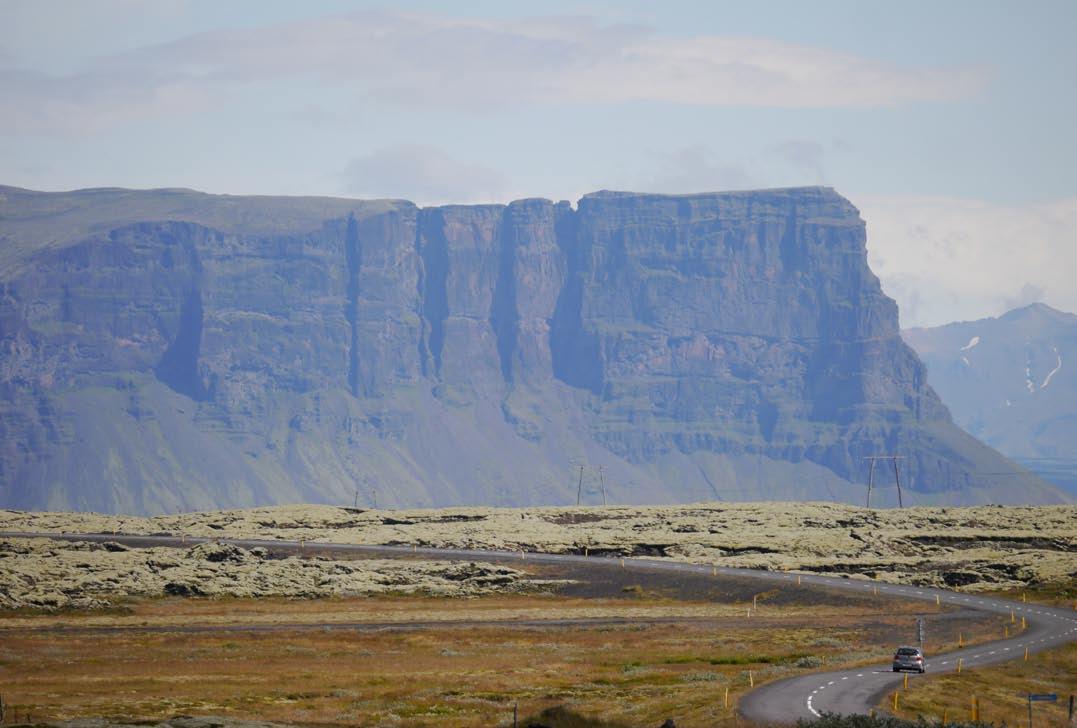
I was somewhat nervous as I’d left the map behind and wasn’t sure what I was getting myself in for. While I pondered this a number of two- wheel drive cars came off the road so I finally gritted my teeth and set off. Initially the road was flat then it start- ed to go up in a gentle incline gradu- ally getting a bit steeper. I rounded a corner and a sign indicated the road was going up on a 17% gradient. I turned the next corner and the road seemed to go straight up. Thanking my lucky stars I was in an automatic, I gingerly put my foot down and went up the incline which included a hairpin corner before finally eas- ing out. The good weather I’d had down by the fjord was changing and I was nervous about it raining but I still kept going; it was too exhilarating to turn back. I stopped wherever I could to take photos and eventually got to a height where there were lots of patches of snow. I didn’t think I was too high, maybe around 1000 metres, possibly a bit higher, however my latitude was around 64o north (the Arctic Circle is at 66.56o north). The road continued to climb but it was now in gentle undulations. I could just imagine what it would have looked like during the ice age. Drizzle started and I hesitated but the call of the unknown was too great so I kept going. The road was in good condition and there was light traffic so one eye was care- fully fixed on the rear vision mirror so I could pull over whenever another vehi- cle got too close. The folk at the hostel had talked about the road going by the longest lake in Iceland. When a sign- post came up and I saw the place names on it, I knew where I was headed to. I didn’t actually want to go there, but the drizzle had let up and the road was on a downwards slope so the wheels kept turning. I went along the side of a small lake and when the road changed to seal I pulled over and called it quits. The journey back was as much fun and this time I wasn’t too fazed about the drizzle. Going down the 17% incline was probably freakier than driving up it, particularly with the hairpin corner. If you weren’t careful you’d go straight over the edge.
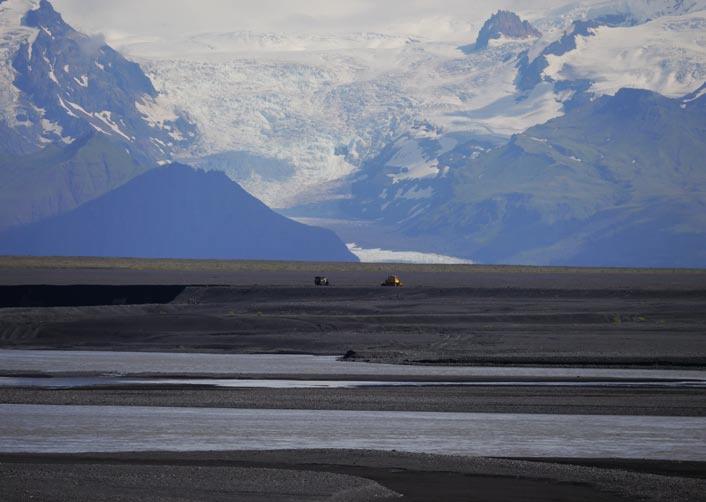
At dinner that night Eamonn and I compared sto- ries and agreed our departure time for the next day. The weather that day was great and we took our time driving back around the fjords, stopping at different sights. We made good time to Hofn so decided to go onto to Road F985 where four-wheel drives take you up the Skala- fellsjokull. There you have a choice of doing a 4WD tour on the upper reaches of the glacier to a point where the horizon is the icecap, or going on a set path on a skidoo. My choice was the 4WD tour which I’d done on my previ- ous visit and really enjoyed. Eamonn came along too. The drive is quite cool, figuratively and literally. We followed the tracks of previous vehicles and on the odd occasion I got a brief glimpse down into narrow blue slots. The driver said going later in the season could become quite hazardous with the crevasses opening up. We stopped a couple of times for photos and a brief play in the snow before heading back. We had a cuppa at the cafe and then it was back to the car and to the camping ground in Hofn.
We were so lucky with the weather when camping and this night was no exception. From the camp ground there were glaciers in all directions coming down off the icecap. Knowing I would never be going back there again, it was both magical and sad.
Early the next morning I dropped Eamonn at the bus terminal and then drove out to the airport to catch my flight back to Reykjavik. I was so fortunate with the flight as my seat was on the land-side of the plane so had wonderful views over the icecap and to the interior on the other side. It was a magical flight but again tinged with sadness.
Landing in Reykjavik I caught a taxi back to the hotel, sent another parcel home, did some serious shopping and had a scrummy lasagne for dinner. Before I knew it I found myself at another airport the next morning about to head to Greenland; and that is another story (which as it happens, is on page 78).
Comments
Comments are not open yet.