
Text taken from the club newsletter.
EAGER BEAVER
How (or how not)
to get into canyoning by MEGAN SETY
Canyoning—it’s the perfect combination of climbing and tramping skills, particularly if you love water and going where few other people go.
When David asked who was keen for a weekend canyoning trip a short drive from Wellington, my hand flew up to say ‘pick me, pick me, pick me’. The proposed route involved only a daytrip (no heavy packs) and up to three 35 plus metre waterfall abseils—who wouldn’t say yes?
On the other side of the Rimutakas a friendly farmer has given access to the start of the Waiorongomai track. There’s basic camping at the road end where we spent Friday night with toilets, picnic tables and a water tap.
Since we had a big and unknown day ahead, we had planned to be away early. Instead, we slept in and got away around 8:30 am, an hour after David’s suggested start time. Oops, for the first time and not the last.
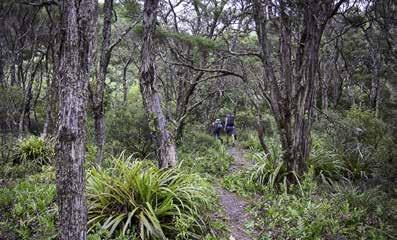
It’s an easy 3 hour walk in on a mix of riverbed and fairly well marked track to Waiorongomai Hut. We reached the hut, stashed a few bits of gear and kept moving. We followed the Kiwicanyons guide, travelling upstream briefly before using a side stream to gain access to a brief bush-bash up the ridge line. From the top of the ridge, we dropped down the other side towards our entrance to the creek and the Eager Beaver Canyon.
Just on 12 pm, we stopped to eat lunch, layer up and put harnesses and helmets on. We didn’t need the gear yet, but it seemed easier to rig up while dry and warm instead of faffing in a pool of water at the top of an abseil. Over lunch David reviewed the anchor system and rules unique to canyon abseils.
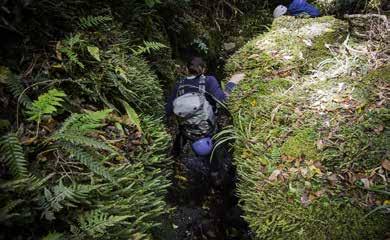
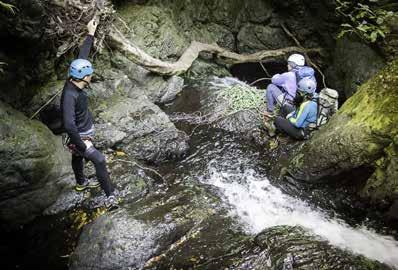
Initially the creek was narrow, small and full of log debris. It felt more like scrambling. About 20 minutes in, we reached the first mini waterfall—really just a stream tumbling down three metres of slippery moss-covered rocks. We decided to set up an anchor and abseil. It would have taken 10 minutes to scramble around, but it was a chance for everyone to practice the anchor and abseil system.
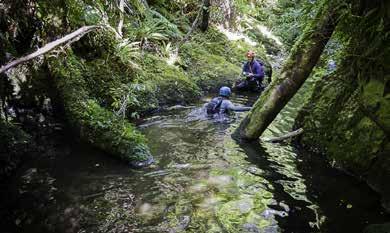
Based on the route description and map, we had expected to be mostly ankle to knee-deep in a stream with easy travel. But the streambed widened slightly with pools growing deeper. The pools varied in depth, but after the first hour, we were nearly always in water that was at least knee deep and more often up to our waist and at times swimming. It was fun—this is canyoning after all.
As a water baby I loved it. However, I did not love my body temperature. Since we had expected to spend little time in the water and Wellington’s summer had been unseasonably hot, we had made a major mistake. We were not adequately dressed. We had elected not to wear wet-suits or neoprene booties. Instead we had chosen to wear multiple layers of merino and polypropylene. It was not enough. Oops, again.
I was wearing merino long johns, heavy weight polypropylene pants over that, two merino shirts, two merino jumpers, a merino hat, merino gloves and two pairs of merino socks. At 45 minutes, before hitting any major abseils, and only having swum through a few pools, my body was shaking uncontrollably. It was an odd experience. I couldn’t control the shaking, but I didn’t feel cold. Wasn’t that a sign of hypothermia? Being cold, but feeling warm. But it was too early and there were no other signs. I said something to the rest of the crew, as I watched them shiver and shake, teeth chattering. We all agreed—we were uncontrollably shaking from the cold, but not uncomfortable.
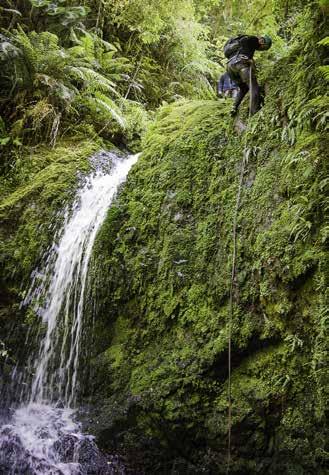
David was setting up our first real abseil. It was one of many 5 to 10 metre high abseils. We were still excited to abseil every chance we got—in hindsight that cost us precious time and only increased our time standing around in water, dropping our body temperatures. Oops.
We kept pressing on, laughing, enjoying the travel and wondering when we would finally hit the piece de resistance—the epic three in a row 35+ metre abseils. All the while, seizing every chance to stand in the sun when it rarely appeared.
We became increasingly aware of how cold we were and that we weren’t able to move fast enough to warm- up. We changed our approach to the downstream travel. We stopped looking for abseil stations and starting looking for the fastest, yet still safe descent route, scrambling around or jumping into pools or down- climbing. We had initially been attempting to follow the superb guide provided by Kiwicanyons, but realised it was much better to approach each obstacle in its current state, assessing the best way to get down and move on.
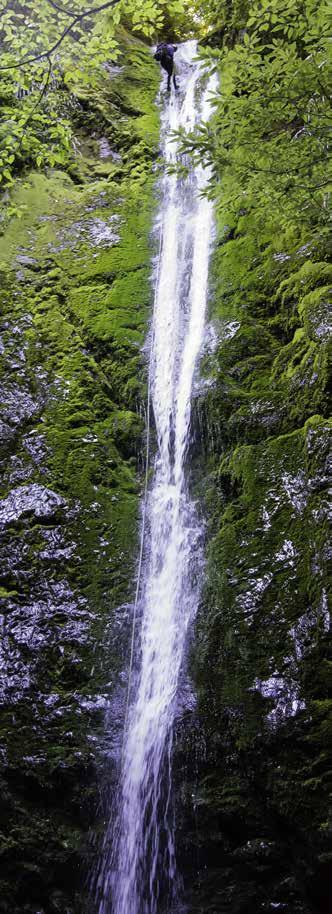
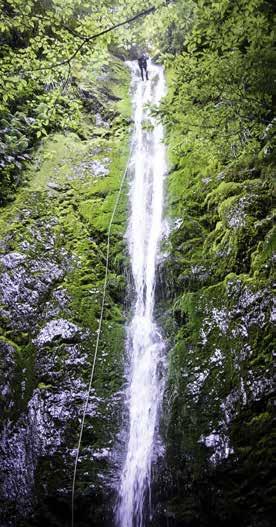
A couple more hours and finally we hit the motherload—the first big waterfall. It was incredibly intimidating and thrilling. To get to the top of the waterfall, we had to down-climb into a small canyon working through a few pools until reaching a cave with a thigh deep pool at the precipice of the waterfall. I peered over the edge and was unable to see the bottom of the waterfall. What was awaiting us?
I had been at the front of the group when we came to the top of the waterfall. I was sitting there wondering who would go first while David set up the anchor. David asked if I wanted to go first.
We were all freezing, shaking and a bit apprehensive. I didn’t have time to faff. I jumped into the pool at the top of the waterfall, fed the rope through my belay device, double-checked David’s anchor and leaned back over the waterfall. I hoped I would see the bottom and if something wasn’t right, we could fix it. I could see at most 15 metres below.
I’ve abseiled many times, in many situations. But as a climber when abseiling, I always make sure my rope hits the ground—you don’t want to abseil off the end of your rope. That is the exact opposite in a canyoning abseil. Abseiling into a pool with heaps of rope still caught up in your belay device or dangling in the water is very dangerous. The rope could get wrapped around your body, and you could struggle to get unattached from the rope, especially if you ended up directly under a forceful waterfall. We couldn’t see the bottom, so David made a rapid estimate of how much rope to put out based on the Kiwicanyons guide.
I let the rope slide through my belay device, walking down the slippery rock face, doing my best to stay to the side of the main waterfall. After 10 metres, I wrapped the rope around my thigh a few times, an old school ‘brake’
and pushed myself out from the rock to look down. I still couldn’t see the bottom and now I couldn’t see the top either. I gave up and figured I would deal with whatever I found at the bottom soon enough.
I stopped looking down and starting look around—it was spectacular. It was like descending into a bottomless cave. I was heading down a rockface that continued in a near full circle, all the way behind. The walls all around me were shear, full of moss and plants, and the trees that were above were growing over in a canopy. It seemed to take ages but finally I could see the pool below.
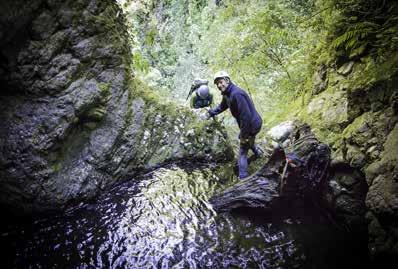
I stopped and checked how much rope was out. In the perfect scenario, the rope wouldn’t quite reach the pool and I would be able to abseil off the end. It wasn’t the case, but it wasn’t bad. There was a huge pool at the bottom—some 10 metres across. There were a couple of large fallen trees at the far side, well away from where I would land. I had an extra 2-3 metres of rope floating in the pool, but I would easily be able to tread water and extricate myself from the belay device. I hurried down, knowing the others would be shaking with cold.
Once I hit the bottom, I was grateful that my gear was inside a dry bag in my pack because the extra air in the bag created a flotation device, making it easy to disentangle myself from the rope (as treading water in tramping boots is not as easy as one would hope). I swam to the biggest log, pulled myself on and looked up to see David. I gave him the sign I was OK, and then signalled that the rope was too long. He adjusted the anchor, and checked again. I confirmed it was good, and then the rest of the crew came down.
It took at least 45 minutes to get all six of us down the waterfall. I suppose if we had had a greater sense of urgency it might have taken 30 minutes, but I think we each wanted those extra few minutes to take in the moment. One after another, we dropped into the pool, swam to the far side and hurried 5 minutes downstream to a spot of sun that was rapidly disappearing as sunset approached.
We gathered up the rope and pushed on. We came to another series of deep pools and short drops that could be down climbed or abseiled. As we collected at the bottom, approaching the next big waterfall, Tony asked me if I was cold. I said ‘yes, but I’m OK, you OK’? He hesitated and then said, ‘no I think I’m getting too cold’. I was surprised. Tony introduced me to the 13 hour day epics, swimming across ocean channels with a pack full of 8 days of food and navigating off-track at night. This was looking a bit serious.
Tony began surveying the rest of the group. At least two people weren’t keen to continue. I hadn’t yet considered the possibility. It was only 4 o’clock. We’d only been in the stream for 4 hours and were just about to hit the next two big abseils. We had a kilometre of river travel left. Why stop now?
We were spread on opposite sides of the stream. Water was crashing down. It was loud. We were cold and shivering. It took less than 10 minutes to realise we shouldn’t continue. There was a brief moment, where we thought of splitting into two groups, but that idea was rapidly thrown out. It was clear that we were all cold. We’d been cold for at least 3 hours. We had several hours to go and would be moving at our slowest pace, as we stacked up at the top of the big waterfalls waiting our turn to abseil. The sun was no longer reaching the canyon. There was no way to get warm. Our body temperatures would only be dropping. And once we descended the next series of pools, we would have no way to go upstream or to bash out of the creek. We would have to finish via the canyon, no matter how cold or wet we were.
In fact we could have ended up like this party who visited the canyon a few weeks after us:
“It took a bit longer than expected and it got dark at the top of the second major waterfall, and then on the last major abseil our ropes got stuck (50 m 9 mm dynamic and 50 m 11 mm static) the ropes were probably crossed but the two of us couldn’t pull it down and it was pitch black by this point and we couldn’t see what was going on even with head torches. Knowing we had a few shorter abseils left we had no choice but to pull as much rope down as possible and cut them (very, very soul crushing/tears in my eyes) thankfully we got just enough to get out of the canyon get back to the cabin and enjoy a few brews.”
Smart thinking prevailed, and we immediately started talking about the best route out of the canyon. Remarkably, no one had brought a full topo map for the area. Oops.
We had only the Kiwicanyon guide, the topos for the bushbash and entrance to the stream and a GPS. We were cold and made a fast decision to exit via the ridge that would return us where we first dropped in to the creek. Mike pushed up to scout the route, confirmed it was doable, but dodgy—steep, exposed, loose, but for a short distance. We immediately headed that way.
The next 500 metres of ground travel was precarious. It was incredibly steep and alternated between loose rock and dirt with exposed rock faces with 200 m drops either side. I was grateful that we were all climbers. One rock face would have easily been a grade 14. It was at the end of a very narrow ridge with a shear drop off to one side all the way down to the valley floor. What had started as an off track tramp and river adventure had become something else.
Pushing uphill rapidly warmed our bodies and made it easier to move. An hour later we’d cleared the worst of the difficult terrain and another 30 minutes more had brought us back to the top of the ridge. We stopped, had a snack for the first time since lunch, laughed about the adventure and then picked up and moved on. It was now almost 6 pm, we still had to get to the hut and back out, and we were tired.
We arrived back at the cars, just on 8 pm—almost 12 hours after starting. It had been an epic day trip. One that has left me wanting more, but also given me a bit of a kick in the butt. We had made several major mistakes on this trip, exactly the kinds of things that David Clearwater’s book talks about:
- Dress appropriately—take into account the cold temperature of the water, lack of sun and a lot of time standing around. • Know your exit routes before you start—bring maps that will allow you to navigate those exit routes. • Keep an eye on the time—be efficient, only abseil when needed and use two ropes to leap- frog anchor setups. • Allow plenty of time—plan as much time as possible accounting for both daylight and maximising the hottest part of the day while in the water. But it wasn’t all bad. We all lived to tell the tale and can’t wait for next summer to go back. What we did right:
- While we should have had wet-suits, we did all have many layers of clothes and everyone had managed to keep at least 1-2 items of emergency clothes dry in a drybag. • We did have a GPS and the Kiwicanyon guide and some of us had considered exit routes, so we were able to safely navigate an exit route though not ideal. • Members in the group raised alarms bells before the situation was dangerous. Everyone participated in the conversation and everyone agreed to the safest option. • We also had a PLB and had left our intentions with friends. We had written our intentions in the hut book and told people we had passed on the track.
When we set out on this trip, I had planned to write up a how to for a magazine. As I sat at the bottom of the first 35 metre waterfall, I thought to myself that this is not an appropriate trip. While canyoning is an excellent sport for trampers and climbers to explore, it requires specific technical skills and expertise. You cannot wing it on number 8 wire and hope to get by.
You must have fitness, navigation and river travel knowledge. You must have rope skills including building anchors and abseiling. You must understand that building anchors and abseiling in a canyoning scenario can be more complex and precarious than common climbing situations, particularly due to the nature of water. If it’s something you want to try, I recommend David Clearwater’s advice—seek out mentoring and training from experienced people.
The club offers trips with a range of difficulties, but in the mountains there are really only two grades— either you can do it or you can’t.
Comments
Comments are not open yet.