
Text taken from the club newsletter.
Mt PATRIARCH
Kahurangi National Park by MATT CONWAY
Long weekends provide a good opportunity for club trips to head a bit further afield than the usual destinations, and these trips often involve heading across Cooks Strait to make the most of tramping in the upper South Island.
Queen’s Birthday this year was no exception, with no fewer than three club trips (nearly 30 people) heading over to the Kahurangi National Park for the weekend.
There was an Easy-Medium trip bound for Kiwi Saddle Hut, a Medium Fit group off to conquer Mt Owen, and in the middle of these two a Medium grade group doing the circuit around Mt Patriarch. I was part of the Medium group along with seven others: Kerry (our leader), Bernie, Elodie, Rodrigo, Sophie, Sumudu, and Yen Fei. I was looking forward to heading back to Kahurangi, after having had a really enjoyable four days in the park in the Mt Arthur area just after Christmas.
After an uneventful trip across the straight - always a good thing - it was a couple of hours drive to the overnight stop at the Siberia Flats campsite. The campsite lived up to its name, particularly for anyone tempted to take a lightweight sleeping bag. I was pleased that I decided to pack the extra weight of my four seasons bag and I had a relatively comfortable night.
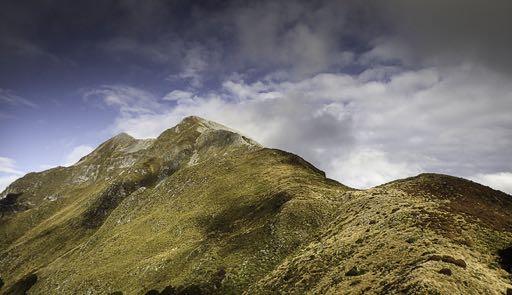
After a frosty start, we set off along the Wangapeka track in reasonably good time. The pay-off for the cold, clear night was a beautiful fine morning the next day, and after about 40 minutes we found a good spot to warm up, where we were joined by the easy-medium group, who were heading along the track towards Kings Creek Hut for their first night’s stop. From this spot, we were able to get a great view of our target for the trip, Mt Patriarch, which looked impressive in the morning sun.
We continued along the Wangapeka track, stopping regularly to take in the view, and therefore regularly having the easy medium group catch up with us. Apart from the beautiful morning, another really enjoyable feature of the walk along the track was the number of whio on the Wangapeka river. Soon after leaving Siberia campsite we heard the bird’s distinctive call and soon saw a pair at the edge of the river. That sighting was quickly followed by another one, and before lunch we had heard at least another two whio.
As trampers, spotting or hearing a whio is not entirely unusual, and we don’t necessarily appreciate that they are endangered and are actually rarer than some species of kiwi. So encountering that number of whio along a relatively short stretch of river was pretty special. We stopped for lunch just after crossing the bridge at the junction of the Wangapeka River and Kiwi Stream, where we were once again joined by the Easy Medium group along with a number of robins on the lookout for any scraps.
Heading up Kiwi Track, we heard not only another whio, but also saw and heard plenty of robbins and at one stage spotted a kea flying overhead. Kiwi Track itself was nice even and well-benched track. We found out later that this was because it was apparently a pack track for the gold miners in the 1800s over to the Crow River.
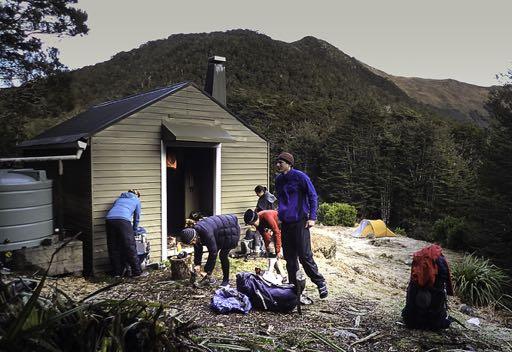
We eventually arrived at Kiwi Saddle Hut after a solid eight hour walk. The hut is a fairly standard six bunker, with a nice view northwest. As it happens this was the second Kiwi Saddle Hut I had visited during the year, having visited its namesake in the Kawekas in March.
The Kawekas Kiwi Saddle is a nicer hut, but the Kahurangi one has the better view—northwest towards Mt Luna and Mt Kendall. As it’s a six bunk hut, with eight of us in the group someone was always going to be sleeping on the floor. As it turned out there was a trio from Nelson doing the same loop as us over the weekend, so it did mean that floor space was at even more of a premium.
I decided to avoid the debate about who got a bunk, and set up my tent, keeping an eye on the resident weka lurking around looking for an opportunity to steal any loose items.
That night involved a communal dinner out of the club recipe book, this time Pad Thai. It is a great recipe, although the ratio of noodles to sauce was quite large, ensuring that there was plenty of food for everyone. The temperature dropped pretty quickly when the sun did, but with everyone in the hut and Elodie doing a great job of keeping the fire going, the inside of the hut was pretty toasty.
After washing up, I left the others to sort out how they were going to fit themselves into the hut for the night, and headed out to the tent feeling pretty full and looking forward to the next day’s travel along the tops, and hopefully being able to get up to Mt Patriarch.
Sunday was not quite as perfect as it had been the day before with some high cloud and wind. It took a little while for everyone to get themselves sorted out, so we ended up leaving a little bit later than originally planned.
After about a kilometre of bush travel, there was a fairly steep climb up onto the ridge just to the north of Mt Patriarch. When Bernie and I got up to the ridge we got a bit chilly waiting for the rest of the group not realizing that they had actually stopped for a break just below the bushline.
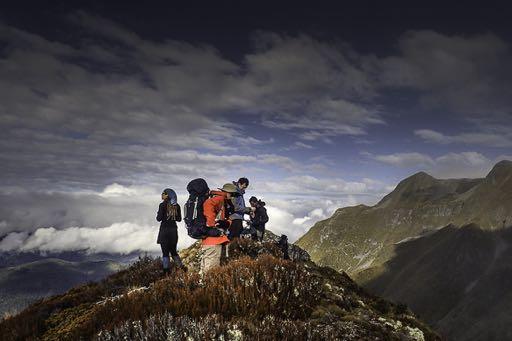
After we all finally re-grouped there was some discussion whether we should make the detour up to Mt Patriarch. Given the delay in setting off, and the fact that the weather not looking great—with cloud swirling around Mt Patriarch—Kerry made the decision that we should continue along the tops towards our destination for the night, John Reid hut. As is often the case in these situations, about 15 minutes after we had set off in the opposite direction the weather cleared and we looked back to see the twin peaks of Mt Patriarch bathed in sunshine. However, it was too late to turn back so we continued on our way enjoying the improvement in the weather and the views.
While the routes along the tops between Kiwi Saddle and Mt Patriarch huts isn’t a marked track, it is clearly pretty well used so there was a clear path to follow for most of the day. Bernie was generally out in front doing the route finding, we me usually just behind him and then the rest of the group following behind. We stopped for lunch at a tussock slope near the high point of the day (point 1566), where the Gibbs route descends down to the Wangapeka river.
After lunch, the weather stared to close in and the temperature dropped. This was also where the only semi- tricky part of the route was, a bit of a sidle and scramble around one of the peaks just before reaching the track down to John Reid hut.
After getting around the peak, a kea dropped in to check us out. Obviously we weren’t very interesting because it was a just brief visit.
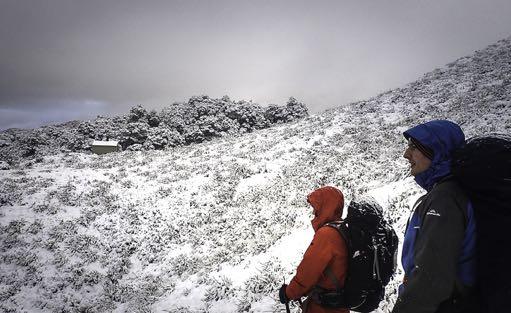
We continued on with the snow starting to fall lightly just as we reached the track down to John Reid Hut. Arriving at the hut we found that there were already two people in residence, so with the trio from Nelson on their way there were going to be 13 of us in a standard six- bunk hut.
So, even though the snow was getting a bit heavier, I decided that being in a tent was still probably the more comfortable option for the night. Luckily I found a nice flat space in the trees about 50 metres from the hut and got the tent up before the snow really started falling.
I was happy with my decision after I got back into the hut to help prepare dinner. With 12 other people in there, plus gear, there wasn’t a lot of room. But everyone seemed to manage to get their respective dinners cooked, and then find a spot to eat dinner in reasonable comfort.
So, after another tasty meal from the club recipe book, I decided to head back to the tent for an early night. It was actually a pretty comfortable night, apart from being woken from bits of snow occasionally dropping from the trees onto the tent.
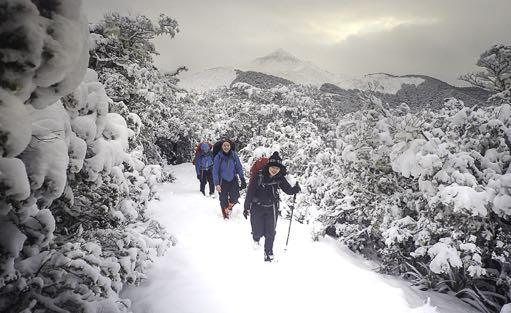
The next morning it was a reasonably early start in order to meet up with the vans in good time, so after a quick breakfast we headed out along Chummies track. For about the first kilometre the track sidled along the hill before dropping down into the bush. Normally this would be relatively straight forward, but with the covering of 10-15cm of snow following the track proved a bit tricky a times and it was slow going.
However, views of the surrounding landscape covered in a fresh coating of snow helped to make up for this, and once we reached the bushline progress improved. The final stretch of Chummies track involves a fairly steep descent of around 400 metres down to the Wangapeka river.
Bernie and I got down to the river first and while we were waiting for everyone else the two vans and the other two groups turned up on the other side of the river.
So, by the time we got ourselves prepared for the river crossing, we had an audience of 20 people (including the chief guide) on the opposite bank keenly assessing our river crossing technique.
Luckily we managed the crossing without any mishaps, and after getting changed and finding space in the vans we all headed back to Picton, with a stop along the way to refuel on sugar and caffeine. After another uneventful ferry trip we were back in Wellington later that evening.
While long weekends generally only provide one extra day out in the hills they often feel more relaxed and provide a good opportunity to explore somewhere different. Queen’s Birthday this year was no exception—an interesting route with a great group of people and the trip was one of my tramping highlights during the year.
The Kahurangi National Park is a very special place, and I’m already planning my next trip down there in the summer.
Comments
Comments are not open yet.