
Text taken from the club newsletter.
TRAVELLING ON FIJI TIME
Cycle touring, tramping, and sea kayaking in Fiji by HARRY SMITH
September 2017: I’m in Nadi at the start of a month-long cycle tour of Fiji. Te plan: to cycle the 500-kilometre ring- road around Viti Levu, the main island. Tis is just about the only sealed road and what nearly every cycle tourist who visits Fiji does. I will proceed anticlockwise, travelling on the Queen’s Road around the south of the island from Nadi to Suva, then back to Nadi on the King’s Road around the north of the island. I also hope to journey up into the highlands and climb some of the mountains. Hopefully I’ll get to visit some of the offshore islands as well, if time permits. I got here last night and am already getting into the swing of things. Te people are friendly—everywhere I go people say ’bula’ (hello). I’ve already tried kava (yuk—it tasted like mud and lef my mouth feeling numb). Most importantly, I’m beginning to learn all about the concept of ‘Fiji Time’—a relaxed attitude to life where time doesn’t matter and nobody worries if things take longer than expected.
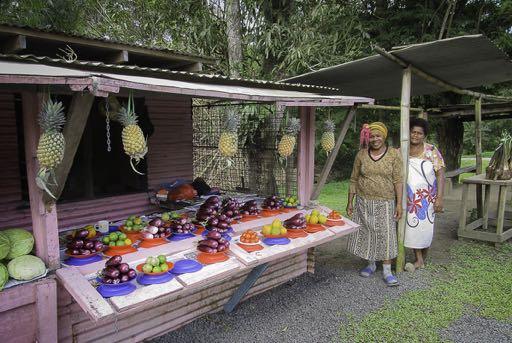
Natandola Beach and the old Coral Coast Railway. Afer a day looking around Nadi, I’m on my way, off along the Queen’s Road to Sigatoka, 70 km away on the south coast. Man it’s hot. I pass through sugarcane fields and farms, then rounded hills, taking in the sights. Hindu temples, Islamic mosques. Supermarkets with awful blaring Indian music—how can they stand it? Roadside fruit and vege stalls with waving Fijian women. Little shops with Indian shopkeepers. I stop for an icecream and somebody tells me I can free-camp at Natandola Beach, only a few kilometres away. Apparently this is one of the nicest beaches in Viti Levu. Sounds good to me—it’s swelteringly hot and I’m quite happy to abandon my plan of going all the way to Sigatoka today. I’m getting into this Fiji Time. I head off down a side road and afer a bit of navigational confusion I arrive out at a beautiful sandy beach. I camp under some trees and go in for a cooling swim.
Morning comes and I am faced with a long climb from the beach back up to the Queen’s Road. But I’ve spotted an intriguing alternative. An old narrow- gauge sugarcane railway line runs around the south coast and joins the Queen’s Road further to the east. On the map it looks like it will save me time—can I follow it? Before the trip I saw a report on the internet by someone who cycled along this railway and he didn’t seem to have any problems. It seems like a good option. Yeah, go for it.
I soon discover it’s tougher going than I thought. Tat guy had a mountain bike not a touring bike, and he didn’t have panniers. Also, the railway line has since closed down. Some of it is now a golf course for rich foreign tourists. Much of it is unrideable. I’m forced to push my bike for long stretches of rough track and along the sleepers, always worried about getting pinch punctures from the bounces. Ten I have to laboriously man-handle my bike and panniers over some of the derelict tressle bridges. Finally I am able to cut back onto the main highway and tar seal. What a relief. It’s taken me about 6 hours to do perhaps 15 kms on the railway—I probably could have got here in 2 or 3 hours on the road. But I’ve enjoyed it—it’s been an adventure and I’ve seen a slice of Fiji that I wouldn’t have seen otherwise. I’ve passed through some remote villages and along a wild stretch of coast. And so what if it’s taken me most of the day? I’ve got a month and I’m on Fiji Time.
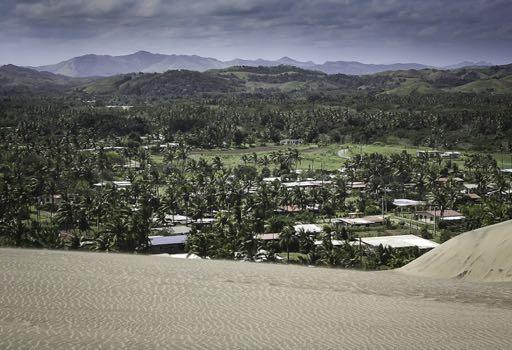
Sigatoka Dunes. I camp for the night in the sand dunes near the Sigatoka Sand Dunes National Park. Tis is the only surf beach on Viti Levu. It’s a nice spot and I’m trying to shake off a nasty sore throat I’ve had for weeks now so I’ll stop and have a rest day here. In the morning I head off along the beach, exploring the sand dunes which rise up like a mini Sahara Desert, a complete contrast to the palm trees and corrugated iron shacks of the Fijian villages a short distance inland. When I get back to my campsite in the afernoon I enjoy a long swim in the surf. Ten I come across something in the guidebook saying sharks like hanging out in the fresh water of the river mouth, just a short distance around the corner from where I’ve been swimming.
A second night camped in the sand dunes and I’m off into Sigatoka itself. I’m 70 km from Nadi and originally thought I would get here on Day 1—now I have finally made it on Day 5. I have happily descended into Fiji Time.
The Coral Coast. Eastwards along the Coral Coast. Tis is probably the most beautiful stretch of coastline on Viti Levu—though sadly much of it is built up with expensive hotels for rich foreign tourists. Fijian villages with small box-shaped houses and corrugated iron shacks can occasionally be found interspersed between all the tourist resorts. Most of these places are way out of my price range—I spent the night at Te Beach House, one of the very few budget accommodation options.
Te next day I continue eastward towards the resort town of Pacific Harbour. Te road goes inland and becomes hilly. I face a whole succession of steep climbs. One damn hill afer another—will they never end? Tey’re made worse by the bloody trade winds, which blow consistently from the south-east. Tey rise each morning and strengthen throughout the day, and I’m going straight into them. I struggle up a hill in the heat and the humidity, and when I finally get to the top and should be able to relax I’m hit by the full force of the winds and have to pedal hard across the crest and down the other side. If I ever do this trip again I think I’ll go clockwise instead. When I finally reach the coast and Pacific Harbour I’ve done all of 40 kilometres for the day and I’m completely knackered.
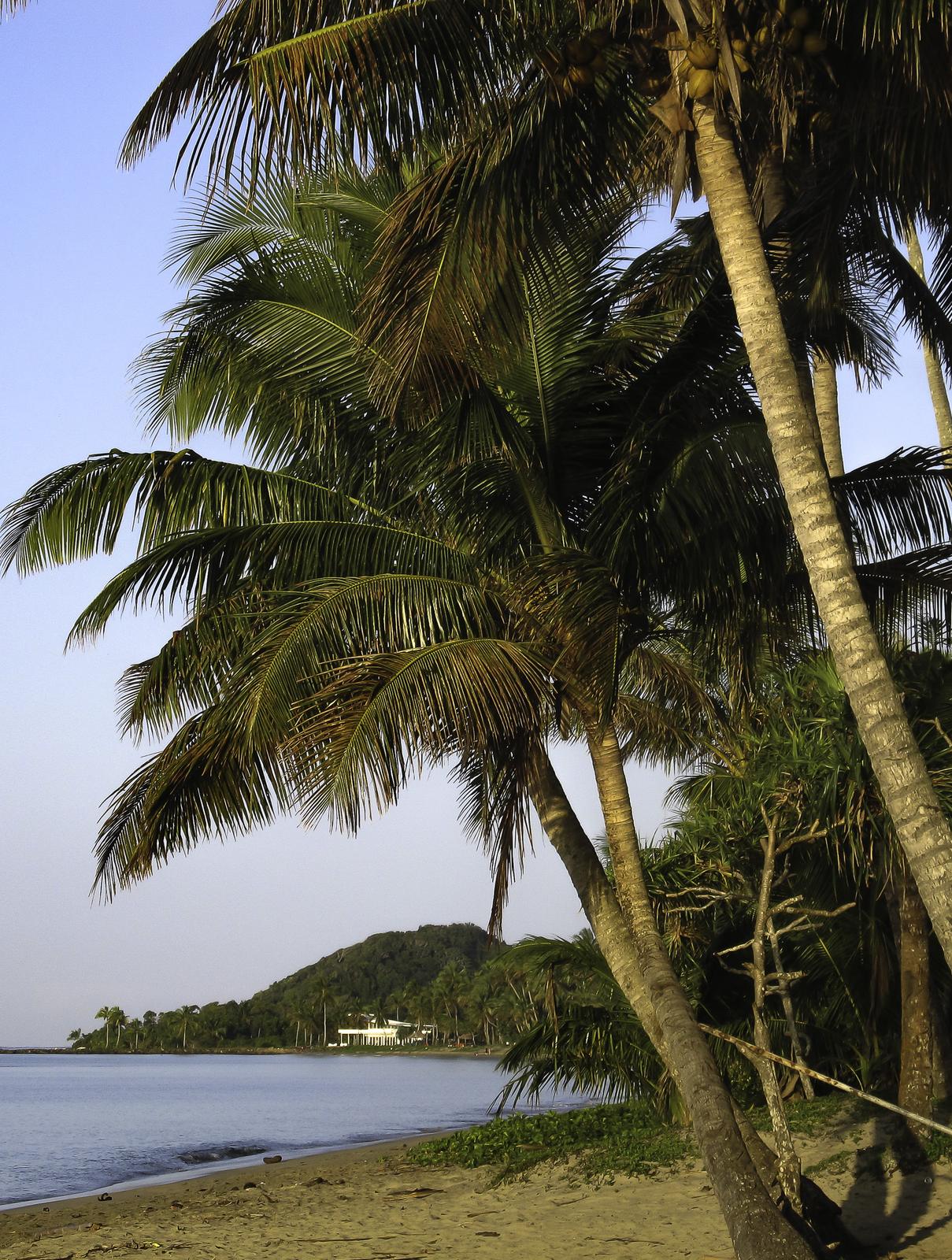
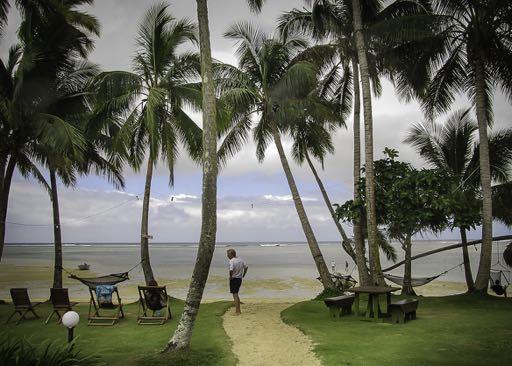
Pacific Harbour Blues. Where to stay? Te Seventh Day Adventist Camp is right at the back of the beach. I’m not a Seventh Day Adventist but it doesn’t seem to be a problem. I have a little A-frame hut to myself and the use of a kitchen with a gas burner. Out in front lies a beautiful sandy beach, palm trees arch overhead, and far out to sea lies Beqa Island, tall and mysterious and beguiling in the distance. My own Fijian paradise, and all for $7 a night.
I’ll have another rest day here—I have cheap accommodation on the beachfront and I want to throw off this damn sore throat. And anyway, I have definitely succumbed to Fiji Time and am in no great hurry. I just sit at a picnic table at the back of the beach sipping cups of tea and relaxing and watching life go by. Here at the beach the trade winds are providing some relief from the scorching heat but go a few hundred metres inland and it feels like a furnace.
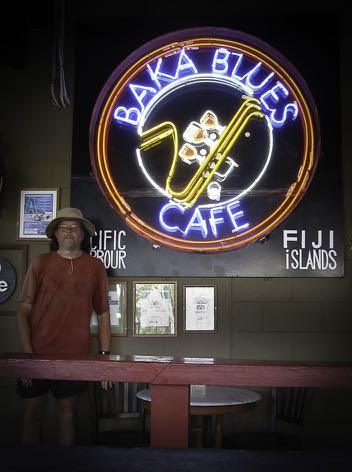
Wandering down town I have made an exciting discovery—a Blues Bar. For a blues music fan like me this is an unexpected treat. Inside is multi-coloured neon lighting and shiny chrome fittings. A classic American jukebox sits in the corner; paintings of Muddy Waters, John Lee Hooker and other blues greats adorn the walls. Sonny Boy Williamson is playing on the stereo. Somehow a little slice of the Mississippi Delta has been magically transported to the South Seas. I’m in heaven. On the last couple of cycle touring trips I’ve done I’ve managed to arrange it so that I could attend a music festival along the way; this wasn’t possible this time but now I have the next best thing.
Apparently there’s a concert on tomorrow night so I’m going to stay in Pacific Harbour a third night just so I can attend. Te benefits of Fiji Time.
Suva. Off on the final leg of the Queen’s Road to Suva. Another swelteringly hot day—I stop in every little shop in every little village along the way for an icecream—either a Choc Attack or a Blitz. Blitzes are awesome—a delicious butterscotch flavoured cookie- crumb-coated treat.
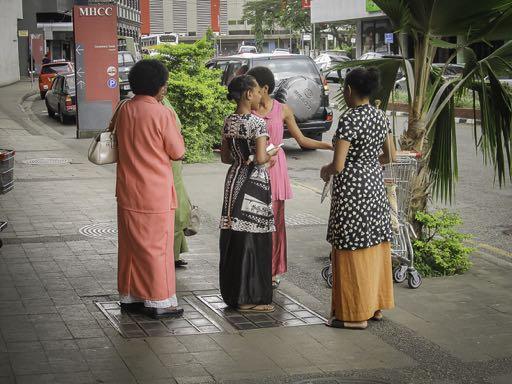
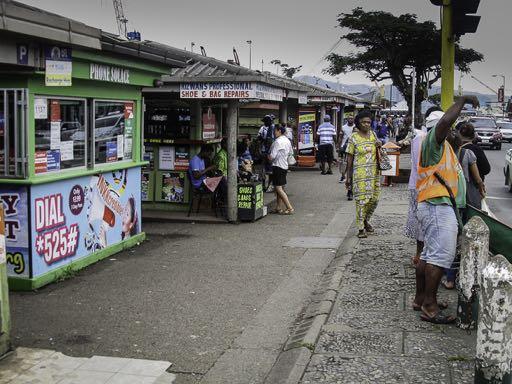
Te traffic gets heavier as I near Suva, and in town are crowds of people. It’s Saturday and market day. Another decision—where to stay? I check into the South Seas Hotel, the first of a number of old colonial-era hotels I will stay at during the trip. Camping options are pretty limited in Fiji so these old hotels become my favourite accommodation choice. Tere’s one in most towns along the way—they’re sometimes a bit run down and the plumbing can be a bit dodgy, but they’re cheap and they unquestionably have character. Most of the guests are local Fijians rather than foreigners, and the staff are always relaxed and friendly. Tis is my kind of place, not some sterile luxury hotel full of rich foreign tourists. Te South Seas is a large rambling wooden building in the hills above town, with creaking stairs and a spacious sunporch with comfortable armchairs. Ancient faded 1950s Pan Am posters and portraits of the Queen Mother line the walls. It feels like Somerset Maugham or Grahame Greene might suddenly appear around the corner at any moment.
I stay in Suva for three nights, checking out the sights, the shops, and the markets. I’m in no hurry and spend hours just wandering around and watching life go by. I’ve now fully adapted to Fiji Time.
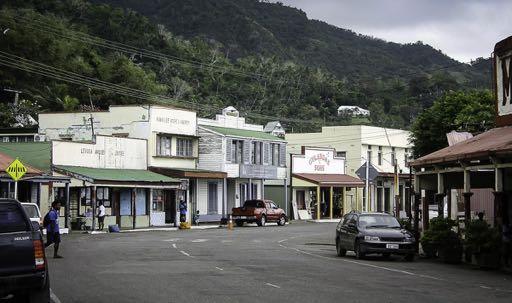
Ovalau Island. I’m leaving my bike behind for a couple of days to go and visit the old colonial capital of Levuka on Ovalau Island, to the east of Viti Levu. Te ferry lef about two hours late but nobody seemed to mind—clearly it’s running to Fiji Time. Levuka is a fascinating place—a time relic of an earlier era, like something out of an old Wild West movie set. Quaint old colonial buildings with wooden verandahs line the main street along the waterfront. Narrow alleys and steps lead up into the hills where old wooden houses nestling in the bush overlook the town centre.
I’m staying in another old colonial hotel which dates back to the nineteenth century featuring billiard tables, antique furniture, and four-poster beds. Somerset Maugham would definitely feel right at home here.
Returning to Suva afer two nights in Levuka, I’m a bit disappointed when the ferry actually leaves on time, but my confidence in Fiji Time is happily restored when we spend two hours at the end of the crossing circling the landing waiting to dock. Apparently another ferry is inconveniently occupying the only berth.
The Road North. I’m back on my bike and beginning my journey around the north of Viti Levu back to Nadi. And I finally seem to have got rid of my bloody sore throat. As if to recognise that I’m now on the return leg of my trip, the Queen’s Road has become the King’s Road instead. Te traffic is slow and heavy and scary as I head out of Suva but it virtually disappears once I’m past Nausouri. Afer several hours through undulating hills I reach Korovou where I spend the night in another old colonial hotel. I go dinner shopping in the local fruit and vege market and the Fijian women stall owners seem amazed that a male can actually cook.
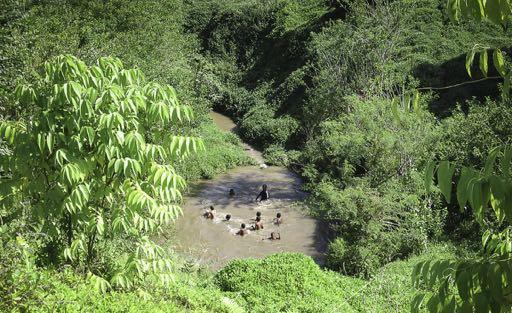
From Korovou the King’s Road runs inland through the middle of the island. Tis stretch of road used to be notorious—long and winding , narrow and unsealed— but it’s been done up, sealed, and realigned in places, and it’s now actually better going than some other parts of the ring road. I climb into the hills, then descend a massive hill into a major river valley. Man, I’m glad I didn’t have to cycle up that. Ten I pass through a whole succession of little villages full of small box-like corrugated iron houses. Women are doing their washing in a stream, groups of boys are swimming in the muddy waters of the river. Tis is the real deal, the real Fiji, a million miles away from the sparkling sandy beaches, coral reefs, and luxury resorts of all the tourist brochures.
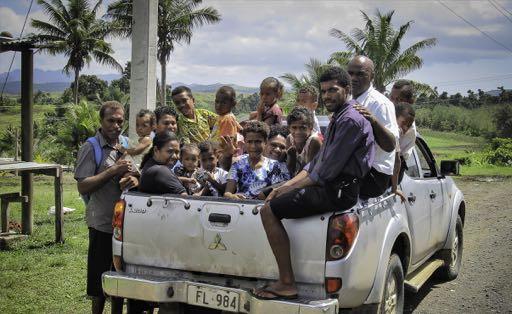
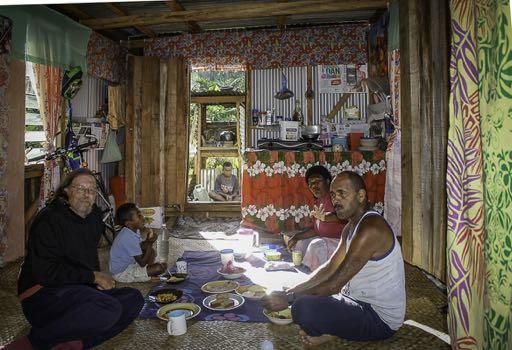
As I’m passing through one village a friendly guy stops me and invites me in for a cup of tea. I meet the whole family, including the parents and grandparents. Bula. Bula. Bula. Bula. A whole host of children roam in and out of the house—their connection to the family seems a bit vague but it doesn’t seem to matter. Tey all live in a three-roomed corrugated iron house. Ancient family photos line the walls. Tey treat me to tea and scones, then invite me to stay the night. Te next hotel is still a long way away and I’m not sure if I’ll find anywhere to camp, so I gratefully accept the offer. In the evening I share the family dinner—a basic selection of fried fish, instant noodles, boiled cassava, and some freshly cooked, sweet, floury concoctions— somewhere between a scone and a pancake. Delicious. We sit round on woven mats on the floor and the food is laid out on a sheet. In the evening, as guest of honour, I get to sleep in one of the only beds, while the others sleep on the floor. In the morning when I bid farewell to my friendly hosts, I promise to send them photos when I get back home. Tey don’t have much and live a pretty simple life but they’ve been very generous to a passing stranger and I’ve welcomed the opportunity to stay with them.
Back on the King’s Road along the river valley through more villages, then a sharp descent back down to the coast and around some pretty bays. I’m now on the northern side of the island and should have the trade winds at my back but, wouldn’t you know it, the road has dog-legged back to the east for a few kilometres and I find myself struggling exhaustedly into the wind once more. I’m sure it’s done it just to spite me. I finally reach Rakiraki and the hotel has no budget accommodation. Two hundred bucks for one night? Bugger that. It’s back to the tent instead. I end up camping for the night behind some bushes in the corner of a sugarcane field among a group of grazing cattle.
Nananu-i-Ra Island. Off the northern tip of Viti Levu lies Nananu-i-Ra, a small island with several backpacker-type resorts. Lonely Planet describes it as a must-visit location, so I’ll take another break from the cycling and go over there for a couple of days. I ring up Safari Lodge, one of the resorts, and the owner soon zips over in his boat to pick me up at the wharf. Warren is a sun-bleached Aussie guy—a keen diver who has single-handedly built the whole resort from scratch over the last 30 years. I throw my gear aboard and we’re off.
Also on board are the only two other resort guests, Pete, a fellow New Zealander from Auckland, and Caroline from Paris. Pete’s heading off kite-surfing for the day, so I’ve scored a free ride out to the reef. I spend the next few hours snorkelling round the reef, exploring the underwater channels between the coral formations and watching the pretty coloured fish darting around. It’s great. In the afernoon we head across the lagoon to the lodge. I’m staying in the self-catering backpacker dorm up the back, with a stunning view from the deck. Rich Japanese tourists would pay millions for this view and I have it all to myself for $30 a night.
Warren has some sit-on kayaks available for use, so in the morning I decide to go off and paddle right around the island. It’s 12 kms round but it’s low tide so I have to add a few more kilometres to go way out around some of the headlands to avoid the coral reefs. I’m by myself but I don’t feel in any danger. Tere’s a Fijian fisherman way offshore up ahead and I give him a friendly Bula. He’s pretty surprised to see me. But, man, it’s hard work coming back down the far side of the island in the afernoon into the trade winds. And then I round the southern end of the island and have to battle across with the wind on my side, threatening to blow me ashore onto the reefs. I’m completely knackered and really struggling. If I can just make it across to that moored catamaran, I should be able to tuck in behind it, out of the wind. Yes. I’ve done it. I pull in and hang on to the stern rope, totally exhausted. Ten minutes’ rest and I set off again, but the wind is just as strong and tiring as before. A few hundred metres later I’m completely exhausted again. I pull ashore in the lee of a little offshore island and have another 20-minute rest. At last I manage to battle round the south-eastern tip of Nanaui-i-Ra and have the wind at my back for the final exciting run home.
I only meant to spend two nights out here on Nananu-i-Ra but it’s so nice that I’ve decided to stay on for another day. Tat’s what Fiji Time is for. I spend the extra day walking down to the far end of the island, out along the grassy ridgelines. Tere are superb views back to the mainland and the steep mountain escarpment of the Viti Levu Highlands. I drop down to a remote bay, sit on a nice deserted sandy beach, and pluck wild pawpaws from the trees. Paradise doesn’t get much better than this.
Mt Victoria. Warren drops me back on the mainland in the morning and it’s back on the bike. I don’t have too many days lef afer all this Fiji Time but I’m still keen to get up into the highlands and climb Mt Victoria / Mt Tomanivi, the highest peak in Fiji. It’s got to be done. Tough I’m not sure how I’m going to get up to Navai, the highland village at the base of the mountain. On the map it looks like a long way up a steep, rough, unsealed road. Maybe I can cycle up, but it looks like hard work. I’ll probably be walking the whole way. Maybe I’ll get a ‘carrier’ (a taxi ute). I ponder the options as I cycle along. But when I get to Tavua I discover there’s a bus leaving for Navai in half an hour’s time. Perfect timing. Even better, a Fijian guy at the bus stop invites me to stay at his place in the village. I have to pay $25 for five seats on the bus as there’s no luggage compartment and my bike takes up the whole back seat, but it’s worth it.
Te bus winds its way slowly up the gravel road into the hills. School kids in neat uniforms on their way home from school get on and off. We begin ascending a steep escarpment and I can sense a distinct change around me – the landscape is growing wilder, less populated, more rugged. Te temperature is cooler and less humid. We reach the top of the escarpment and enter a remote highland valley; it feels like a lost world, isolated from the coastal lowlands. A few small villages occupy the flat valley floor. Te bus rumbles on and eventually, just on dark, we arrive in Navai. Tis is it—time to get off and unload the bike. I head off to my new-found Fijian friend’s place and meet his wife. It’s a small, one-room corrugated iron shack with woven straw matting on the floor and a single bed at the far end. Outside, a small enclosed fireplace serves as the kitchen. Away from the tourist façade, most Fijians live in poverty.
But I’ve just found out from my Fijian friend that there are a few strings attached to staying in Navai. ‘Lots of Vaivalagis come to climb the mountain’, he tells me. ‘All stay in village. Many visitors. Village make rules for visitors. If you stay with family in village you must pay family $35 a night. I forgot to tell you. Village rule.’
‘Uh—OK’, I say. ‘Good. Also you must pay $30 to the village. Village rule.’ ‘Well OK, I suppose so. If that’s the rule.’ ‘If you stay with family we must have kava ceremony. You must buy kava. Village rule. $5, $10, $15, you choose.’ ‘Well, I don’t like actually kava.’ ‘Fiji custom. Must have kava ceremony.’ ‘Well OK, alright, yeah, if that’s the custom, I suppose so.’ ‘If you go up mountain you must have guide. Village rule.’ ‘Well, you know, back in New Zealand I’m a tramper and if you just show me the start of the track I think I can probably find my own way.’
‘Very tough track. Dumb Vaivalagis get lost all the time. Must have guide. Village rule.’ ‘Well, OK, sure, I guess so. If you insist. How much for a guide?’ ‘Guide $25. But just for you, my friend, I think we can do it for 20.’ Tis little jaunt of mine into the highlands to climb Mt Victoria is turning out to be a more expensive enterprise that I had imagined. But still, in the scheme of things I guess it’s nothing like the quarter of a million you would have to pay to climb Mt Everest…
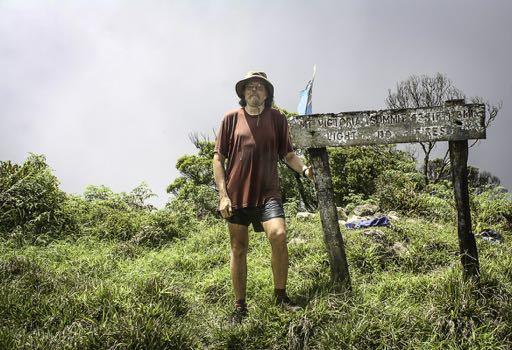
In the morning I meet my guide—a young boy called Tom. Te track up the mountain is a bit steep and muddy but nothing that a Tararua tramper wouldn’t take in his stride. And once you’re on the start of the track you couldn’t possibly go wrong—there’s only one track junction and it’s obvious which way to go. But the heat and humidity still make it hard work and I arrive at the top pouring with sweat. Te top is a bit disappointing for the highest spot in a country—no open tops or sub-alpine tussock zone here. Instead we emerge out of the jungle into a small grassy clearing with hazy views out over the surrounding country. In the middle of the clearing stands an ancient moss- encrusted signpost, and attached to the signpost is a small, limp Fijian flag. Welcome to Mt Victoria.
Afer an hour or two on the summit—I’ve had to pay for a guide so I’m damn-well going to get my money’s worth. I race back down, impressing my young guide with my New Zealand tramping speed. I spend the afernoon wandering
Te next day is a Sunday and there’s no bus back down to the coast, so I’ve got no option—I’ll have to cycle down. Te road is pretty rough and I’m worried about getting pinch punctures in my back tyre. Sure enough, as I cycle down the steep escarpment out of the highlands I get a flat. Damn it. Damn it. Damn it. Afer laboriously unloading all my gear and fixing it, I think it’s probably safer and just as fast to walk the bike down the hill instead. At the bottom I come to a little village and discover there is a bus from there out to the main highway. the bus leaves in 15 minutes and costs $2 and the driver isn’t going to charge me for my bike. If I try riding my bike it will probably take me another three or four hours. It’s not a hard decision to make. Another night in an old colonial hotel in Tavua and I’m back on my way westward around the north of the island. Tis is the dry side of the island, with bare brown hills and cattle wandering in the road. I’m now into sugarcane country and lots of ancient trucks loaded up top-heavy with cut cane trundle by, transporting it to the local sugar mills. Te sides of the roads are littered with spilt cane stalks. Small, narrow-gauge sugarcane railway lines criss-cross the landscape. Tere are fires in the fields burning off the sugarcane stubble and a haze of smoke hangs in the air. Eventually I reach Lautoka, Fiji’s second-largest city, and spend the night in yet another old colonial hotel.
Mt Evans. I am now down to my last few days but there’s one side-trip that I’m still keen to do—an ascent of Mt Evans, the second highest peak in Viti Levu. I get a carrier up to Abaca, the little village nestled in the hills below the mountain. Abaca is the headquarters for Koroyanitu National Heritage Park, a kind of local grass-roots village conservation initiative. All the surrounding mountain land belongs to the local villages but they’ve set it aside as an informal park and in return receive income from tourists visiting the area. Seems like a good sensible scheme. Te park contains some of the last untouched forests in Viti Levu, including some rare stands of Pacific Kauri. Abaca itself is set in a stunning location, with towering cliffs encircling the head of the valley. Mt Evans isn’t as high as Mt Victoria but it feels far more dramatic. I get billeted in a corrugated iron house with a village family and set off to visit the local waterfalls and climb to a nearby scenic lookout.
In the morning I set off to climb Mt Evans itself. Te track winds up the hillside opposite the village through extensive grasslands, then ascends a steep escarpment and enters the forest. I pass some impressive Pacific Kauri around the village, giving the village kids rides up and down the road on my bike, and consuming an endless supply of delicious home-baked Fijian food rustled up by my host’s wife.
trees and follow the ridge up to the top of the mountain. I emerge out into an open clearing—and there to my surprise, right in the very middle of the clearing, is a New Zealand-style tramping hut (I learn later that it was built by New Zealand as an aid project and is almost certainly the only New Zealand tramping hut in the entire South Pacific).
A group of Japanese students is in residence. ‘Konnichiwa’ (hello), I say, one of my two words of Japanese. Tey giggle. Apparently this is a very Japanese reaction but I am lef wondering whether I accidentally said ‘your grandmother is a warthog’ by mistake. One of them speaks a bit of English and tells me there’s a good lookout point about 10 minutes further on. ‘Arigato’ (thank you), I say, my only other word of Japanese. Tey giggle again, leaving my linguistic prowress rather dented. As promised, a bit further on the track emerges out on top of a towering cliff where there are hazy views out over the surrounding lowlands and across to the distant ocean.
A stop for lunch, then it’s back down the mountain. As I near the village I suddenly hear a strange whirring sound. I’m completely puzzled—what on earth is it? Where on earth is it coming from? Ten I looked up and there is a large drone hovering overhead. How utterly bizarre. I couldn’t have been more surprised if I had seen a flying saucer.
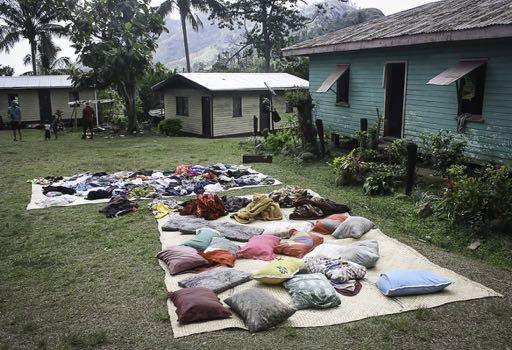
I reach the centre of the village to discover a possee of parked utes and landrovers and a team of Americans standing round. Turns out they’re part of a high-tech World Bank-funded project to map the country. Around me are simple corrugated iron houses, washing lies spread out to dry in the sun, chickens are pecking around, and a tethered horse is contentedly munching grass; before me the technicians adjust controls and play with their computers while fascinated little village kids look on. A more surreal contrast between advanced 21st century technology and traditional village life would be hard to imagine.
But this unexpected appearance of the survey party could solve a problem for me. I was planning to spend another night in the village and cycle back down to Lautoka in the morning, but I haven’t really been looking forward to it. On the way up in the carrier it looked damn rough, pitted and rocky; there’s no way I could have riden up it, and even going down I think I’ll probably find it unrideable on my road bike—and puncture-heaven if I try. I’ve also sensed that I’m a bit of a burden to my host family. Now I have an opportunity of getting back down to Lautoka this very day in ease and I grab it. Any spare room for a bike in the ute? I ask hopefully. Sure buddy, no problem, I’m told. I throw my bike in the back and when the technicians have finished work I get a ride back into town, where I spent another night in the Lautoka Hotel.
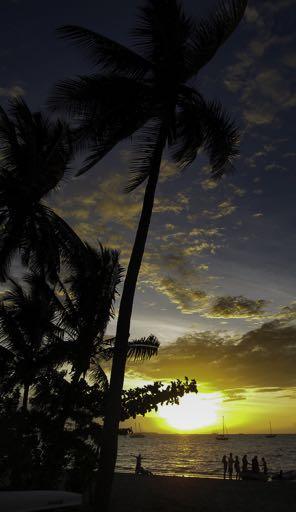
Farewell to Fiji. I’m now down to my very last day. I fly back to New Zealand tomorrow morning and even Fiji Time can’t change that. Te road from Lautoka back to Nadi is narrow with heavy traffic and the temperature is swelteringly hot. I pull into a small shop and buy my last Blitz icecream. I pass the airport and somehow manage to spend a frustrating hour lost in the backroads of Nadi before finally reaching my hostel out at the beach. Ten I have a busy couple of hours cleaning my bike and packing up my gear. Flying home is always the worst part of any cycle touring trip. At last my chores are finished and I wander over to the kava circle where a group of Fijian guys are sitting strumming guitars and singing songs. Waves are rolling in on the beach and the palm trees are silhouetted against the starry sky. A Fijian guy walks past hawking fresh green coconuts. Around me sit lots of eager young backpackers fresh off the plane, while I sit there relaxing and feeling like an experienced old Fijian hand. It’s been a great trip. Cycle touring is a great way to travel and see a country. I feel like I’ve got beyond the glossy brochures and seen a bit of the real Fiji. Te landscape around Viti Levu has been varied and interesting but what’s really made the trip for me is the friendliness of the Fijian people. Unknown strangers have invited me into their homes and offered me cups of tea. School kids have rushed over and crowded around my bike whenever they’ve spotted me going past. Fijian women at roadside fruit and vege stalls have all waved as I’ve gone by. And everywhere I’ve been I’ve heard the ubiquitous Fijian greeting of ‘Bula.’ Sitting here around the circle on my very last evening I feel sad to be going home. I even venture another sip of kava as I sit back listening to the strumming guitars, savouring my final few hours of Fiji Time.
Comments
Comments are not open yet.