
Text taken from the club newsletter.
Toxic hut bagging
Sam Harrison | 22 Feb 2026 | Fiordland National Park
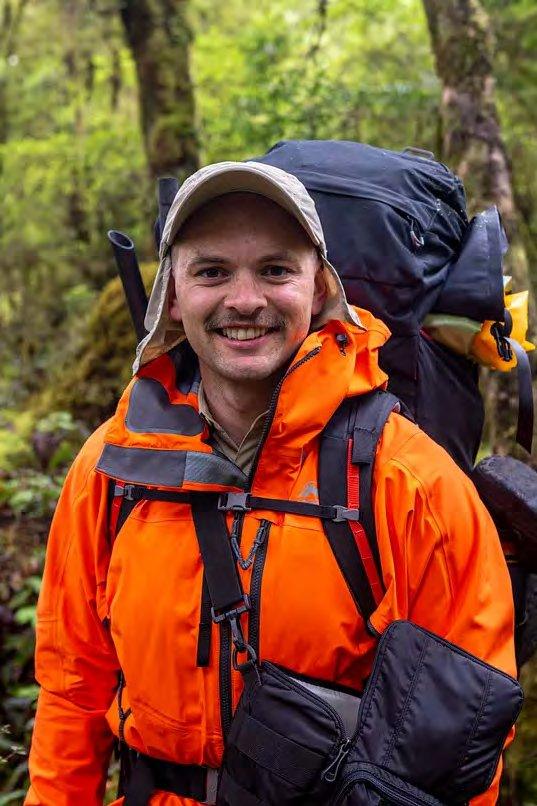
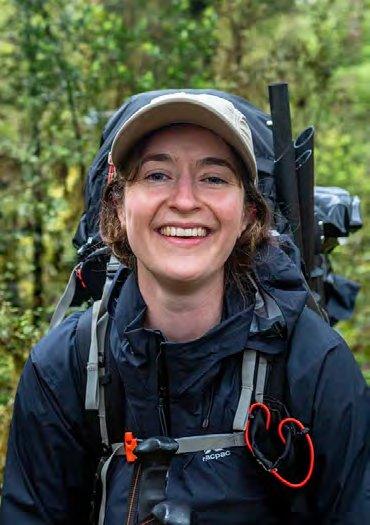
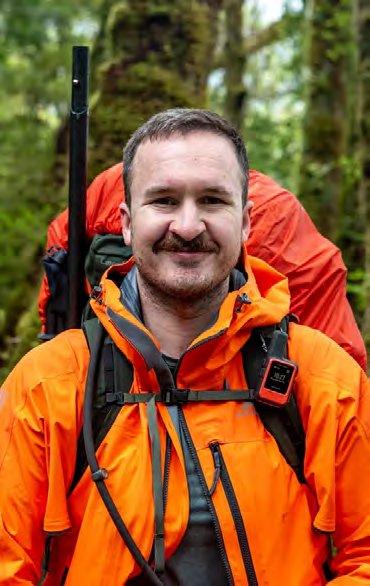
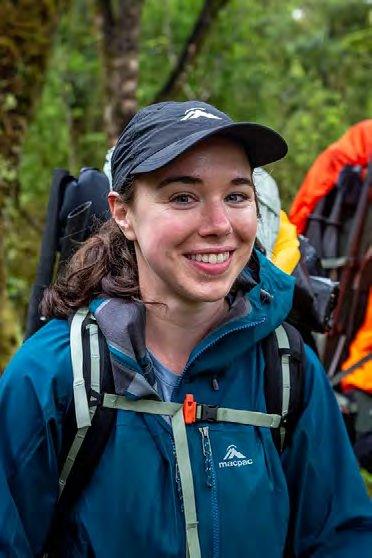
The pie and the prologue Sitting on a bench outside the Milford Road Merchant I blew on the pie that I clutched in my hands. It was still too hot. I couldn’t help but ponder what was about to unfold. I was on the verge of the trip of a lifetime. Some months before I had been given a scholarship by the Federated Mountain Clubs of New Zealand to undertake an expedition into the heart of Fiordland over January 2026. My fellow expedition members were Tess, Ellen and Regan — master masochists of the finest variety.
Our plan was simple, we would strike out across Lake Te Anau, climbing through the Murchison Mountains till we were under the remote peak of Mt Irene. Traversing this we planned to then drop into the Large Burn to eventually end up at Caswell Sound. We’d then swing back up the Stillwater River till we could cross over the range to George Sound. Then it would just be a simple matter of following the George Sound Route back out to our ride back across Lake Te Anau. In doing so we would bag seven huts, loving some of them as part of FMC’s Love Our Huts campaign.
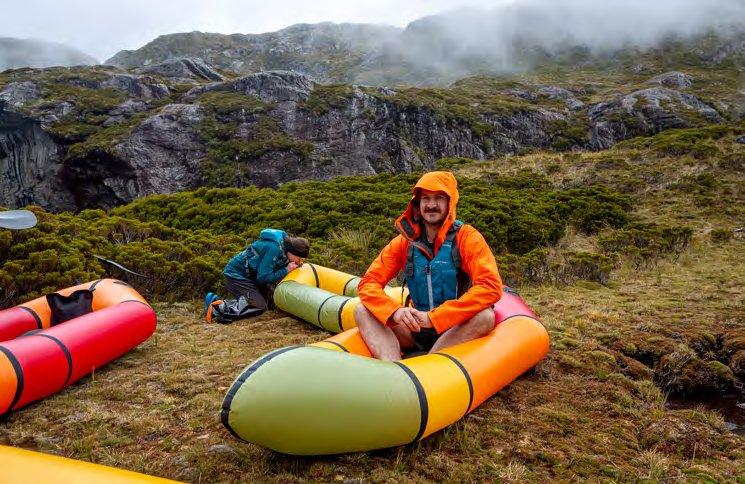
Our packs would be crammed full of the twelve days’ worth of rations that Ellen had made her mother help dehydrate while she was visiting from the states. On top of this we’d each have a packraft, crafted by Regan over the course of a month in his Newlands sweatshop (aka his garage). The packs themselves and much of the other gear had been supplied for demolition by Macpac, who I’d promised some photos if we survived our ordeal.
And somehow all of these strands had come together, culminating in this pie before me. By the time I had pondered all of the above it was no longer thermo-nuclear, enabling me to take a bite and cover myself in pastry.
I. The mysterious case of the disappearing bivvy The boat happily skipped across the broken water of Lake Te Anau. The mountains around us were enveloped in mist. We were accompanied on our voyage by a wiry German boy clad head to foot in black wet-weather gear. His name was Marius. He had reached out to Regan to see if he could share the boat with us at the start and end of our trip. We were somewhat apprehensive, as he we had no idea how capable he was or how prepared he was for the week or so he would be alone in the remote country he would need to traverse.
“Are you Sam Harrison? I’ve read your blog”
Marius said over the crashing of waves.
Instantly all of my apprehensions melted away. He was a fan. He must know what he is doing. Or he is good at pretending like me. The skipper deposited Marius at the outlet of the Doon river and we watched him grow smaller as the boat pulled away. Our stop was just across the bay at Junction Burn Hut.
One by one we stepped off the boat and into our new world. After a quick stop off to admire the dead piles of sandflies in the hut we made our way past the no unauthorised access DOC sign and onto the track up the Junction Burn (the Murchison Mountains is a specially protected area and a permit from DOC is required to visit).
Our packs weighed heavily on us as we wombled our way through the forest. The river soon forked and we began venturing up the Woodrow Burn. Despite the dense rainforest around us the track was well cut and marked, better than some parts of the Tararuas I thought.
Given this and the relative lack of elevation gain we made good progress. A collection of large rocks jutting into the river made an irresistible lunch location. Ellen was tasked with whipping up peanut butter from a bag of powder, the result being more of a smoothie than a spread. No matter, calories are calories. As is the way with Fiordland, no sooner had we stopped had the sandflies descended so it wasn’t hard to get motivated to get moving again.
It wasn’t long after lunch that we had our first casualty of the trip — one of Regan’s aluminum walking poles. He wasn’t very impressed.
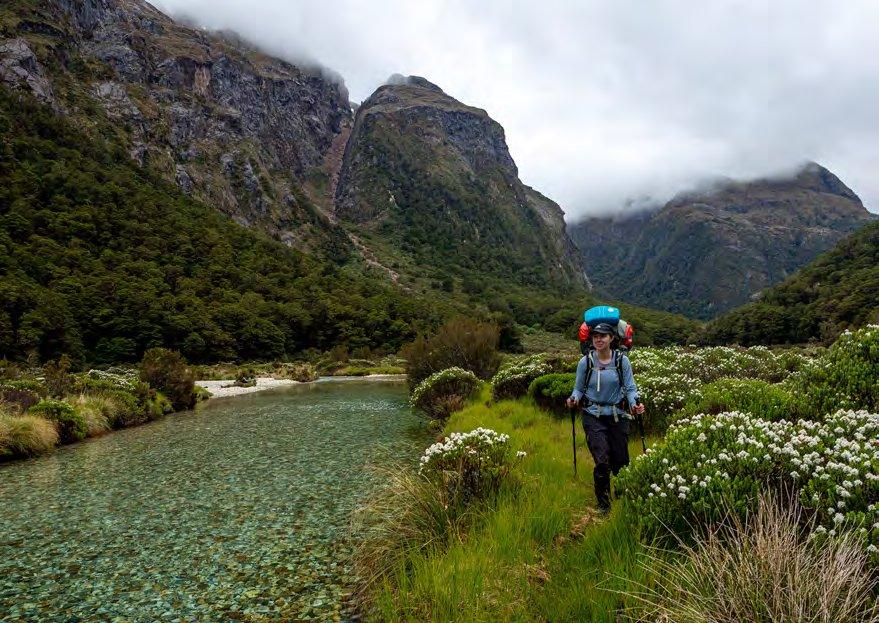
As we gained elevation so did the fog, slowly rising to reveal sheer walls of rock, smoothed by the action of glaciers long ago. Water cascaded over these faces, tumbling into the ether from streams unknown high above. All of this water meant the occasional bog of course, but that wasn’t unexpected.
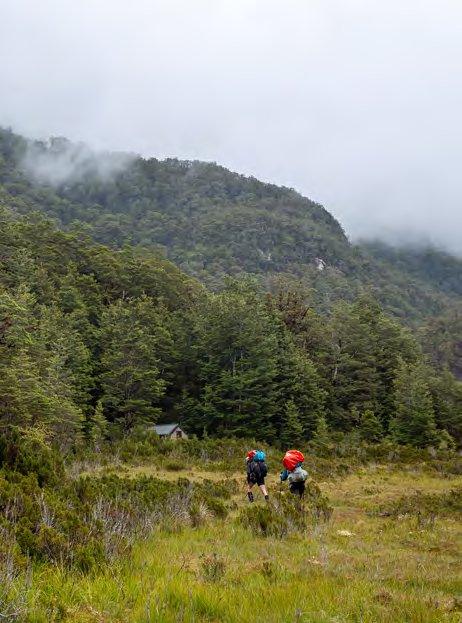
The valley soon began to open up, the forest receding like my hair, the track soon bringing us to a large swampy flat. This gave us serious “hut vibes”. The map even agreed. Woodrow Bivvy was meant to be close. The problem was it simply wasn’t. No matter how much we trod up and down the river could we find the damn thing.
It was only when we had given up all hope of finding the bivvy that we stumbled upon it, half a kilometre further upstream than we had anticipated, tucked into the treeline.
It was a joy to finally get our packs off our backs. This joy was cut short by one of the most vicious swarms of sandflies that I had encountered up until that moment. We rushed to get into the cramped sanctuary of the bivvy, climbing over each other to fit. Given the bivvy’s location in a swamp it shouldn’t be a surprise to anyone that it was a bit dank inside. An entry into the hutbook summed it up far better than I ever could:
Woodrow Biv – sure ain’t roomy
Woodrow Biv – rather gloomy
At least the dimness
Masks the grimness
Of the mould but truth be told –
This fetid little find
Could use some sunshine!!!
We did our best to clean, scrubbing mould off the mattresses. Tess and I then ventured out across the swamp to find the river for a quick dip. Chased back by sandflies, dinner was consumed in the little biv before we tucked up for the night, eager to get some kip.
II. Robin Saddle: Dead or alive Our objective for day two was Robin Saddle Hut. As the crow flew it wasn’t a great distance. But crows don’t have to carry eleven days’ worth of food and equipment. It was hard to get motivated to move in the morning. It was not a lightening fast start by any standards, not helped by the cramped conditions and lingering sandflies. We were finally ready just before 8.30am, setting off across the end of the swampy flats before entering the forest. The track climbed steadily as the river gorged below us. When we next saw the river it was cascading between rocky walls. We couldn’t help taking a second to admire it.
The track might have been easily negotiable had it not been for the burden of our packs. There were a few bits of fresh treefall to navigate, an ordeal worst for Regan as he was carrying an extra large packraft paddle pole in his pack that seemed to snag on every branch.
The track soon grew narrower and we traversed beside bluffs before the markers plunged down a rock face. Gingerly we negotiated this, mostly on our asses. From here the track meandered pleasantly to reach the upper Woodrow flats.
It was here that Regan had the sudden realisation that the reason why he had been enjoying the last half an hour so much was because he was no longer in possession of his extra large packraft pole. Given he hadn’t even had a chance to use it there was nothing for it but to backtrack in the hope we could locate it. Some 25 minutes back, up that steep rock face and passed the narrow bluffs, we found the pole peacefully resting next to a stream. Phew. We returned to the girls, who had hunkered down amid clouds of black bastards. They were eager to move.
Crossing a small flat we stayed on the true- right, climbing briefly before passing the turnoff to Wisely Biv and descending to a second flat. The route across the flat was well marked, meandering between huge flowering hebes and bottomless bogs. We entered the forest again as the valley turned to the west and after a couple of hundred metres we crossed over to the true- left of the Woodrow.
A few unexpected mudholes later we were making our way around the grassy edge of a large silty flat that appeared to be a particular favourite with the Canadian geese. Halfway along this flat we decided that it was well-past lunchtime so we dumped our packs and Ellen got busy rehydrating some hummus.
Unfortunately we discovered that while semi-rehydrated extra strength garlic hummus is partially edible, it does little to repel sandflies. No sooner had the last morsels of food been inhaled we were back walking again. Climbing further upstream the previously clear water of the Woodrow transformed into a vibrant aquamarine, a sight that distracted us from our garlic infused digestive systems.
Further upriver we passed around the northern side of a swampy lake, before doubling back to enter the bush for the climb to Esk Saddle. A cacophony of grunts echoed through the bush as Regan and I struggled under our 90L packs. In a rare moment of kindness I offered to carry Regan’s one-man tent and soon regretted it. It was more of a marked face than a track, a steep ascent up roots, scratching at the dirt. It was a joy when we finally reached a rocky outcrop that offered our first views of the trip.
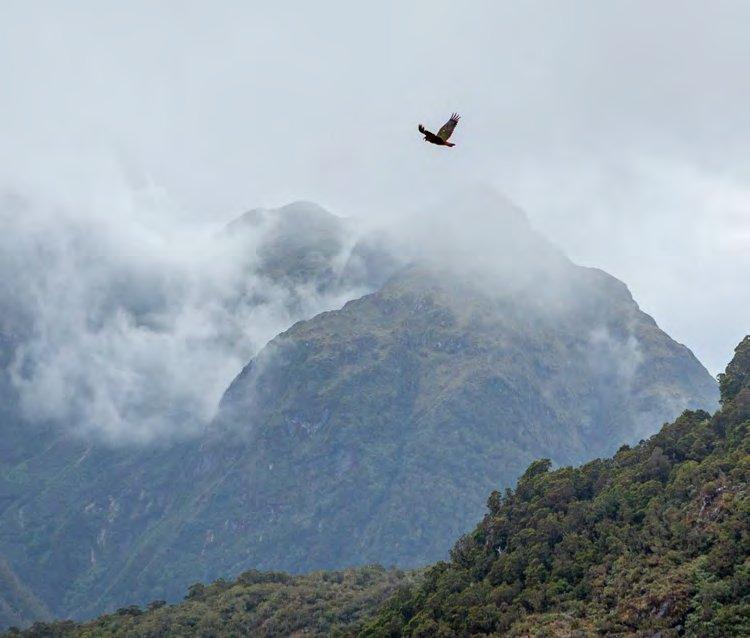
This elation was short lived as I soon went ass over tit trying to negotiate a steep rock with my pack on. Dusting myself off I tried to continue with what semblance of dignity I had left. We stopped for a break on the saddle itself, enjoying the rare absence of sandflies. From here our path to Robin Saddle was laid out before us, seemingly impossibly far in the distance. Leaving Esk Saddle and the track behind we faced our first obstacle. The ridge rose in a series of steps, sheer vegetated walls offering a fine puzzle to navigate. We put our faith in Regan and he came through. Following a narrow ledge on the northern side of the bluff we soon made our way onto easier slopes, much to the bemusement of several kea.
The next step to pt 982 was negotiated starting from the south, cutting up diagonally to the north. Lake Duncan and Lake Te Au sat snuggly in the backdrop of this climb, shimmering jewels of the remote Murchisons.
It was a bit of a grunt up to the weathered rock landscape of pt 1096. Passing the highpoint we continued along the ridge to the base of the hill in front of us. To our left a steep scree strewn bench stretched out to Robin Saddle.
Tess led valiantly out in front across the scree slope, scouting a way for the rest of us. She beckoned for us to follow.
I don’t quite know how she was making it look so easy, I fumbled around on the loose rock worried my pack was about to break my ankle. The first scree slope was followed by a second, this one steeper than the last. Tess skipped down this, leaving the rest of us to figure out quite how she had done it. After some slipping and sliding we were reunited on slightly flatter terrain. From here we climbed over a large bouldery spur, weaving our way through stunted vegetation. On the far side we found a stream, tumbling turbulently down into a tranquil pool suspended above the valley far below. Our weary bodies demanded a snack. In doing so we were joined by two “juvi” kea, much to everyone’s delight.
From the pool we climbed up tussocked slopes to gain the rim of a large basin, a tarn occupying its centre. We continued due west and after consulting our notes began to climb the spur towards pt 1161. This was a steep plod. After gaining some altitude we gained a rocky ledge which we followed to the southwest, climbing up gradual slopes till we had conquered the plateau above Robin Saddle.
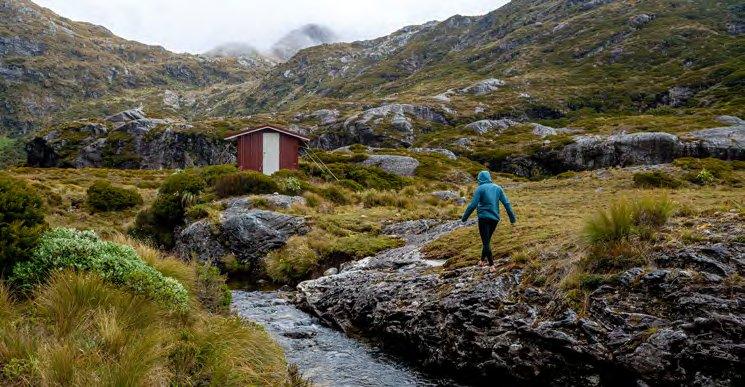
If we had been hoping to be close to the hut we were sorely disappointed. On cresting the next rise the basin containing Robin Saddle Hut was revealed, a long way down.
The path of descent was far from obvious. Moir’s Guide mentioned a cairn but with our best endeavours (okay maybe a bit half-hearted, we were tired) we couldn’t find it. Instead, we gingerly made our way down a rocky gut, relieved when this opened out before us into a scree fan. The bottom of this fan deposited us on a large shelf. Following this west we crossed over a small stream and began our final descent to the hut.
This was easy enough, especially for the desperate. I was willing to take the risk of having to wade through scrub if it meant a direct line to the hut. With broken bodies we collapsed on the hut’s doorstep, a little before 7pm.
As soon as we stopped our legs seized and we were paralysed by our fatigue. The thought of ever leaving that place filled me with nausea. Basic mental functions failed to fire. It was abundantly clear that pasta was required before we made any adult decisions about our plans for the next day. Indeed, mountains of pasta did improve our mental capacity. We resolved to have a rest day at the hut. Our knees rejoiced. “What’s an eight
III. Maiden voyages and mountain daisies Toabsolutely no ones surprise it was sleep ins all round. When I did eventually poke my head out of the hut I was greeted with pea soup, grey cloud enveloping everything in a swirling mass. I don’t do well at sitting still by myself. After a hot drink I spent some time writing up notes. Later in the morning there were signs of life from the girls and we went, sans snoring Regan, down to the lake to check out its potential for our maiden packraft.
When we got back Regan was still dead to the world. I pulled out the paper maps I was carrying, cross referencing entries from the antique hut book (circa 1985) to our intended route on the topo. When Regan eventually did rouse around 11.30am he declared “I have to have a nap to recover from my sleep”. He promptly fell asleep again. We waited a little longer, preparing lunch before finally deciding to wake the old man up for the start of his day. After feeding him lunch we decided that we should tackle hut cleaning first, as part of FMC’s Love Our Huts campaign.
When the mattresses were scrubbed and laid out to dry it was finally time for our packrafts to come out and play. After an introductory safety talk from Regan, who had never packrafted in his life (neither had we), we set about inflating our colourful rafts on the shore of the lake.
After a circuit of the lake and practising some safety techniques that Regan had seen on Youtube we headed back in. Packing up the rafts was almost harder than inflating them. Back at the hut we set about completing all of the crosswords in the Wilderness Magazines in the hut.
When this was exhausted and the others dug out their kindles I decided to go for a walk. I headed northwest from the hut, crossing the steam and climbing up a knoll so I could see down towards the Irene River. It was a spectacular place of sheer-sided mountains and lush vegetation. The shriek of nearby kea haunted the valley walls.
I ventured down the hill a little bit, curious to see what I could find. In the mud I chanced upon a large footprint, later confirmed by Ellen to have been left by a takahē. I was chuffed. In the wilderness I wondered if the others in the hut were missing me. I retraced my steps. Two kea landed on a rock nearby. I chatted to them for some time.
As I crossed back over the knoll the girls came out to greet me. They too were getting restless legs. I told Ellen about the kea and she was off in a flash, not one to miss ornithological action.
letter word for mountain daisy?”
We spent the remainder of the evening before dinner reading the hut book and wondering what tomorrow would bring. We planned to tackle the side of Mt Irene if the weather was good, traversing its western flank. Otherwise we would do a long slog down to the Irene River and then back up. Regan reassured us that his InReach forecast showed little rain for the next week. Before the trip I had talked to a friend of Tess’ dad, John Cocks, who had done the traverse and said it was doable. His parting words were somewhat ominous on reflection:
“Whatever happens, you’ll have your own adventure”
I didn’t dwell on this in the hut, the shepherds pie steaming in the billy now taking my full attention. No point worrying about the future.
Read about the rest of the sandfly-infused adventure here (we ran out of printing budget, sorry!): medium.com/p/ 0a2b6a8867e8
Comments
Comments are not open yet.