
This report is shown as scanned pages until a volunteer types it up. Skip to the machine-read text (unproofread), which a screen reader can read.
Machine-read text (unproofread)
Read from the scans by software, so it contains mistakes. Typing it up properly would help blind readers: use Suggest an edit.
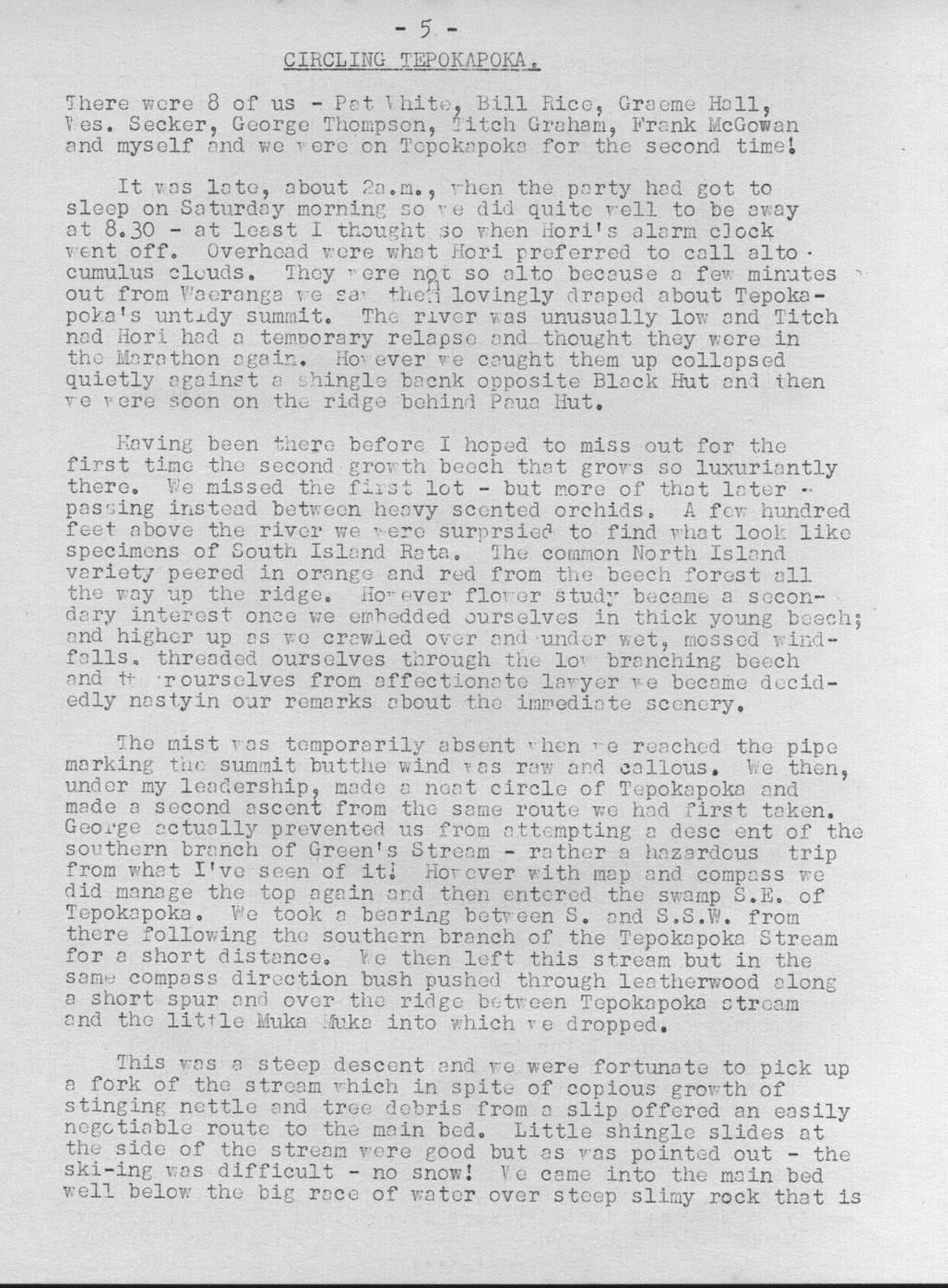
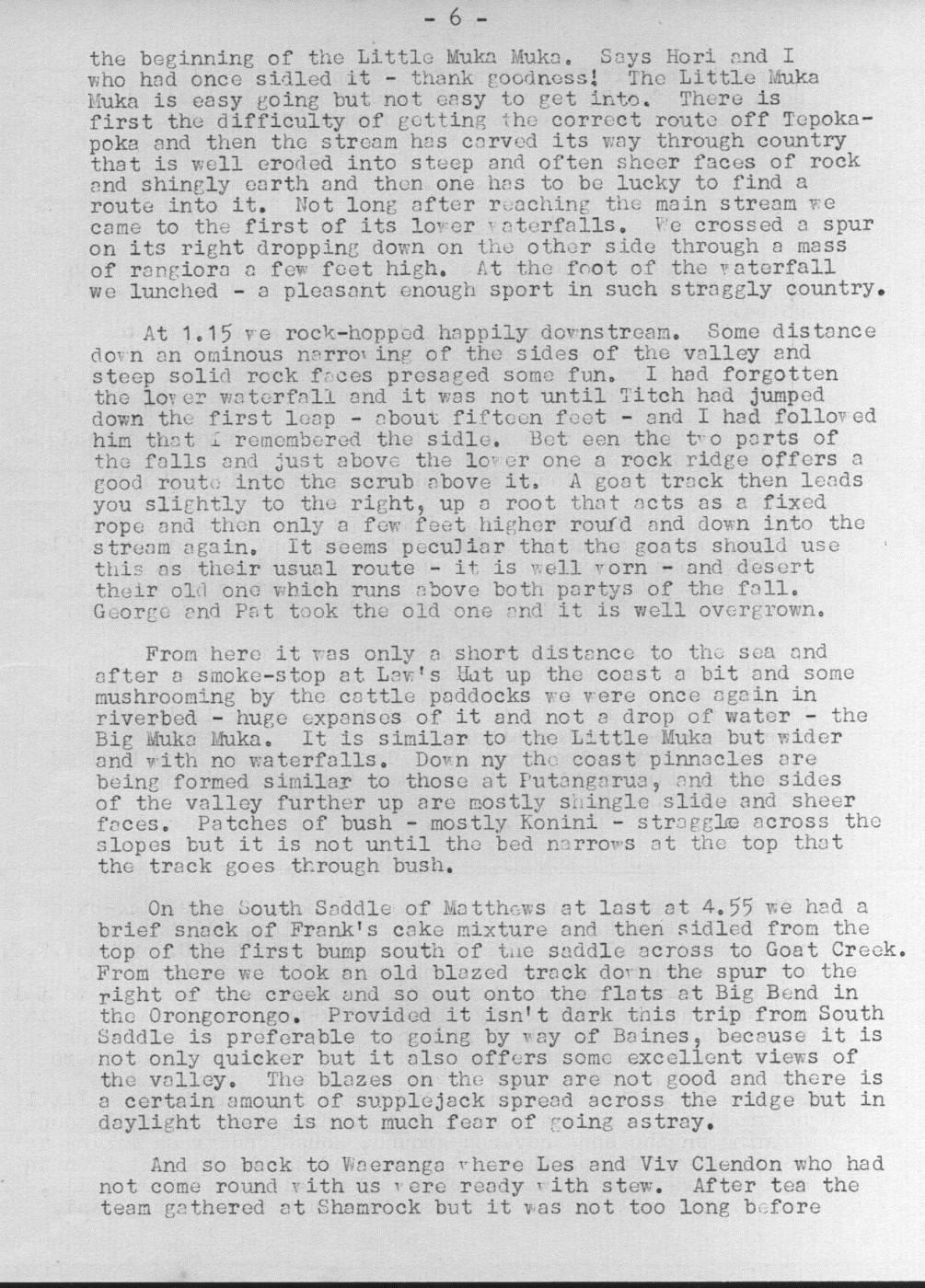
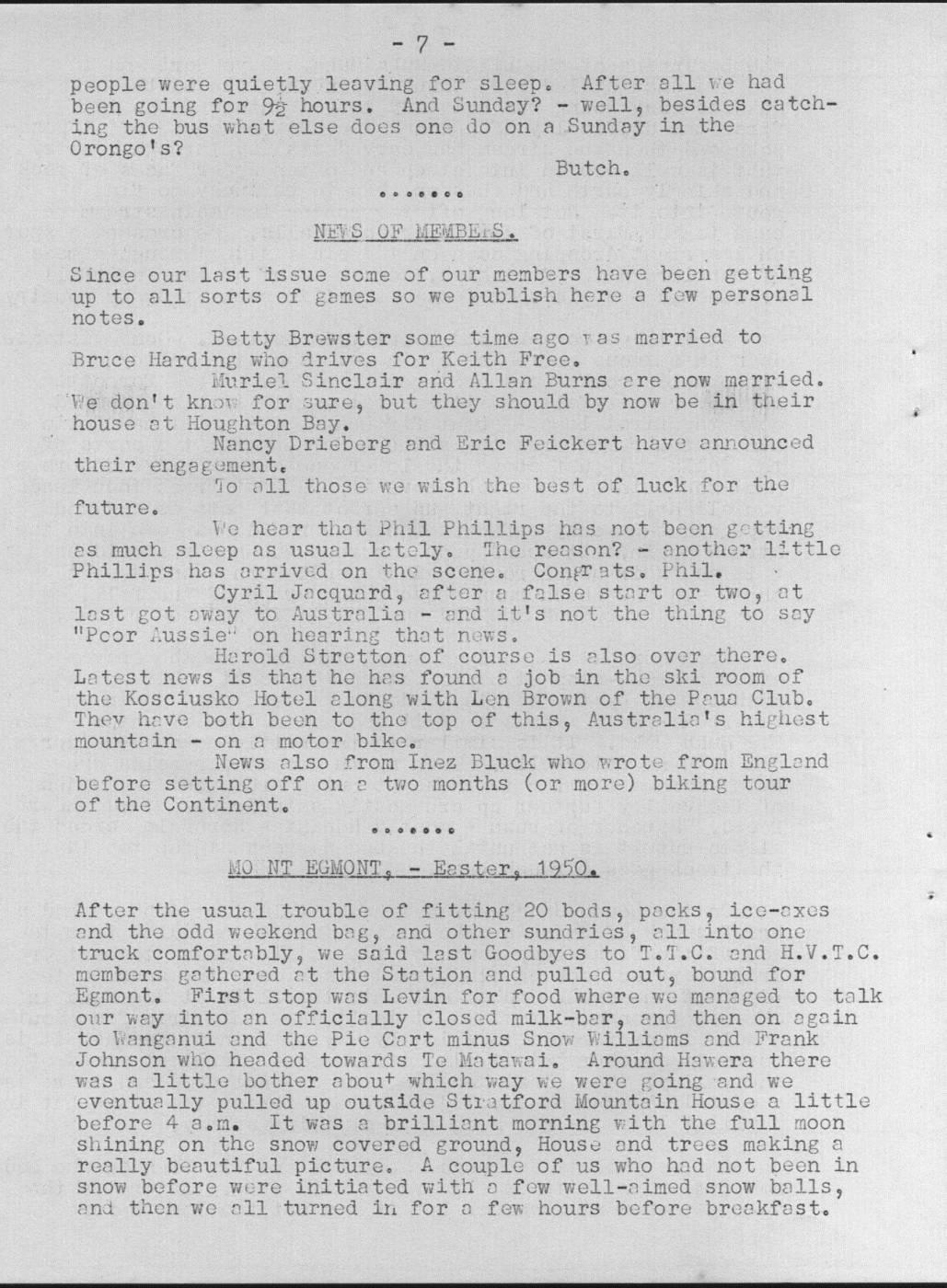
CIRCLING TEPOKAPOKA. There were 8 of us = Pat Thite, Bill Rice, Graeme Holl, Ves. Secker, George Thompson, fitch Graham, Frank McGowan and myself and we V ere on Topokapoka for the second timel It vas late, about 2a.Mo, vhen the party had got to sleep on Saturday morning so ve did quite rell to be away at 8.30 I at least I thought s0 when Hori's alarm clock vent off. Overhead were what Hori preferred to call alto. cumulus clouds. They TF ere not so alto because a few minutes - out from Vaeranga ve sar thefi lovingly draped about Tepoka = poka's untidy summito The river was unusually low and Titch nad Hori had a temporary relapse and thought they were in the Marathon again. Hoi ever ve cought them up collapsed quietly against a shingle bacnk opposite Black Hut and then ve rere soon on the ridge behind Paua Hut. Kaving been there before I hoped to miss out for the first time the second grov th beech that grovs so luxuriantly there. We missed the fiist lot - but more of that later : passing instead between heavy scented orchids, A few hundred feet above the river we rere surprsied to find vhat look like specimens of South Island Ratao The common North Island variety peered in orange and red from the beech forest all the way up the ridge. Horever florer study became a socondary interest once we emhedded ourselves in thick young beech; and higher up as we crewled over and undor wet, mossed windfalls. threaded ourselves through the lot branching beech and tt rourselves from affectionate lavyer re became decidedly nastyin our remarks about the immediate scenery. The mist vas temporarily absent t hen T e reached the pipe marking the summit butthe wind vas raw and callous. We then, under my leadership, made a noat circle of Tepokapoka and made a second ascent from the same route we had first taken. George actually prevented us from attempting a desc ent of the southern branch of Green's Stream - rather a hazardous trip from what I've seen of iti HoT ever with map and compass we did manage the top again and then entered the swamp S.E. of Tepokapoka. Ve took a bearing betveen S. and S.S.W. from there following the southern branch of the Tepokapoka Stream for a short distance. le then left this stream but in the same compass direction bush pushed through leatherwood along a short spur and over the ridge betr een Tepokapoka strcam and the little Muka Juka into which ve dropped. This was a steep descent and we were fortunate to pick up a fork of the stream vhich in spite of copious growth of stinging nettle and tree debris from a slip offered an easily negctiable route to the main bedo Little shingle slides at the side of the stream vere good but as vas pointed out - the ski-ing was difficult - no snow! Ve came into the main bed well below the big race of water over steep slimy rock that is the beginning of the Little Muka Muka. Says Hori and I who had once sidled it - thank goodness! The Little Muka Muka is easy going but not easy to get into. There is first the difficulty of getting the correct route off Tepokapoka and then the stream has carved its way through country that is well eroded into steep and often sheer faces of rock and shingly earth and then one has to be lucky to find a route into it. Not long after reaching the main stream we came to the first of its lorer T aterfalls. ve crossed a spur on its right dropping down on the other side through a mass of rangiora a few feet high. At the foot of the raterfall we lunched - a pleasant enough sport in such straggly country. At 1.15 ve rock-hopped happily dovnstream. Some distance dovn an ominous narror ing of the sides of the valley and steep solid rock faces presaged some funo I had forgotten the lov er waterfall and it was not until Titch had jumped down the first leap - about fifteen feet - and I had follov ed him that I remembered the sidle. Bet een the tro parts of the falls and just above the lover one a rock ridge offers a good route into the scrub above it. A goat track then leads you slightly to the right, up a root that acts as a fixed rope and then only a few feet higher rourd and down into the stream again, It seems peculiar that the goats should use this as their usual route - it is well vorn = and desert their old one which runs above both partys of the fall. George and Pat took the old one and it is well overgrown. From here it vas only a short distance to the sea and after a smoke-stop at Law's Hat up the coast a bit and some mushrooming by the cattle paddocks we vere once again in riverbed I huge expanses of it and not a drop of water I the Big Muka Muka. It is similar to the Little Muka but wider and vith no waterfalls. Down ny the coast pinnacles are being formed similar to those at Putangarua, and the sides of the valley further up are mostly shingle slide and sheer faces. Patches of bush - mostly Konini I straggle across the slopes but it is not until the bed narrows at the top that the track goes through bush. On the South Saddle of Matthews at last at 4.55 we had a brief snack of Frank's cake mixture and then sidled from the top of the first bump south of tue saddle across to Goat Creek. From there we took an old blazed track dorn the spur to the right of the creek and so out onto the flats at Big Bend in the Orongorongo. Provided it isn't dark this trip from South Saddle is preferable to going by way of Baines, because it is not only quicker but it also offers some excelient views of the valley. The blazes on the spur are not good and there is a certain amount of supplejack spread across the ridge but in daylight there is not much fear of going astray. And so back to Waeranga rhere Les and Viv Clendon who had not come round vith us T ere ready T ith stew. After tea the team gathered at Shamrock but it was not too long before people were quietly leaving for sleep. After all we had been going for 92 hours. And Sunday? - well, besides catching the bus what else does one do on a Sunday in the Orongo's? Butch. o
Comments
Comments are not open yet.