
This report is shown as scanned pages until a volunteer types it up. Skip to the machine-read text (unproofread), which a screen reader can read.
Machine-read text (unproofread)
Read from the scans by software, so it contains mistakes. Typing it up properly would help blind readers: use Suggest an edit.
A TRIP TO THE COROMANDEL RANGE. As is usual with South baund trips the Auckland Tramping Club truck left Grafton Library soon after 7.30 p.me Friday for Thames on the Ceromandel Peninsula., We had difficulty in finding Karaka Rd, at the back of Thames and when we eventually found it the passable road terminated at the last house about half a mile from the town. Due to the lateness and also the steep country, we were compelled to oamp en the tram track, without any shelter or protection of trees. Fortunately it was a olear night but a very heavy dew made everything sedden. Breakfast was a miserable meal at day-break. We followed the tram tracks for about twe miles, then struck a track up a side stream to the crest of a bush eovered ridge, At intervals along the tram tracks we had seen quite a number of entrances to abandened gold mines. Oceasicnally we had splendid views everlooking the Coromandel Range frem a new dilapidated pack track which followed the erest of the ridge. The general outlook was similar to the Tararuas, with peaks up to 22 thousand feet high. If it did not equal the Tararuas for height it certainly did in ruggedness. The ridge centinued(simdlor to the Waiopehu ridge)till we came to Cresbie's Clearing, where we had lunch. The olearing situated on the ridge was apparently cleared by the Crosbie family many years age, for the purpose of farming, but due to the poor facilities ( the paok track being the only cemmunication) the farm became deserted. Lunch over we set off dewn Crosbie Stream to the Waiwawa River,which drains into Mercury Bay on the East of the Peninsula, At the junction Crosbie- Waiwawa, we turned upstream tewards the head of the Waiwawa River. Half a mile further on we camped on a small bush covered river flat. It was quite cheerful but most of us went to bed early to catch up on lost sleep. It was a pleasant sensation to wake up to the noises of the busheto relax in the warmth of the sleeping bag and to gaze at the feliage above. The morning air was ccol but after breakfast around the fire we left at 8 o'clock for up river. In less than an hour we came to the camp of the second half of our party, who were doing the trip in reverse. They were still having breakfast. We exchanged notes about the country travelled by both parties. It appeared,at that time,that our party. numbering eleven were in for a hard day with plenty of first class bush whacking - supplejack, windfalls, etc. We left the main river up a side stream for the saddle. The whole of the country we had traversed( and indeed the remainder of the trip) so resembled the Tararuas that one almost felt one was back in the old stamping ground. We waded, scrembled and climbed waterfalls and passed many side streams until we came to a fork with an equal volume of water in each branch. After consulting the map and compass we went off up the dividing ridge and within a short time arrived in the near proximity of the saddle,
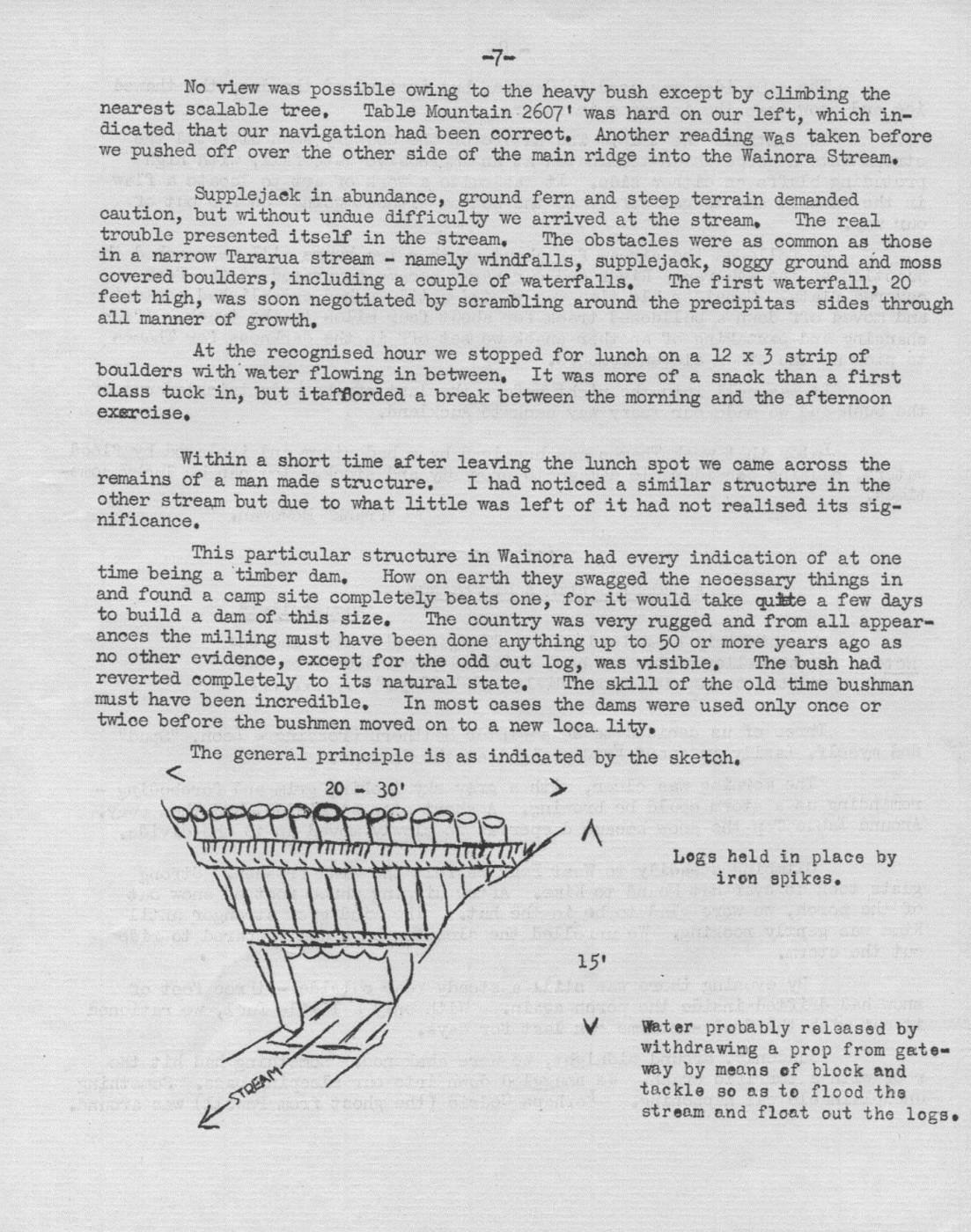
No view was possible owing to the heavy bush except by climbing the nearest scalable tree, Table Mountain 2607' was hard on our left, which indicated that our navigation had been correct. Another reading Was taken before we pushed off over the other side of the main ridge into the Wainora Stream. Supplejack in abundance, ground fern and steep terrain demanded caution, but without undue difficulty we arrived at the stream, The real trouble presented itself in the stream, The obstacles were as common as those in a narrow Tararua stream - namely windfalls, supplejack, soggy ground and moss covered boulders, including a couple of waterfalls. The first wa terfall, 20 feet high, was soon negotiated by sorambling around the precipitas sides through all manner of growth, At the recognised hour we stopped for lunch on a 12 x 3 strip of boulders with'water flowing in between, It was more of a snack than a first class tuck in, but itafforded a break between the morning and the afternoon exercise. Within a short time after leaving the lunch spot we came across the remains of a man made structure. I had noticed a similar structure in the other stream but due to what little was left of it had not realised its significance. This particular structure in Wainora had every indication of at one time being a timber dam, How on earth they swagged the necessary things in and found a camp site completely beats one, for it would take quite a few days to build a dam of this size. The country was very rugged and from all appearances the milling must have been done anything up to 50 or more years ago as no other evidence, except for the odd cut log, was visible. The bush had reverted completely to its natural state. The skill of the old time bushman must have been incredible, In most cases the dams were used only once or twice before the bushmen moved on to a new loca. lity. The general principle is as indicated by the sketch. < 20 - 30' > PPPFPPPPPPAPPO ITNTUTUTT UITITT TT trty Logs held in place by iron spikes. 15' Water probably released by withdrawing a prop from gateway by means of block and TICEAN tackle so as to flood the stream and float out the logs.
The same idea was used in Canada, but instead of the dam, the thawed ice and snow gave the increase in water. To continue the trip. The nature of the country soon diverted the stream into a gorge which terminated at an impressive wat terfall, with high protuding bluffs on either side, It was quite a work of art to locate a flaw in the rampart and to get safely to the bottom withoutmgoing too far out of our way. We followed the stream for about another two hours till we reached the junction of the Kaueranga River and our party became separated at the fern covered flats. Considerable time was wasted until we had established contact and moved off down a bulldozed track for about four miles to the truck. After changing and partaking of another snack we set off in the darkness for Thames to pick up the other eleven members. It was well into the night before the last of the bods trickled out of the bush and we made our weary way back to Auckland, Later that week Thames was beseiged by a bad storm and isolated by flood wat ters, causing considerablé damage to property and stock, You can be lucky sometimes. "Frank" McGowan,
Comments
Comments are not open yet.