
This report is shown as scanned pages until a volunteer types it up. Skip to the machine-read text (unproofread), which a screen reader can read.
Machine-read text (unproofread)
Read from the scans by software, so it contains mistakes. Typing it up properly would help blind readers: use Suggest an edit.
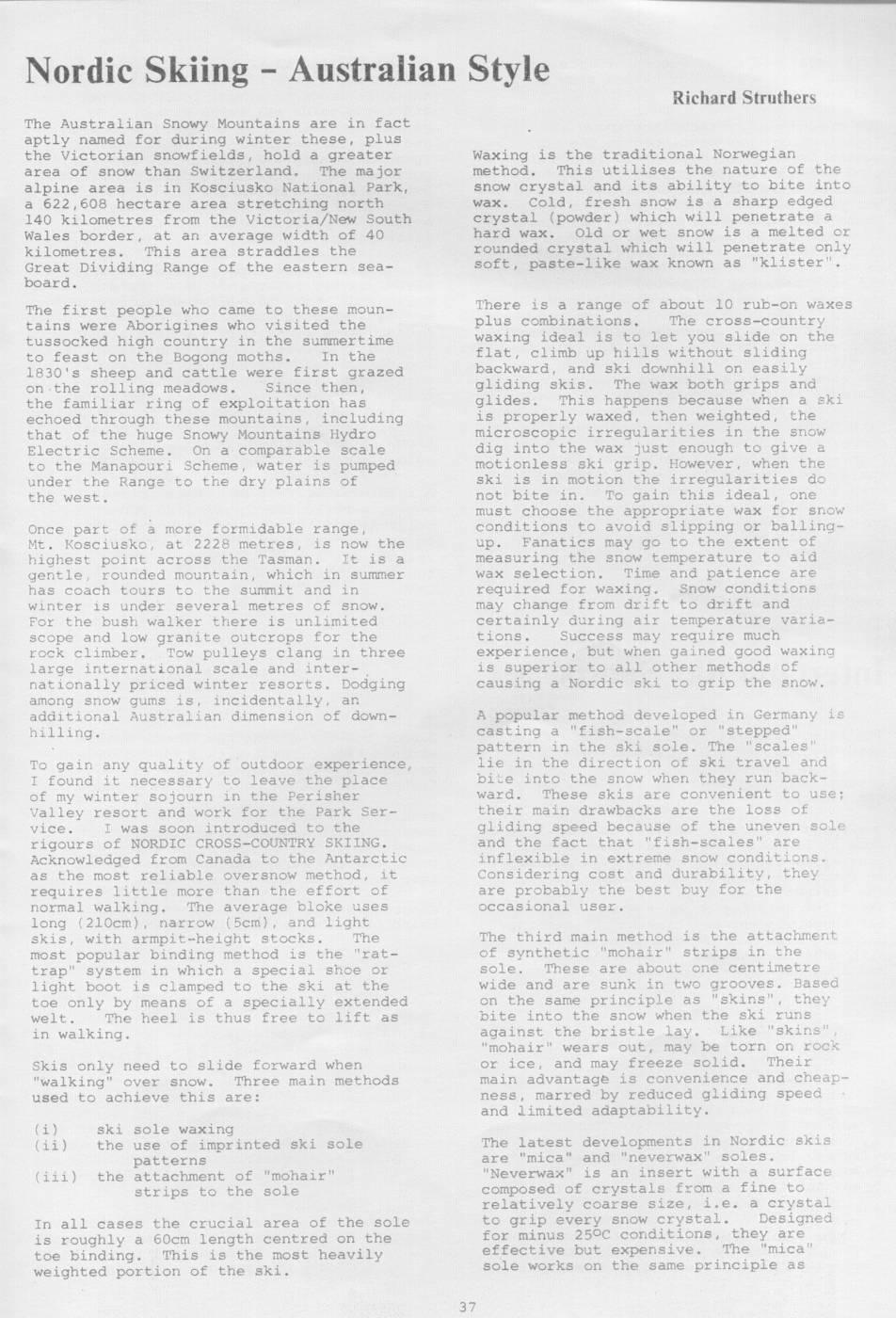
Nordic Skiing I Australian Style Richard Struthers The Australian Snowy Mountains are in fact aptly named for during winter these, plus the Victorian snowfields, hold a greater Waxing is the traditional Norwegian area of snow than Switzerland. The major method. This utilises the nature of the alpine area is in Kosciusko National Park, snow crystal and its ability to bite into a 622,608 hectare area stretching north wax. Cold, fresh snow is a sharp edged 140 kilometres from the Victoria/New South crystal (powder) which will penetrate a Wales border, at an average width of 40 hard wax. Old or wet snow is a melted or kilometres. This area straddles the rounded crystal which will penetrate only Great Dividing Range of the eastern seasoft, paste-like wax known as "klister". board. The first people who came to these moun- There is a range of about 10 rub-on waxes tains were Aborigines who visited the plus combinations. The cross-country tussocked high country in the summertime waxing ideal is to let you slide on the to feast on the Bogong moths. In the flat, climb up hills without sliding 1830's sheep and cattle were first grazed backward, and ski downhill on easily on the rolling meadows. Since then, gliding skis. The wax both grips and the familiar ring of exploitation has glides. This happens because when a ski echoed through these mountains, including is properly waxed, then weighted, the that of the huge Snowy Mountains Hydro microscopic irregularities in the snow Electric Scheme. On a comparable scale dig into the wax just enough to give a to the Manapouri Scheme, water is pumped motionless ski grip. However, when the under the Range to the dry plains of ski is in motion the irregularities do the west. not bite in. To gain this ideal, one must choose the appropriate wax for snow Once part of a more formidable range, conditions to avoid slipping or balling- Mt. Kosciusko, at 2228 metres, is now the up. Fanatics may go to the extent of highest point across the Tasman. It is a measuring the snow temperature to aid gentle, rounded mountain, which in summer wax selection. Time and patience are has coach tours to the summit and in required for waxing. Snow conditions winter is under several metres of snow. may change from drift to drift and For the bush walker there is unlimited certainly during air temperature variascope and low granite outcrops for the tions. Success may require much rock climber. Tow pulleys clang in three experience, but when gained good waxing large international scale and interis superior to all other methods of nationally priced winter resorts. Dodging causing a Nordic ski to grip the snow. among snow gums is, incidentally, an additional Australian dimension of down- A popular method developed in Germany is hilling. casting a "fish-scale" or S stepped" pattern in the ski sole. The scales" To gain any quality of outdoor experience, lie in the direction of ski travel and I found it necessary to leave the place bite into the snow when they run backof my winter sojourn in the Perisher ward. These skis are convenient to use; Valley resort and work for the Park Sertheir main drawbacks are the loss of vice. I was soon introduced to the gliding speed because of the uneven sole rigours of NORDIC CROSS-COUNTRY SKIING. and the fact that "fish-scales" are Acknowledged from Canada to the Antarctic inflexible in extreme snow conditions. as the most reliable oversnow method, it Considering cost and durability, they requires little more than the effort of are probably the best buy for the normal walking. The average bloke uses occasional user. long (210cm), narrow (5cm), and light skis, with armpit-height stocks. The The third main method is the attachment most popular binding method is the "ratof synthetic 'mohair" strips in the trap" system in which a special shoe or sole. These are about one centimetre light boot is clamped to the ski at the wide and are sunk in two grooves. Based toe only by means of a specially extended on the same principle as skins", they welt. The heel is thus free to lift as bite into the snow when the ski runs in walking. against the bristle lay. Like "skins" "mohair" wears out, may be torn on rock Skis only need to slide forward when or ice, and may freeze solid. Their "walking" over snow. Three main methods main advantage is convenience and cheapused to achieve this are: ness, marred by reduced gliding speed and limited adaptability. (i) ski sole waxing (ii) the use of imprinted ski sole The latest developments in Nordic skis patterns are "mica" and "neverwax" soles. (iii) the attachment of "mohair" "Neverwax" is an insert with a surface strips to the sole composed of crystals from a fine to relatively coarse size, i.e. a crystal In all cases the crucial area of the sole to grip every snow crystal. Designed is roughly a 60cm length centred on the for minus 250C conditions, they are toe binding. This is the most heavily effective but expensive. The "mica" weighted portion of the ski. sole works on the same principle as
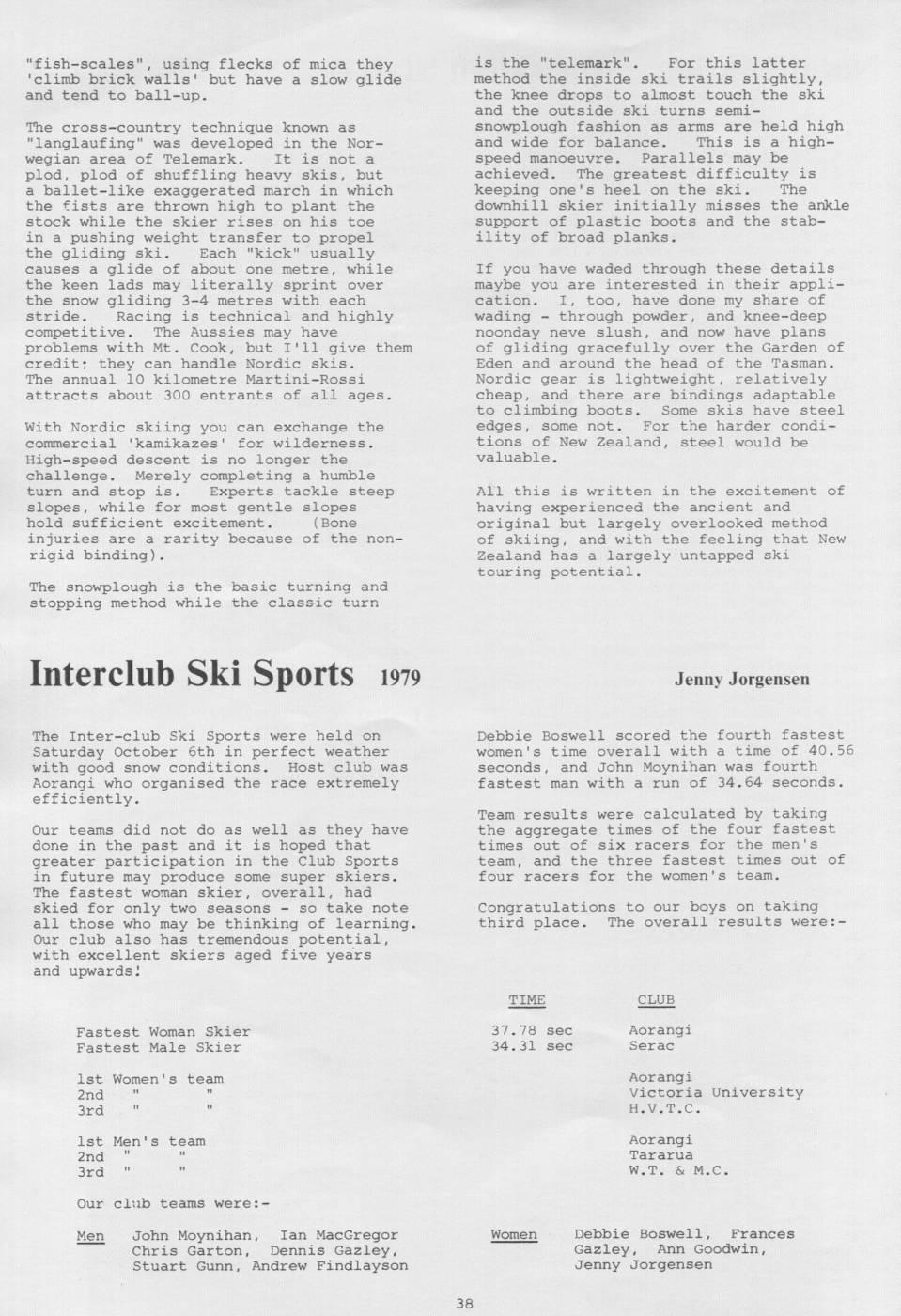
"fish-scales", using flecks of mica they is the "telemark". For this latter climb brick walls' but have a slow glide method the inside ski trails slightly, and tend to ball-up. the knee drops to almost touch the ski and the outside ski turns semi- The cross-country technique known as snowplough fashion as arms are held high "langlaufing" was developed in the Norand wide for balance. This is a highwegian area of Telemark. It is not a speed manoeuvre. Parallels may be plod, plod of shuffling heavy skis, but achieved. The greatest difficulty is a ballet-like exaggerated march in which keeping one's heel on the ski. The the fists are thrown high to plant the downhill skier initially misses the ankle stock while the skier rises on his toe support of plastic boots and the stabin a pushing weight transfer to propel ility of broad planks. the gliding ski. Each "kick" usually causes a glide of about one metre, while If you have waded through these details the keen lads may literally sprint over maybe you are interested in their applithe snow gliding 3-4 metres with each cation. I, too, have done my share of stride. Racing is technical and highly wading - through powder, and knee-deep competitive. The Aussies may have noonday neve slush, and now have plans problems with Mt. Cook, but I'll give them of gliding gracefully over the Garden of credit; they can handle Nordic skis. Eden and around the head of the Tasman. The annual 10 kilometre Martini-Rossi Nordic gear is lightweight, relatively attracts about 300 entrants of all ages. cheap, and there are bindings adaptable to climbing boots. Some skis have steel With Nordic skiing you can exchange the edges, some not. For the harder condicommercial kamikazes' for wilderness. tions of New Zealand, steel would be High-speed descent is no longer the valuable. challenge. Merely completing a humble turn and stop is. Experts tackle steep All this is written in the excitement of slopes, while for most gentle slopes having experienced the ancient and hold sufficient excitement. (Bone original but largely overlooked method injuries are a rarity because of the nonof skiing, and with the feeling that New rigid binding). Zealand has a largely untapped ski touring potential. The snowplough is the basic turning and stopping method while the classic turn Interclub Ski Sports 1979 Jenny Jorgensen The Inter-club Ski Sports were held on Debbie Boswell scored the fourth fastest Saturday October 6th in perfect weather women's time overall with a time of 40.56 with good snow conditions. Host club was seconds, and John Moynihan was fourth Aorangi who organised the race extremely fastest man with a run of 34.64 seconds. efficiently. Team results were calculated by taking Our teams did not do as well as they have the aggregate times of the four fastest done in the past and it is hoped that times out of six racers for the men's greater participation in the Club Sports team, and the three fastest times out of in future may produce some super skiers. four racers for the women's team. The fastest woman skier, overall, had skied for only two seasons so take note Congratulations to our boys on taking all those who may be thinking of learning. third place. The overall results were:- Our club also has tremendous potential, with excellent skiers aged five years and upwards! TIME CLUB Fastest Woman Skier 37.78 sec Aorangi Fastest Male Skier 34.31 sec Serac 1st Women's team Aorangi 2nd Victoria University 3rd H.V.T.C. 1st Men's team Aorangi 2nd Tararua 3rd W.T. & M.C. Our club teams were:- Men John Moynihan, Ian MacGregor Women Debbie Boswell, Frances Chris Garton, Dennis Gazley, Gazley, Ann Goodwin, Stuart Gunn, Andrew Findlayson Jenny Jorgensen
Comments
Comments are not open yet.