
This report is shown as scanned pages until a volunteer types it up. Skip to the machine-read text (unproofread), which a screen reader can read.
Machine-read text (unproofread)
Read from the scans by software, so it contains mistakes. Typing it up properly would help blind readers: use Suggest an edit.
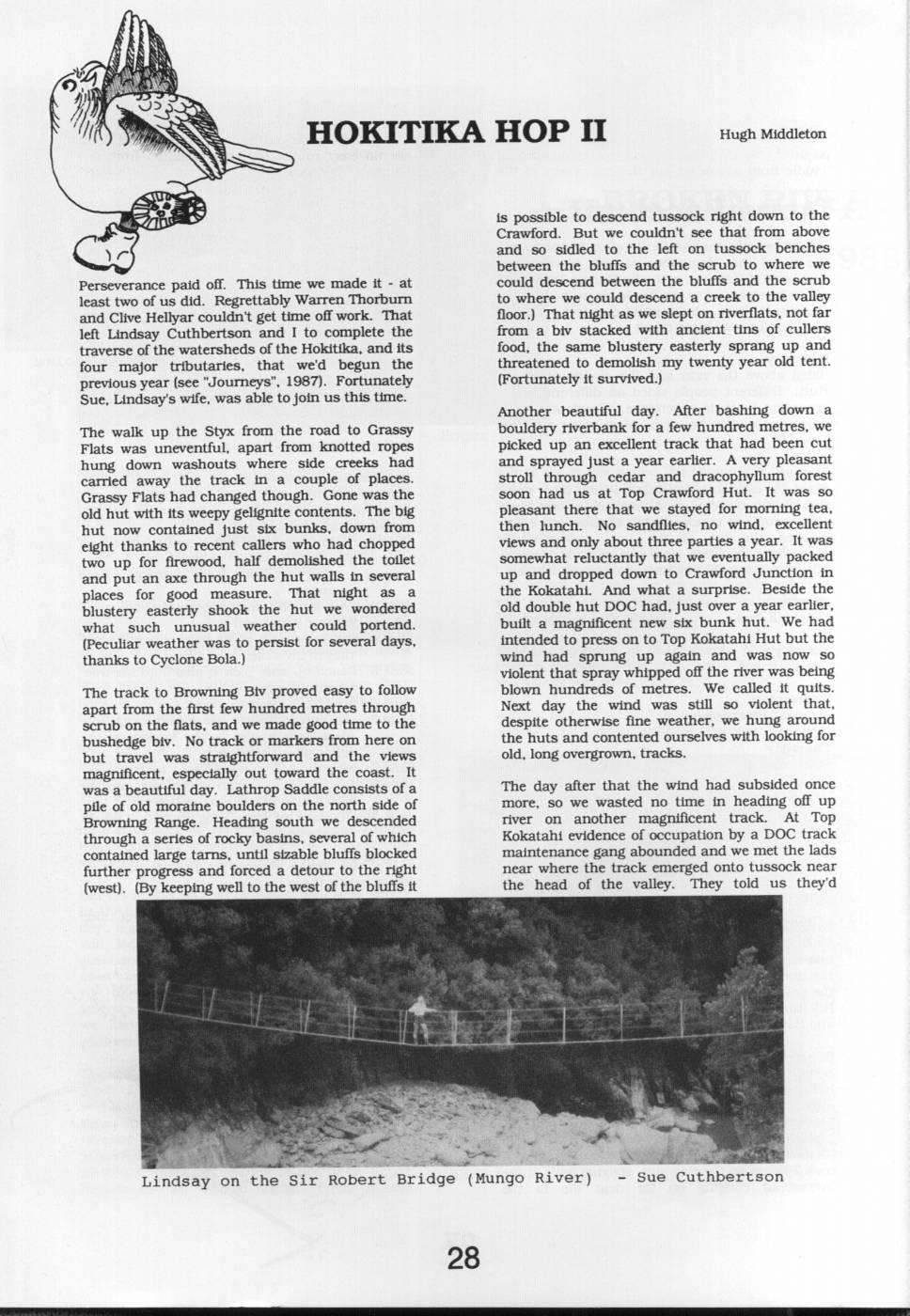
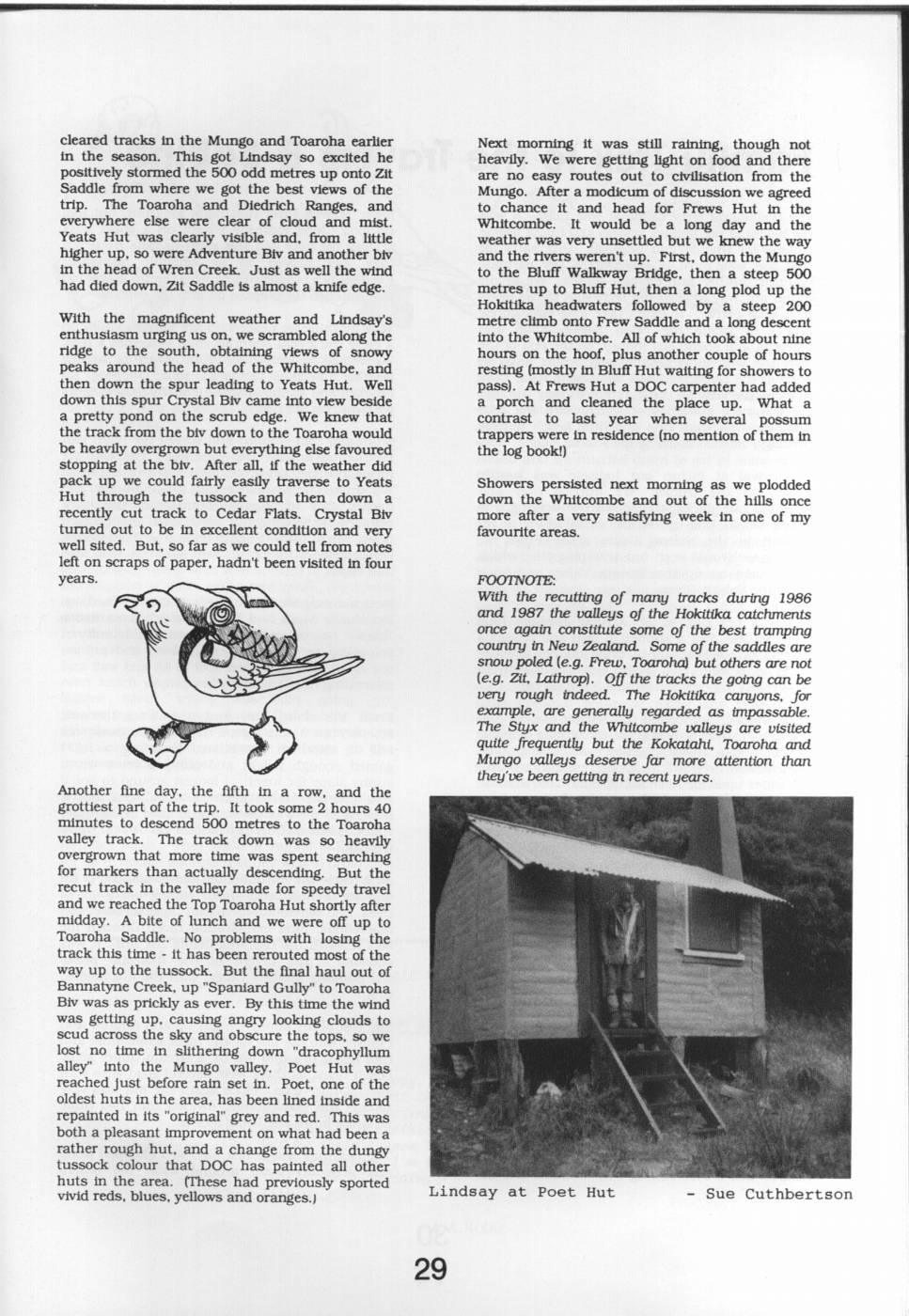
HOKITIKA HOP II Hugh Middleton is possible to descend tussock right down to the Crawford. But we couldn't see that from above and so sidled to the left on tussock benches between the bluffs and the scrub to where we Perseverance paid off. This time we made it at could descend between the bluffs and the scrub least two of us did. Regrettably Warren Thorburn to where we could descend a creek to the valley and Clive Hellyar couldn't get time off work. That floor.) That night as we slept on riverflats, not far left Lindsay Cuthbertson and I to complete the from a biv stacked with ancient tins of cullers traverse of the watersheds of the Hokitika, and its food, the same blustery easterly sprang up and four major tributaries, that we'd begun the threatened to demolish my twenty year old tent. previous year (see "Journeys", 1987). Fortunately Fortunately it survived.) Sue, Lindsay's wife, was able to join us this time. Another beautiful day. After bashing down a The walk up the Styx from the road to Grassy bouldery riverbank for a few hundred metres, we Flats was uneventful, apart from knotted ropes picked up an excellent track that had been cut hung down washouts where side creeks had and sprayed just a year earlier. A very pleasant carried away the track in a couple of places. stroll through cedar and dracophyllum forest Grassy Flats had changed though. Gone was the soon had us at Top Crawford Hut. It was so old hut with its weepy gelignite contents. The big pleasant there that we stayed for morning tea, hut now contained just six bunks, down from then lunch. No sandflies, no wind, excellent eight thanks to recent callers who had chopped views and only about three parties a year. It was two up for firewood, half demolished the toilet somewhat reluctantly that we eventually packed and put an axe through the hut walls in several up and dropped down to Crawford Junction in places for good measure. That night as a the Kokatahi. And what a surprise. Beside the blustery easterly shook the hut we wondered old double hut DOC had, just over a year earlier, what such unusual weather could portend. built a magnificent new six bunk hut. We had (Peculiar weather was to persist for several days, intended to press on to Top Kokatahi Hut but the thanks to Cyclone Bola.) wind had sprung up again and was now so violent that spray whipped off the river was being The track to Browning Biv proved easy to follow blown hundreds of metres. We called it quits. apart from the first few hundred metres through Next day the wind was still so violent that, scrub on the flats, and we made good time to the despite otherwise fine weather, we hung around bushedge biv. No track or markers from here on the huts and contented ourselves with looking for but travel was straightforward and the views old, long overgrown, tracks. magnificent, especially out toward the coast. It was a beautiful day. Lathrop Saddle consists of a The day after that the wind had subsided once pile of old moraine boulders on the north side of more, so we wasted no time in heading off up Browning Range. Heading south we descended river on another magnificent track. At Top through a series of rocky basins, several of which Kokatahi evidence of occupation by a DOC track contained large tarns, until sizable bluffs blocked maintenance gang abounded and we met the lads further progress and forced a detour to the right near where the track emerged onto tussock near (west). (By keeping well to the west of the bluffs it the head of the valley. They told us they'd de Lindsay on the Sir Robert Bridge (Mungo River) Sue Cuthbertson cleared tracks in the Mungo and Toaroha earlier Next morning it was still raining, though not in the season. This got Lindsay so excited he heavily. We were getting light on food and there positively stormed the 500 odd metres up onto Zit are no easy routes out to civilisation from the Saddle from where we got the best views of the Mungo. After a modicum of discussion we agreed trip. The Toaroha and Diedrich Ranges, and to chance it and head for Frews Hut in the everywhere else were clear of cloud and mist. Whitcombe. It would be a long day and the Yeats Hut was clearly visible and, from a little weather was very unsettled but we knew the way higher up, so were Adventure Biv and another biv and the rivers weren't up. First, down the Mungo in the head of Wren Creek. Just as well the wind to the Bluff Walkway Bridge, then a steep 500 had died down, Zit Saddle is almost a knife edge. metres up to Bluff Hut, then a long plod up the Hokitika headwaters followed by a steep 200 With the magnificent weather and Lindsay's metre climb onto Frew Saddle and a long descent enthusiasm urging us on, we scrambled along the into the Whitcombe. All of which took about nine ridge to the south, obtaining views of snowy hours on the hoof, plus another couple of hours peaks around the head of the Whitcombe, and resting (mostly in Bluff Hut waiting for showers to then down the spur leading to Yeats Hut. Well pass). At Frews Hut a DOC carpenter had added down this spur Crystal Biv came into view beside a porch and cleaned the place up. What a a pretty pond on the scrub edge. We knew that contrast to last year when several possum the track from the biv down to the Toaroha would trappers were in residence (no mention of them in be heavily overgrown but everything else favoured the log book!) stopping at the biv. After all, if the weather did pack up we could fairly easily traverse to Yeats Showers persisted next morning as we plodded Hut through the tussock and then down a down the Whitcombe and out of the hills once recently cut track to Cedar Flats. Crystal Biv more after a very satisfying week in one of my turned out to be in excellent condition and very favourite areas. well sited. But, so far as we could tell from notes left on scraps of paper, hadn't been visited in four years. FOOTNOTE: With the 2 ) recutting of many tracks during 1986 ( and 1987 the valleys of the Hokitika catchments once again constitute some of the best tramping country in New Zealand. Some of the saddles are snow poled (e.g. Frew, Toaroha) but others are not (e.g. Zit, Lathrop). Off the tracks the going can be very rough indeed. The Hokitika canyons, for example, are generally regarded as impassable. The Styx and the Whitcombe valleys are visited quite frequently but the Kokatahi, Toaroha and Mungo valleys deserve far more attention than they've been getting in recent years. Another fine day, the fifth in a row, and the grottiest part of the trip. It took some 2 hours 40 minutes to descend 500 metres to the Toaroha valley track. The track down was sO heavily overgrown that more time was spent searching for markers than actually descending. But the recut track in the valley made for speedy travel and we reached the Top Toaroha Hut shortly after midday. A bite of lunch and we were off up to Toaroha Saddle. No problems with losing the track this time it has been rerouted most of the way up to the tussock. But the final haul out of Bannatyne Creek, up "Spaniard Gully" to Toaroha Biv was as prickly as ever. By this time the wind was getting up, causing angry looking clouds to scud across the sky and obscure the tops, so we lost no time in slithering down "dracophyllum alley" into the Mungo valley. Poet Hut was reached just before rain set in. Poet, one of the oldest huts in the area, has been lined inside and repainted in its "original" grey and red. This was both a pleasant improvement on what had been a rather rough hut, and a change from the dungy tussock colour that DOC has painted all other huts in the area. (These had previously sported vivid reds, blues, yellows and oranges.) Lindsay at Poet Hut Sue Cuthbertson
Comments
Comments are not open yet.