
This report is shown as scanned pages until a volunteer types it up. Skip to the machine-read text (unproofread), which a screen reader can read.
Machine-read text (unproofread)
Read from the scans by software, so it contains mistakes. Typing it up properly would help blind readers: use Suggest an edit.
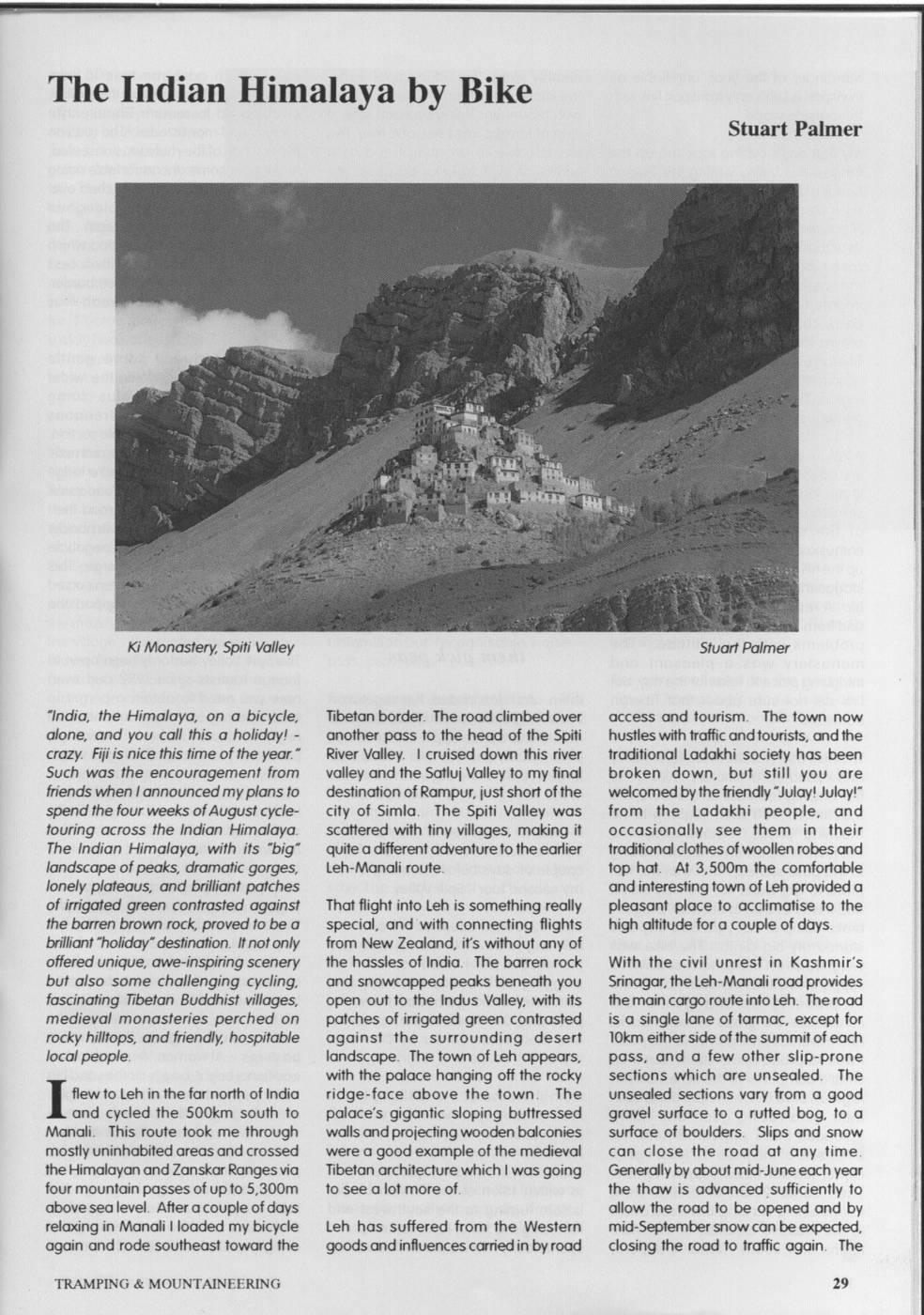
The Indian Himalaya by Bike Stuart Palmer Ki Monastery, Spiti Valley Stuart Palmer "India, the Himalaya, on a bicycle, Tibetan border. The road climbed over access and tourism. The town now alone, and you call this a holiday! - another pass to the head of the Spiti hustles with traffic andtourists, andi the crazy. Fiji is nice this time of the year." River Valley. cruised down this river traditional Ladakhi society has been Such was the encouragement from valley and the Satluj Valley to my final broken down, but still you are friends whenlannouncedi myp plans to destination of Rampur, just short off the welcomedt byt the friendly' Julay!Julay!" spendi the four weeks of August cycle- city of Simla. The Spiti Valley was from the Ladakhi people, and touring across the Indian Himalaya. scattered with tiny villages, making it occasionally see them in their The Indian Himalaya, with its "big" quitea different adventureto the earlier traditional clothes sofwoollenrobesand landscape of peaks, dramatic gorges, Leh-Manali route. top hat. At 3,500m the comfortable lonely plateaus, and brilliant patches and interesting town of Leh provided a of irrigated green contrasted against That flight into Leh is something really pleasant place to acclimatise to the thel barren brown rock, proved to be a special, and with connecting flights high altitude for a couple of days. brilliant "holiday" destination. Itnot only from New Zealand, it's without any of offered unique, awe-inspiring scenery the hassles of India. The barren rock With the civil unrest in Kashmir's but also some challenging cycling, and snowcapped peaks beneath you Srinagar, thel Leh-Manali road provides fascinating Tibetan Buddhist villages, open out to the Indus Valley, with its the main cargo route intol Leh. Thei road medieval monasteries perched on patches of irrigated green contrasted is a single lane of tarmac, except for rocky hilltops, and friendly, hospitable against the surrounding desert 10km either side of the summit of each local people. landscape. The town of Leh appears, pass, and a few other slip-prone with the palace hanging off the rocky sections which are unsealed. The flewt to Leh in the far north of India ridge-face above the town. The unsealed sections vary from a good and cycled the 500km south to palace's gigantic sloping buttressed gravel surface to a rutted bog, to a Manali. This route took me through walls and projecting wooden balconies surface of boulders. Slips and snow mostly uninhabited areas and crossed were a good example of the medieval can close the road at any time. thel Himalayan and Zanskar Ranges via Tibetan architecturer which I was going Generallyby about mid-Juner eachy year four mountain passes of upto 5,300m to see a lot more of the thaw is advanced sufficiently to above: seal level. After acouple of days allow the road to be opened and by relaxing in Manali loaded my bicycle Leh has suffered from the Western mid-September snow can be expected, again and rode southeast toward the goodso andinfluences carriedinbyroad closing the road to traffic again. The TRAMPING & MOUNTAINEERING remainder of the year, unreliable air deathly silent, "big" landscape! Forty- route which gave me time to take transport isl Leh's only transport link with fivel kilometres of brown, barren plains various side trips out of the valley, the outside world. with mountains rising up each side, a climbing up to remote Tibetan-style strip of tarmac, my bike, and me. The villages and monasteries. The road on My first day's cycling took me up the plains came to an abrupt end as a thet first half off the route was unsealed, fertile Indus Valley visiting the Tibetan series of switchbacks dropped me making for some uncomfortable riding Buddhist monasteries of Shey and Tikse down to a river and my campsite. as the bike bounced and lurched over en route. The fifteenth century Tikse the rough surface and ploughed Monastery was a spectacular site, with Another three mountain passes, and through fords of unknown depth. The its various buildings stacked up the a total of 520km and seven days second half was a military road which rocky bluff. The view from the cycling, took me across the Zanskar provides the Indian Army with access monastery of the Indus Valley of and Himalaya Ranges to Manali. The to the sensitive Chinese (Tibet) border. irrigated green crops of barley and final descent from the Rohtang-la at To my relief, this military road was peas, contrasted against the barren 4,000m to Manali at 2,000m over a sealed. brown landscape, was superb. The distance of 50km deserves special Tibetan butter tea was a taste yet to be mention. Three hours of watching the The road included some gentle acquired! The common hot drink in the scenery go by, occasionally pumping sections of cruising down the wider region, Tibetan tea is brewed with a the brakes, and rarely pushing a few braided river valley, plus some generous lump of butter and salt. pedal strokes. On thel Pass there were spectacular and more strenuous patchy, short, alpine grasses and sections. Over one memorable section, AI lesson was learned at the end ofthat flowers, and ponies grazing. Below the the river valley narrowed to a dramatic first day's cycling two days at 3,500m pass there were dramatic glacial-cut gorge of sheer rockfaces, and al ledge is not long enough to acclimatise for rockfaces, perhaps 300m high, with hadbeen cut to support the road some strenuous cycling. The last kilometre narrow waterfalls cascading down 200m above the river. The road then of the day was spent with two spiralled into a series of switchbacks enthusiastic local boys pushing my bike to descend to the river and negotiate I spent the next hour up thel hilli tol Hemisl Monastery, with me the next section of narrow gorge. This staggering behind, gasping in the thin with her and her three time at tunnel-like slothad been carved air. A rest day at Hemis did the trick, in the sheer rockface to support the andi from then onldidn'thave any real companions, helping road. problems with the altitude. The monastery was a pleasant and them pick peas The Spiti Valley has only been open to intriguing place to relaxt for the day, but foreign tourists since 1992 and even I'm still not sure about that Tibetan them. Asl descended, the vegetation now you need to obtain a permit to butter tea. became greener and lusher. Down at enter the region. Consequently, the Manali there were apple orchards and region doesn't feel "touristy", The next day, Ileft thel Indus River Valley pine forests, and the river boiled over particularly in the small villages which and cycled up a tributary toward the large boulders offering some coolness a bicycle allows you to pause in, or first and highest pass on ther route, the in the warm, thick, low altitude air. even stay in, while the daily public bus 5,328m (17,600 feet) Taglang-la (la lurches and bounces through. Traffic meaning "pass"). I made camp that In Manali I enjoyed a long overdue on the road was limited to onel bus plus dayjust! before the switchbacks leading shower and relaxed and ate for a a few trucks each day. to the pass started. This was the last couple of days before heading off on place to get water for the next 95km my: second tour Spiti Valley. lenjoyed stopping and making broken and it was 260km to the next village. I English conversation with the locals. broke camp at first light next day and That 2,000m descent from the There was a shepherd spending the started my big climb. The bike was Rohtang-la down to Manali was very day sitting on the summit of the weighed down more than usual with a picturesque but I wasn't SO keen on Kunzum-la(4,550mlwatching his flock. supply off five litres ofwater. Fourt hours slogging all the way back up, SO I He and many other shepherds migrate of plodding up the gentle but concededto taking gal bus back overi the from their homes in the Kulu Valley, continuous 5% grade of switchbacks pass and continued to the southeast 200km away, for one or two months and traverses brought me to the pass. and the Tibetan border by bike from each summer to graze these alpine I was SO proud of my effort! But then there. pastures. A woman dressed in her what a dampener to the achievement! traditional bright, baggy dothesandbig AG group of 18 Dutch cyclists dressed in From the base of the Rohtang-la the smile stopped me on the road to give their lycra racing gear, and riding road climbed up a river valley andover me a huge handful of fresh peas. I unloaded bikes appeared from the the Kunzum-la at 4,550m. From the spent the next hour with her and her other side of the pass. At least I got a Kunzum-la the route continued three companions, helping them pick cup of tea from their support vehicle. southeasti following the Spiti River down peas. Our conversation didn't get past Then came 20km of exhilarating to within 15km of the Tibetan border smiles and basic sign language but freewheeling via long traverses down before turning to the southwest and their hospitality was communicated. to the massive expanse of the More following the Satluj River to Rampur. I On another occasion there was a group Plains at 4,500m. What a superb, spent nearly two weeks on this 560km ofl high-spirited children and women at TRAMPING & MOUNTAINEERING the 1,000 year old Tabo Monastery singing and joking as they laboured shifting boulders. They loved the novelty of some assistance from this tall, fair-haired foreigner. The 73 year old head monk at Dankar Monastery, who had fled the Chinese invasion of Tibet in 1959, invited mei intol his home for Tibetan butter tea. Luckilylwas atl least able to tolerate this strange brewbyt this stage. Such gentle, welcoming people. The larger village of Nako was typical of the Tibetan-style villages in the region. At an altitude of3,700m, Nako is located 600m above Spiti Valley children the Spiti Valley floor and has as superb backdropof: snowcapped parka, which tends to filter rather than followed, but within twenty minutes I peaks. Ispent an afternoon wandering repel rain, took on the elements. Five was comfortable in my own room at the maze of narrowt footpaths between kilometres later there was that the camp, complete with BBC TV anda the village's flat-roofed stone houses. unfamiliar but recognisable noise hot shower. Prayer flags flew from each rooftop. psss, psss, psss puncture! Donkeys, COWS and goats sat in corrals The rain continued for the next two alongside or beneath the houses. Repairs completed, - battled on. The days. The camp's good food and Prayer walls of inscribed stones divided roadremained dramatic, with it carved comfort was some conciliation for the the narrow footpaths. The chanting of into the walls of the gorge-like valley frustration. The frightening roar of the monks and blasting of trumpets These deforested, steep, valley walls river below the camp and an active sounded from the monastery. What a are prone to slipping at the best of rockslide a hundred metres time warp! This could have been 500 times, but weakened by the road- downstream, was more than enough years ago. The people of this village cuttings, it only takes a common to convince me that attemptingto move and others in the region live a life a monsoon rainfall to trigger numerous on was not an option. The rain stopped world apart from ours. They spendi the slips. I dodged a few boulders and it dawned a beautiful, clear day I summer months of June, July and deposited on part ofther road and then farewelled my Canadian friends and August growing and harvesting their saw the occasional rock fall and spent the next two hours pushing and crops of peas and barley. During the bounce across the road. I started to carrying myl loaded bike over five: slips. remaining 9 months of the year there question how wise it was to be Once over these slips the road was is no work to be done. They stay negotiating these roads in the rain. My clear, and all mine. No other vehicles indoors sheltering from the harsh cycle helmet didn't really offer much could pass the slips. Fifty kilometres of winter, and visit the monasteries to protection. Iwas then stopped by the fast downhill riding endedi my cycle tour enjoy the various traditional festivals. police. "Government Security. You at the planned destination of Rampur cannot go any further. A big slip has Such an adventure wouldn't be blocked the road." I enquired where I From Rampur it was 500km and 20 complete without a few special could get shelter and al bed. Within two hours off trying bus travel to Delhi Lone difficulties or challenges along the way. minutes my bike was on the back of a travel by public transport in India with With only a day's ride to my final ute and Bill, who worked for a luggage offour separate panniers plus destination I was looking forward to Canadian construction company on a a bicycle is definitely not recording in my diary that I had nearby hydro power project, was recommended! The trip was completed 1,100km of cycling in the driving me back the way I had come completed with frustration but without Indian Himalaya without incident - no towardt the construction camp. Wel had incident a small price to pay for an illness, no mechanical problems, not only travelled 2km when the road was amazing month's adventure! even a puncture! It wasn't to be. The blockedi by another major slip. Trapped last day dawned with continual late between two slips! No problem, Bill Now where next year? It won't bea monsoon rainfall. Dressedinr my reflex knew another route. A hair-raising ride Pacific Island beach! TRAMPING & MOUNTAINEERING
Comments
Comments are not open yet.