
This report is shown as scanned pages until a volunteer types it up. Skip to the machine-read text (unproofread), which a screen reader can read.
Machine-read text (unproofread)
Read from the scans by software, so it contains mistakes. Typing it up properly would help blind readers: use Suggest an edit.
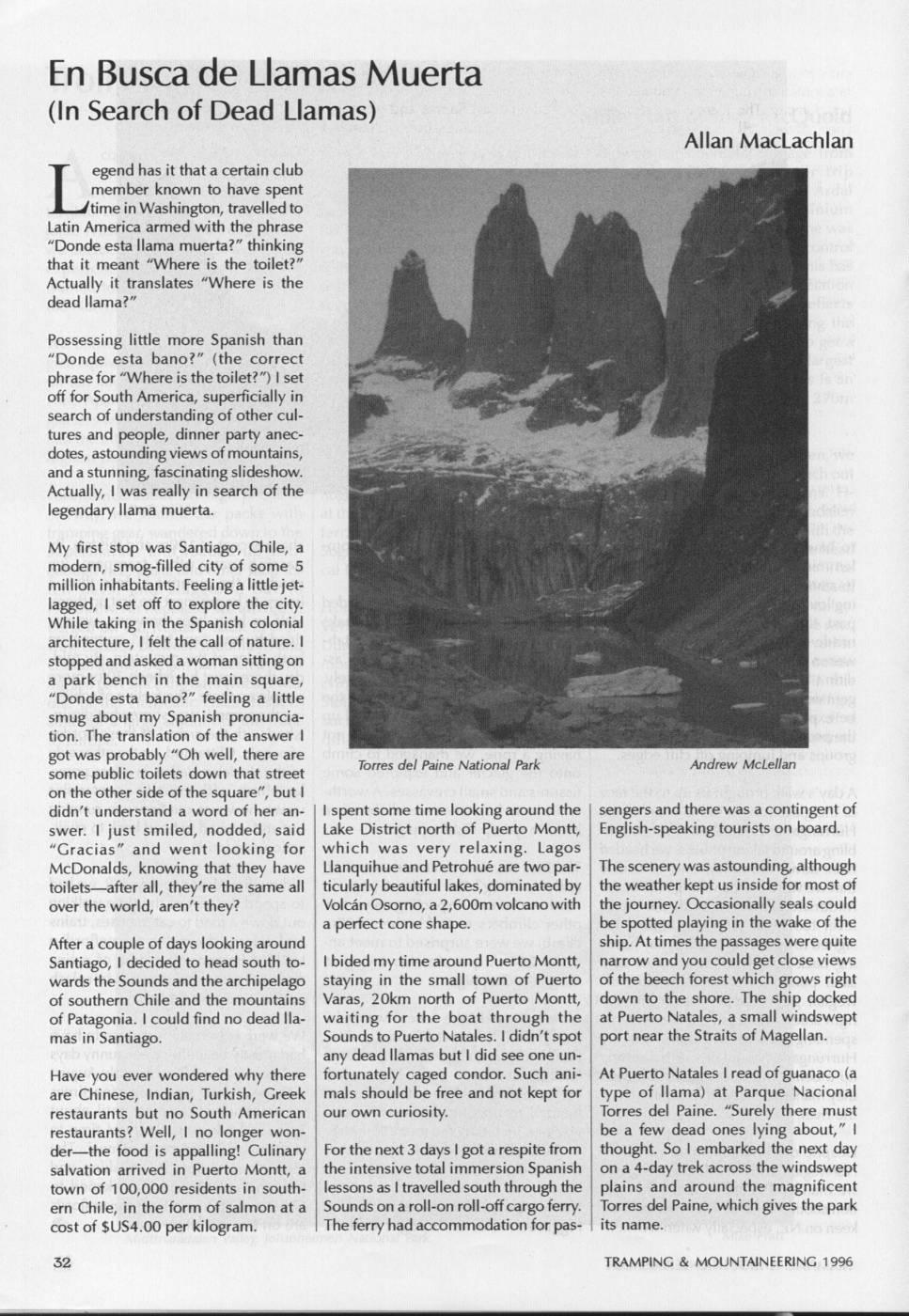
En Busca de Llamas Muerta (In Search of Dead Llamas) Allan MacLachlan egend has it that a certain club member known to have spent time in Washington, travelled to Latin America armed with the phrase "Donde esta llama muerta?" thinking that it meant "Where is the toilet?" Actually it translates "Where is the dead llama?" Possessing little more Spanish than "Donde esta bano?" (the correct phrase for "Where is the toilet?") I set off for South America, superficially in search of understanding of other cultures and people, dinner party anecdotes, astounding views of mountains, and a stunning fascinating slideshow. Actually, I was really in search of the legendary llama muerta. My first stop was Santiago, Chile, a modern, smog-filled city of some 5 million inhabitants. Feeling a littlej jetlagged, I set off to explore the city. While taking in the Spanish colonial architecture, I felt the call of nature. I stopped and asked a woman sitting on a park bench in the main square, "Donde esta bano?" feeling a little smug about my Spanish pronunciation. The translation of the answer I got was probably "Oh well, there are Torres del Paine National Park Andrew McLellan some public toilets down that street on the other side of the square", but I didn't understand a word of her an- I spent some time looking around the sengers and there was a contingent of swer. 1 just smiled, nodded, said Lake District north of Puerto Montt, English-speaking tourists on board. "Gracias" and went looking for which was very relaxing. Lagos McDonalds, knowing that they have Llanquihue and Petrohué are two par- The scenery was astounding, although toilets-after all, they're the same all ticularly beautiful lakes, dominated by the weather kept us inside for most of over the world, aren't they? Volcân Osorno, a 2,600m volcano with the journey. Occasionally seals could a perfect cone shape. be spotted playing in the wake of the After a couple of days looking around ship. At times the passages were quite Santiago, I decided to head south to- Ibidedi myt time around PuertoMontt, narrow and you could get close views wards the Sounds and the archipelago staying in the small town of Puerto of the beech forest which grows right of southern Chile and the mountains Varas, 20km north of Puerto Montt, down to the shore. The ship docked of Patagonia. I could find no dead lla- waiting for the boat through the at Puerto Natales, a small windswept mas in Santiago. Sounds to Puerto Natales. Ididn'tspot port near the Straits of Magellan. any dead llamas but I did see one un- Have you ever wondered why there fortunately caged condor. Such ani- At Puerto Natales Iread of guanaco (a are Chinese, Indian, Turkish, Greek mals should be free and not kept for type of llama) at Parque Nacional restaurants but no South American our own curiosity. Torres del Paine. "Surely there must restaurants? Well, I no longer wonbe a few dead ones lying about, I - der-the food is appalling! Culinary For the next 3 days I got a respite from thought. So I embarked the next day salvation arrived in Puerto Montt, a thei intensive total immersion Spanish on a 4-day trek across the windswept town of 100,000 residents in south- lessons as travelled south through the plains and around the magnificent ern Chile, in the form of salmon at a Sounds on a roll-on roll-off cargo ferry. Torres del Paine, which gives the park cost of $US4.00 per kilogram. The ferry had accommodation for pas- its name. TRAMPING & MOUNTAINEERING 1996
You get a glimpse of the size of the occasional settlement, cropping of plorer, "Bingham", in the 1920s. To- Patagonian ice cap when you see the Oregano, and some herds of domes- day it is one of the major tourist at- Grey Glacier. The Torres only allowed ticated alpacas, llamas and guanaco. tractions in Peru. Its intricate stonea peek at their tall granite spires which Despite the proliferation of llamas I worki is a miracle over the technology poke 3,500m into the sky. Despite was not able, in my brief visit, to lo- oft thet time, ande even today many theoseeing many guanacos and some mis- cate any legendary llamas muerta. ries abound as to why Machu Picchu chievous, playful zoro (a type of fox), was abandoned and subsequently for- I failed to see any "llamas muerta". As I was reading the Peru chapter of gotten. As with much of the Inca civilimy guidebook, I came across a sec- sation, most of what we "know" about Across the border in Calafate the tion about the renowned Inca civilisa- the Incas is conjecture. search continued. From Calafate I tion which flourished briefly in the went on a dayt trip to the PeritoMoreno 15th and 16th centuries. Thel Inca were All I saw of llamas at Machu Picchu Glacier. As the glacier advanced in dominant in what we now know as was llamas procreating, and no "llaprevious years it blocked the outlets Peru and were more or less obliter- mas muerta' ". The trail, however, was ofone oft thet twol lakes it created, caus- ated by the Spanish colonists in the getting stronger; talking to other touring the lake to build up until the gla- 16th century. ists they said there was definitely Ilacier gave way through a tunnel ofice. mas muerta in Bolivia. As the glacier is no longer advancing My guidebook said that the Inca used and is now retreating, this phenom- llama as offerings to the sun god "Sol". I caught a bus to Copacabana, on the enon has not occurred in the last 8 Inspired by this paragraph, I decided shores of Lake Titicaca. Lake Titicaca years. to head for Machu Picchu, Inca ruins is claimed to be thel highest navigable discovered only this century and lake in the world. Copacabana is a Eastern Patagonia is a dry, windswept, thought to be a spiritual centre for the small town just inside the Bolivian tussock-covered land. Its fragility is Inca civilisation. border. took a boat to the Isla del Sol threatened by over-grazing of sheep (Island of the Sun) and spent the night which are farmed on huge ranches. As I caught a taxi across the border to there, gazing at the brilliantly clear, this area is thinly populated (even with Tacna in Peru, then caught a bus to sky. At 3,800m the air is incredibly huge numbers of sheep), I did not find Arequipa, Peru's second largest city- clear, and the waters of Lake Titicaca any "llamas muerta". a city ofa about 1 million people. spent a brilliant blue. a couple of days here admiring the Inext heard that some llamas muerta Spanish architecture, then caught the The Isla del Sol is credited by thel Inca had succumbed to llama disease at train to Cuzco. Cuzco was the admin- with being the birthplace of the sun, CerroAconcagua, the tallest mountain istrative centre of the Inca civilisation and the nearby Isla del Luna (Island of in South America. Iwent for a day walk and is now a city of some 300,000 in- thel Moon) thel birthplace of the moon. along the track towards thel base camp; habitants. I visited many of the Inca lenjoyed the time on the Isla del Solhowever, the llamas muerta must have ruins around Cuzco, and organised a a chance to relax and watch the world been scavenged by the condors. There 4-day trek on the Inca Trail to Machu go by. are probably now some condors suc- Picchu. cumbing to Crazy Condor sickness. It was in the tourist shops of The trek was well-organised. For Copacabana that the trail of the Ila- Next stop was the Atacama Desert in $US60.00 we had guides and porters mas muerta got stronger; however, it northern Chile. I stopped at Arica, a who carried the tents, put them up, wasn'tuntil reached La Paz, the capicity of 200,000 people on the Pacific and provided and cooked the food. It tal of Bolivia, that I finally found the Coast. The city receives no rainfall at was excellent to gett food presented to elusive llamas muerta. Whilst looking all, and even up on the Altiplano there you at lunchtime, and at the end of around for souvenirs of my travels, I is only 1mm ofr rain each year. The city the day. The trek itself was not par- spotted the llamas muerta hidingi in a is watered by a pipeline from snow- ticularly strenuous, although the climb corner of a shop. Admittedly, they melt in the Andes. Arica is a major port to 4,200m on the second day took its were a lot smaller and significantlyless for Bolivian exports and imports. The toll. animated than the llamas I had seen city was formerly part of Bolivia but elsewhere, but these were definitely became Chilean in the "War of thel Pa- The track follows the Inca Trail to llamas muerta. I parted with my Bs5 cific". Machu Picchu through tropical (SUS1.00) and spent the rest of my rainforest, crossing 3 passes (although time in La Paz sitting in cafés, and From Arica I went on a tour through the third is not SO noticeable as the wandering around the plazas watchthe Atacama Desert to thel Altiplano, a climb is only 100-200m). There are ing the snake-oil merchants ply their plateau 3,000-4,000m above sea many ruins of settlements and sentry wares. level. At sea level the desertis almost posts along the trail which culminates completely barren, with no sign of in Machu Picchu itself on the fourth My mission was now completeplant life; as the altitude increases cac- day. hopefully with plenty of dinner party tus candelabros begins to dot the landanecdotes ("when I was last in scape. Up on the Altiplano, irrigation Machu Picchu was only rediscovered Peru...' ") and the awesome slideshow from snowmelt streams supports the early this century by an American ex- yet to be processed. TRAMPING & MOUNTAINEERING 1996
Comments
Comments are not open yet.