
This report is shown as scanned pages until a volunteer types it up. Skip to the machine-read text (unproofread), which a screen reader can read.
Machine-read text (unproofread)
Read from the scans by software, so it contains mistakes. Typing it up properly would help blind readers: use Suggest an edit.
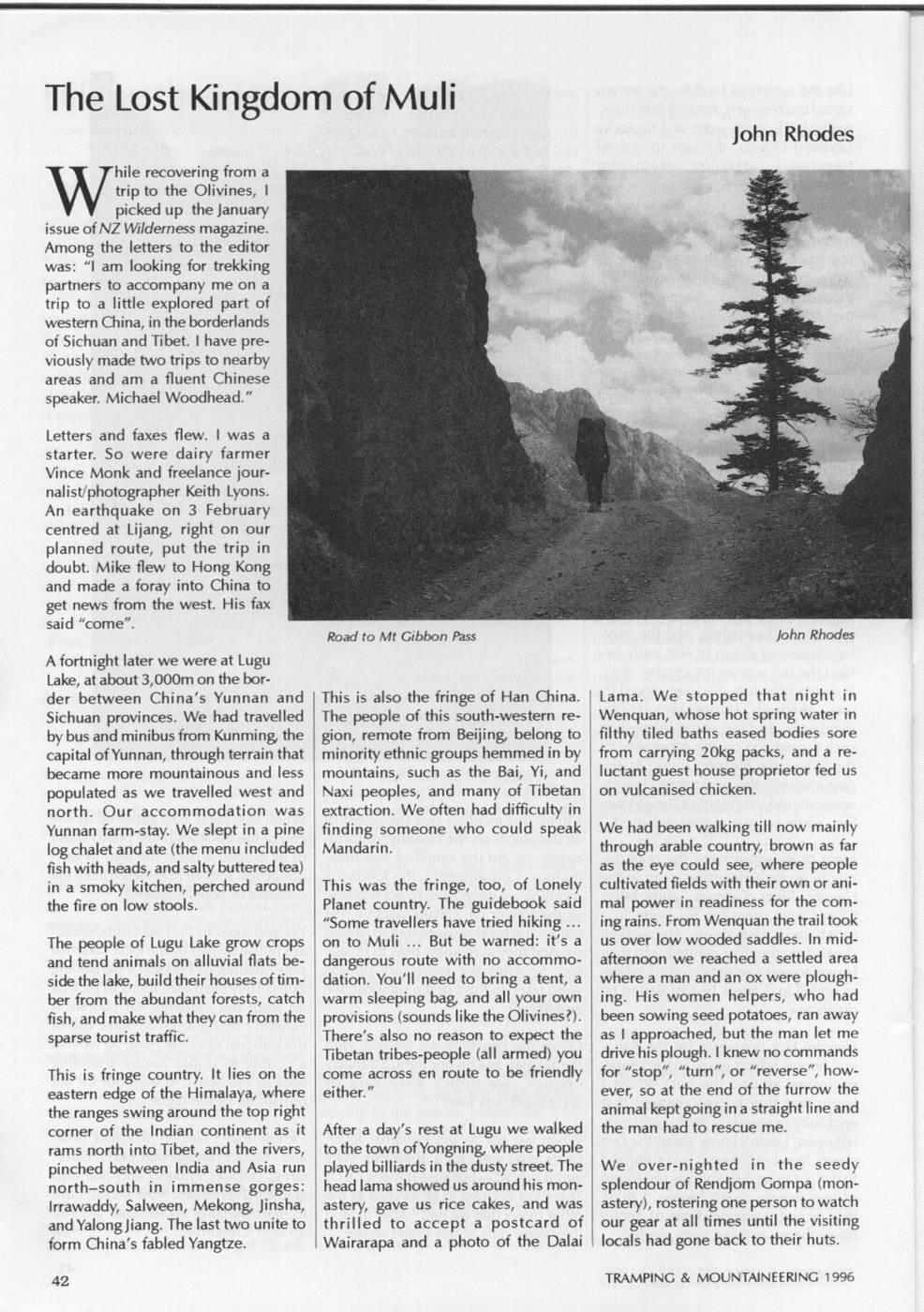
The Lost Kingdom of Muli John Rhodes Thile recovering from a A A I trip to the Olivines, I picked up the January issue ofNZ Wilderness magazine. Among the letters to the editor was: "I am looking for trekking partners to accompany me on a trip to a little explored part of western China, in thel borderlands of Sichuan and Tibet. I have previously made two trips to nearby areas and am a fluent Chinese speaker. Michael Woodhead." Letters and faxes flew. I was a starter. So were dairy farmer Vince Monk and freelance journalist/photographer Keith Lyons. An earthquake on 3 February centred at Lijang, right on our planned route, put the trip in doubt. Mike flew to Hong Kong and made a foray into China to get news from the west. His fax said "come". Road to Mt Gibbon Pass John Rhodes Af fortnight later we were at Lugu Lake, at about 3,000m on the border between China's Yunnan and This is also the fringe of Han China. Lama. We stopped that night in Sichuan provinces. We had travelled The people of this south-western re- Wenquan, whose hot spring water in byb bus and minibus from Kunming the gion, remote from Beijing, belong to filthy tiled baths eased bodies sore capital ofYunnan, through terrain that minority ethnic groups hemmed in by from carrying 20kg packs, and a rebecame more mountainous and less mountains, such as the Bai, Yi, and luctant guest house proprietor fed us populated as we travelled west and Naxi peoples, and many of Tibetan on vulcanised chicken. north. Our accommodation was extraction. We often had difficulty in Yunnan farm-stay. We slept in a pine finding someone who could speak We had been walking till now mainly log chalet and ate (the menu included Mandarin. through arable country, brown as far fish with heads, and salty buttered tea) as the eye could see, where people in a smoky kitchen, perched around This was the fringe, too, of Lonely cultivated fields with their own or anithe fire on low stools. Planet country. The guidebook said mal power in readiness for the com- "Some travellers have tried hiking ing rains. From Wenquan the trail took The people of Lugu Lake grow crops on to Muli But be warned: it's a us over low wooded saddles. In midand tend animals on alluvial flats be- dangerous route with no accommo- afternoon we reached a settled area side the lake, build their houses of tim- dation. You'll need to bring a tent, a where a man and an OX were ploughber from the abundant forests, catch warm sleeping bag, and all your own ing. His women helpers, who had fish, and make what they can from the provisions (sounds like the Olivines?). been sowing seed potatoes, ran away sparse tourist traffic. There's also no reason to expect the as I approached, but the man let me Tibetan tribes-people (all armed) you drive his plough. Iknew no commands This is fringe country. It lies on the come across en route to be friendly for "stop", "turn", or "reverse", howeastern edge of the Himalaya, where either.' ever, So at the end of the furrow the the ranges swing around the top right animal kept going in a straight line and corner of the Indian continent as it After a day's rest at Lugu we walked the man had to rescue me. rams north into Tibet, and the rivers, to the town ofYongning where people pinched between India and Asia run played billiards in the dusty street. The We over-nighted in the seedy north-south in immense gorges: head lama showed us around his mon- splendour of Rendjom Gompa (mon- Irrawaddy, Salween, Mekong, Jinsha, astery, gave us rice cakes, and was astery), rostering one person to watch and YalongJiang. The last two unite to thrilled to accept a postcard of our gear at all times until the visiting form China's fabled Yangtze. Wairarapa and a photo of the Dalai locals had gone back to their huts. TRAMPING & MOUNTAINEERING 1996
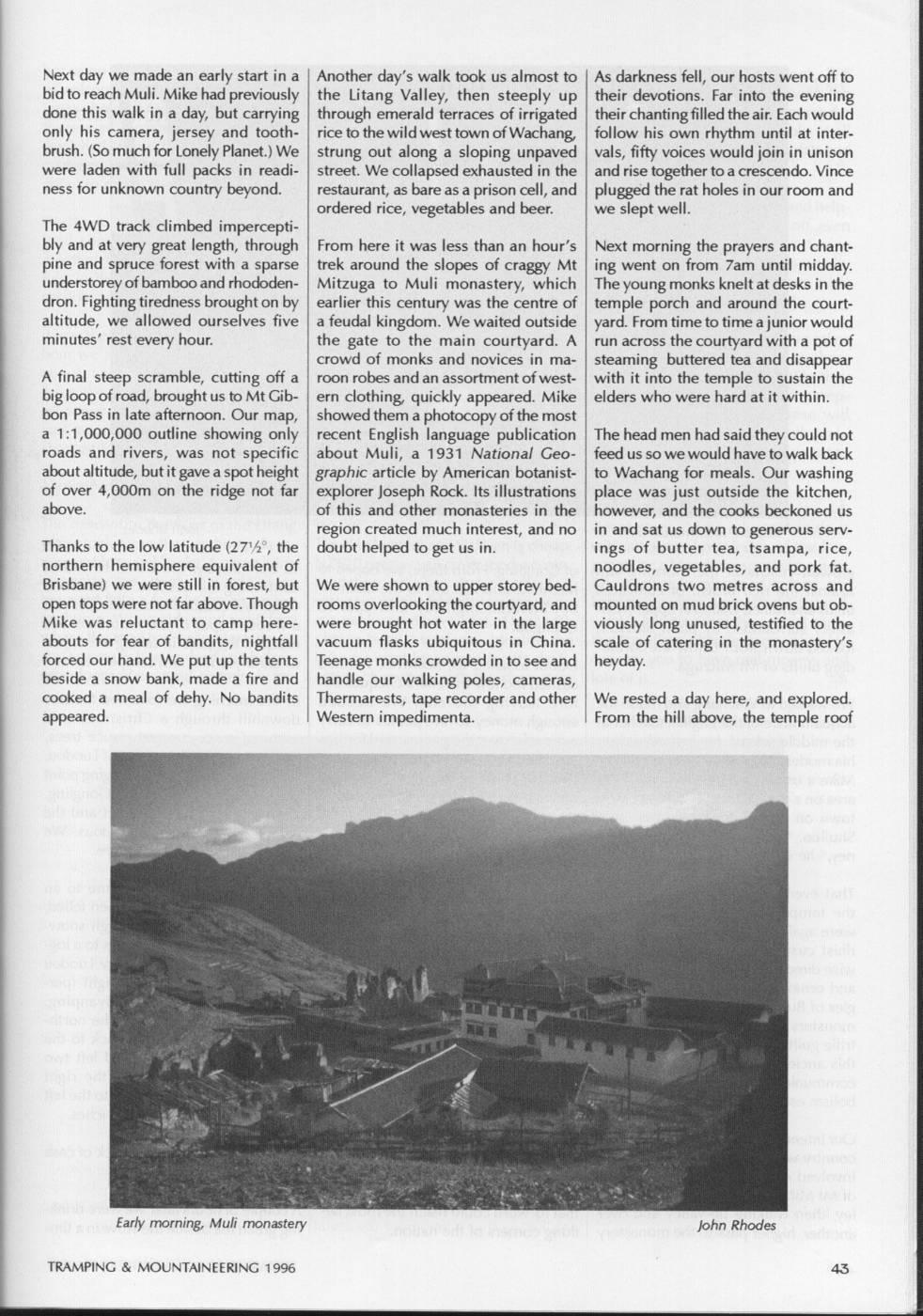
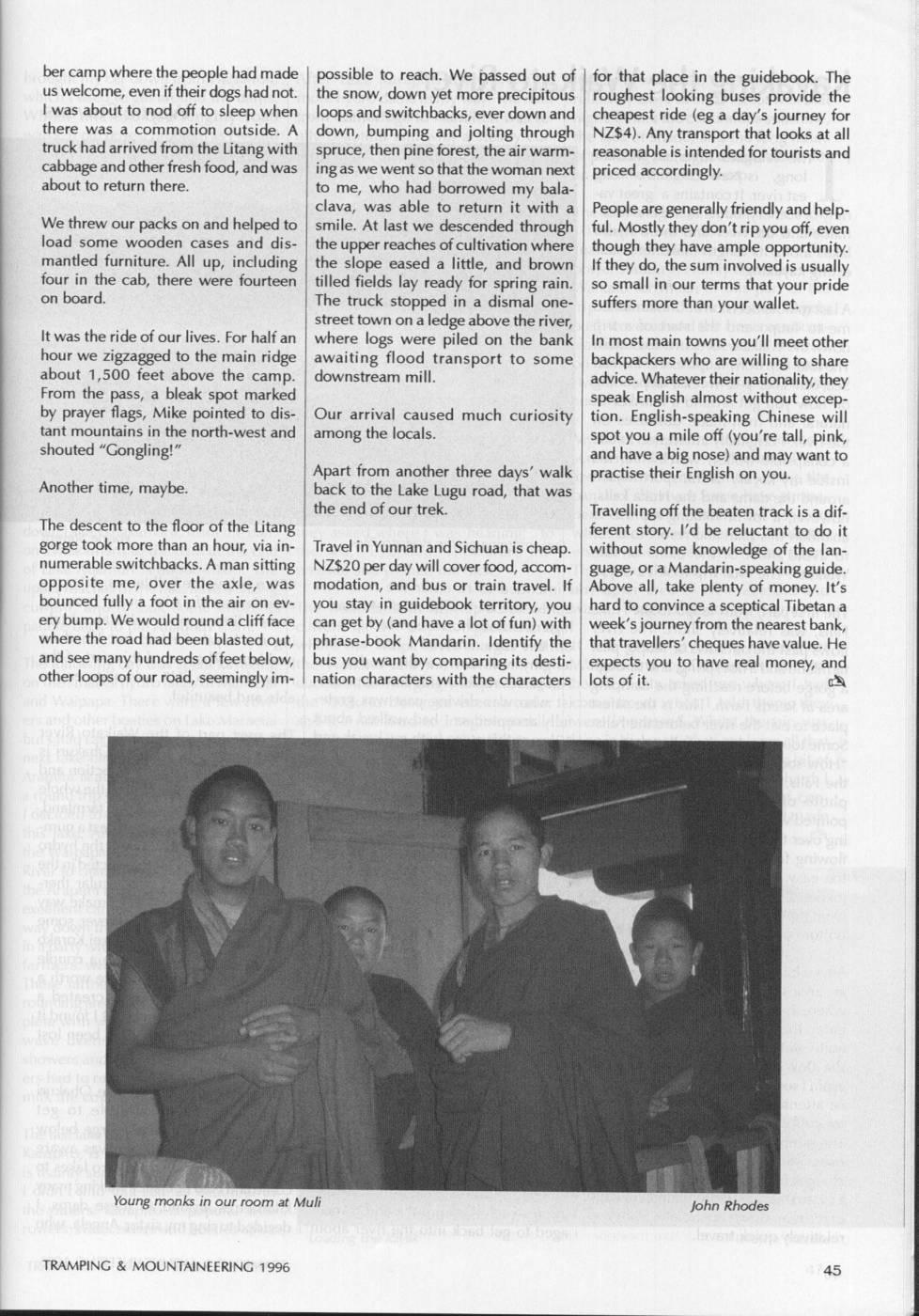
Next day we made an early start in a Another day's walk took us almost to As darkness fell, our hosts went off to bid to reach Muli. Mike had previously the Litang Valley, then steeply up their devotions. Far into the evening done this walk in a day, but carrying through emerald terraces of irrigated their chanting filled the air. Each would only his camera, jersey and tooth- rice to the wildwest town ofWachang, follow his own rhythm until at interbrush. (So much for Lonely Planet.) We strung out along a sloping unpaved vals, fifty voices would join in unison were laden with full packs in readi- street. We collapsed exhausted in the and rise together to a crescendo. Vince ness for unknown country beyond. restaurant, as bare as a prison cell, and plugged the rat holes in our room and ordered rice, vegetables and beer. we slept well. The 4WD track climbed imperceptibly and at very great length, through From here it was less than an hour's Next morning the prayers and chantpine and spruce forest with a sparse trek around the slopes of craggy Mt ing went on from 7am until midday. understorey ofl bamboo and rhododen- Mitzuga to Muli monastery, which They young monks knelt at desks in the dron. Fighting tiredness brought on by earlier this century was the centre of temple porch and around the courtaltitude, we allowed ourselves five a feudal kingdom. We waited outside yard. From time to time aj junior would minutes' rest every hour. the gate to the main courtyard. A run across the courtyard with a pot of crowd of monks and novices in ma- steaming buttered tea and disappear A final steep scramble, cutting off a roon robes and an assortment ofwest- with it into the temple to sustain the bigl loopofr road, brought us to Mt Gib- ern clothing, quickly appeared. Mike elders who were hard at it within. bon Pass in late afternoon. Our map, showed them a photocopy of the most a 1:1,000,000 outline showing only recent English language publication The head men had said they could not roads and rivers, was not specific about Muli, a 1931 National Geo- feed us sO we would havet to walk back about altitude, butit gave a: spot height graphic article by American botanist- to Wachang for meals. Our washing of over 4,000m on the ridge not far explorer Joseph Rock. Its illustrations place was just outside the kitchen, above. of this and other monasteries in the however, and the cooks beckoned us region created much interest, and no in and sat us down to generous serv- Thanks to the low latitude (27%, the doubt helped to get us in. ings of butter tea, tsampa, rice, northern hemisphere equivalent of noodles, vegetables, and pork fat. Brisbane) we were still in forest, but We were shown to upper storey bed- Cauldrons two metres across and open tops were not far above. Though rooms overlooking the courtyard, and mounted on mud brick ovens but ob- Mike was reluctant to camp here- were brought hot water in the large viously long unused, testified to the abouts for fear of bandits, nightfall vacuum flasks ubiquitous in China. scale of catering in the monastery's forced our hand. We put up the tents Teenage monks crowdedi in to see and heyday. beside a snow bank, made a fire and handle our walking poles, cameras, cooked a meal of dehy. No bandits Thermarests, tape recorder and other We rested a day here, and explored. appeared. Western impedimenta. From the hill above, the temple roof Early morning, Muli monastery John Rhodes TRAMPING & MOUNTAINEERING 1996
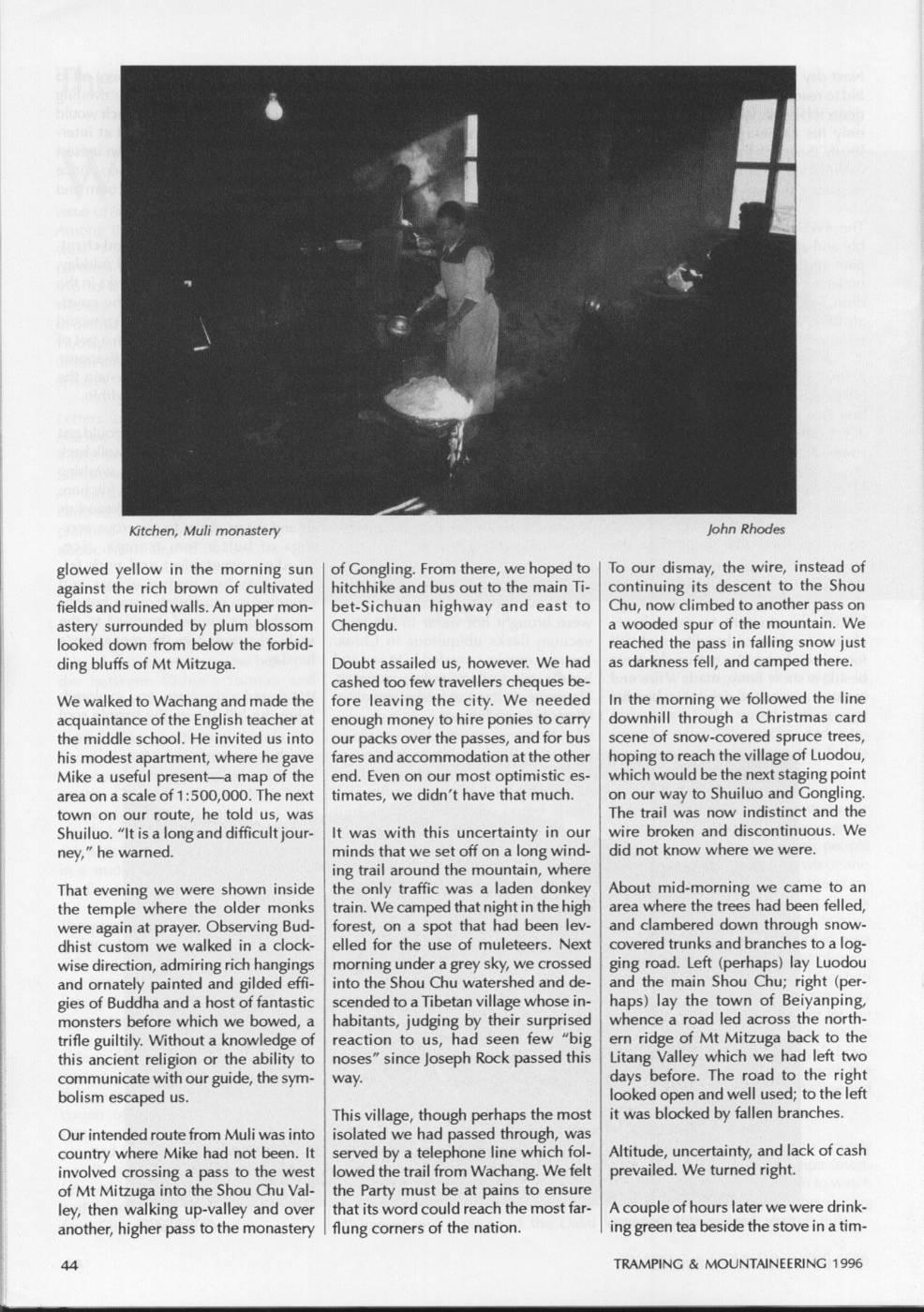
€ Kitchen, Muli monastery John Rhodes glowed yellow in the morning sun of Gongling. From there, we hoped to To our dismay, the wire, instead of against the rich brown of cultivated hitchhike and bus out to the main Ti- continuing its descent to the Shou fields and ruined walls. An upper mon- bet-Sichuan highway and east to Chu, now climbed to another pass on astery surrounded by plum blossom Chengdu. a wooded spur of the mountain. We looked down from below the forbidreached the pass in falling snow just ding bluffs of Mt Mitzuga. Doubt assailed us, however. We had as darkness fell, and camped there. cashed too few travellers cheques be- We walked to Wachang and made the fore leaving the city. We needed In the morning we followed the line acquaintance ofthe English teacher at enough money to hire ponies to carry downhill through a Christmas card the middle school. He invited us into our packs over the passes, and for bus scene of snow-covered spruce trees, his modest apartment, where he gave fares and accommodation at the other hoping to reach the village of Luodou, Mike a useful present-a map of the end. Even on our most optimistic es- which would be the next staging point area on a scale of 1:500,000. The next timates, we didn't have that much. on our way to Shuiluo and Gongling. town on our route, he told us, was The trail was now indistinct and the Shuiluo. "Iti is a long and difficult jour- It was with this uncertainty in our wire broken and discontinuous. We ney," " he warned. minds that we set off on a long wind- did not know where we were. ing trail around the mountain, where That evening we were shown inside the only traffic was a laden donkey About mid-morning we came to an the temple where the older monks train. We camped that nightin thel high area where the trees had been felled, were again at prayer. Observing Bud- forest, on a spot that had been lev- and clambered down through snowdhist custom we walked in a clock- elled for the use of muleteers. Next covered trunks and branches to a logwise direction, admiring rich hangings morning under a grey sky, we crossed ging road. Left (perhaps) lay Luodou and ornately painted and gilded effi- into the Shou Chu watershed and de- and the main Shou Chu; right (pergies of Buddha and a host of fantastic scended to a Tibetan village whose in- haps) lay the town of Beiyanping, monsters before which we bowed, a habitants, judging by their surprised whence a road led across the northtrifle guiltily. Without a knowledge of reaction to us, had seen few "big ern ridge of Mt Mitzuga back to the this ancient religion or the ability to noses" since Joseph Rock passed this Litang Valley which we had left two communicate with our guide, the sym- way. days before. The road to the right bolism escaped us. looked open and well used; to the left This village, though perhaps the most it was blocked by fallen branches. Our intended route from Muli was into isolated we had passed through, was country where Mike had not been. It served by a telephone line which fol- Altitude, uncertainty, and lack of cash involved crossing a pass to the west lowed the trail from Wachang. We felt prevailed. We turned right. of Mt Mitzuga into the Shou Chu Val- the Party must be at pains to ensure ley, then walking up-valley and over that its word could reach the most far- A couple ofl hours later we were drinkanother, higher pass tot the monastery flung corners of the nation. ing green tea beside the stove in a tim- TRAMPING & MOUNTAINEERING 1996 ber camp where the people had made possible to reach. We passed out of for that place in the guidebook. The us welcome, even if their dogs had not. the snow, down yet more precipitous roughest looking buses provide the I was about to nod off to sleep when loops and switchbacks, ever down and cheapest ride (eg a day's journey for there was a commotion outside. A down, bumping and jolting through NZ$4). Any transport that looks at all truck had arrived from thel Litang with spruce, then pine forest, the air warm- reasonable is intended for tourists and cabbage and other fresh food, and was ing as we went SO that the woman next priced accordingly. about to return there. to me, who had borrowed my balaclava, was able to return it with a People are generally friendly and help- We threw our packs on and helped to smile. At last we descended through ful. Mostly they don'trip you off, even load some wooden cases and dis- the upper reaches of cultivation where though they have ample opportunity. mantled furniture. All up, including the slope eased a little, and brown If they do, the sum involved is usually four in the cab, there were fourteen tilled fields lay ready for spring rain. so small in our terms that your pride on board. The truck stopped in a dismal one- suffers more than your wallet. street town on a ledge above the river, It was the ride of our lives. For half an where logs were piled on the bank In most main towns you'll meet other hour we zigzagged to the main ridge awaiting flood transport to some backpackers who are willing to share about 1,500 feet above the camp. downstream mill. advice. Whatever their nationality, they From the pass, a bleak spot marked speak English almost without excepby prayer flags, Mike pointed to dis- Our arrival caused much curiosity tion. English-speaking Chinese will tant mountains in the north-west and among the locals. spot you a mile off (you're tall, pink, shouted "Gongling!" and have a big nose) and may want to Apart from another three days' walk practise their English on you. Another time, maybe. back to the Lake Lugu road, that was the end of our trek. Travelling off the beaten track is a dif- The descent to the floor of the Litang ferent story. l'd be reluctant to do it gorge took more than an hour, via in- Travel in Yunnan and Sichuan is cheap. without some knowledge of the lannumerable switchbacks. A man sitting NZ$20 per day will cover food, accom- guage, oraMandarin-speaking: guide. opposite me, over the axle, was modation, and bus or train travel. If Above all, take plenty of money. It's bounced fully a foot in the air on ev- you stay in guidebook territory, you hard to convince a sceptical Tibetan a eryt bump. We would round a cliff face can get by (and have a lot of fun) with week'sj journeyfrom the nearest bank, where the road had been blasted out, phrase-book Mandarin. Identify the that travellers' cheques have value. He and see many hundreds off feet below, bus you want by comparing its desti- expects you to have real money, and other loops of our road, seemingly im- nation characters with the characters lots of it. Young monks in our room at Muli John Rhodes TRAMPING & MOUNTAINEERING 1996
Comments
Comments are not open yet.