
This report is shown as scanned pages until a volunteer types it up. Skip to the machine-read text (unproofread), which a screen reader can read.
Machine-read text (unproofread)
Read from the scans by software, so it contains mistakes. Typing it up properly would help blind readers: use Suggest an edit.
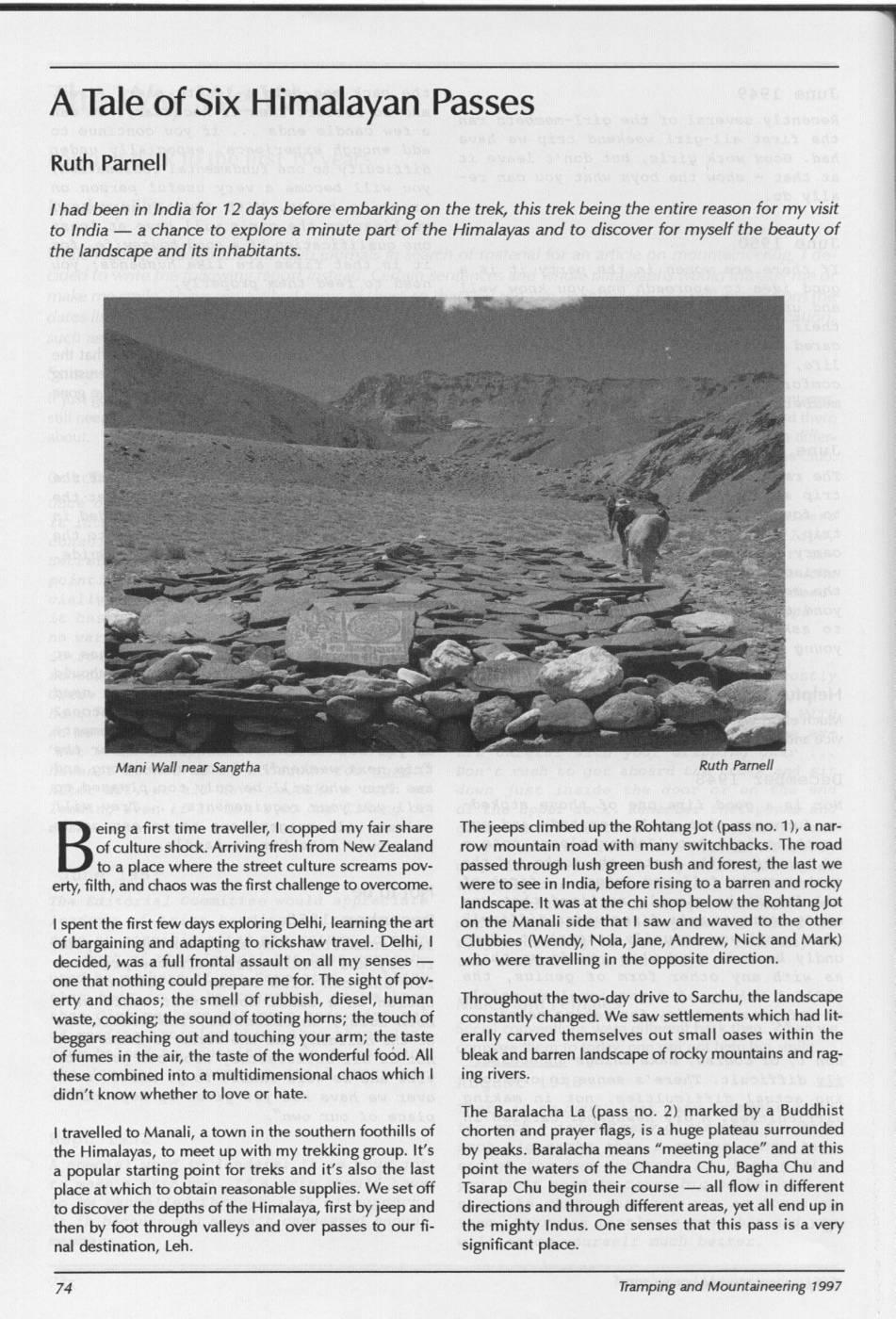
A Tale of Six Himalayan Passes Ruth Parnell I had been in India for 12 days before embarking on the trek, this trek being the entire reason for my visit to India a chance to explore a minute part of the Himalayas and to discover for myself the beauty of the landscape and its inhabitants. Mani Wall near Sangtha Ruth Parnell eing a first time traveller, I copped my fair share Thej jeeps climbed up thel Rohtang Jot (pass no. 1), a narof culture shock. Arriving fresh from New Zealand row mountain road with many switchbacks. The road to a place where the street culture screams pov- passed through lush green bush and forest, the last we erty, filth, and chaos was the first challenge to overcome. were to see in India, before rising to a barren and rocky landscape. It was at the chi shop below thel Rohtang Jot Ispent the first few days exploring Delhi, learning the art on the Manali side that I saw and waved to the other of bargaining and adapting to rickshaw travel. Delhi, I Clubbies (Wendy, Nola, Jane, Andrew, Nick and Mark) decided, was a full frontal assault on all my senses who were travelling in the opposite direction. one that nothing could prepare me for The sight of poverty and chaos; the smell of rubbish, diesel, human Throughout the two-day drive to Sarchu, the landscape waste, cooking; the sound of tooting horns; the touch of constantly changed. We saw settlements which had litbeggars reaching out and touching your arm; the taste erally carved themselves out small oases within the of fumes in the air, the taste of the wonderful food. All bleak and barren landscape of rocky mountains and ragthese combined into a multidimensional chaos which I ing rivers. didn't know whether to love or hate. The Baralacha La (pass no. 2) marked by a Buddhist I travelled to Manali, a town in the southern foothills of chorten and prayer flags, is a huge plateau surrounded thel Himalayas, to meet up with my trekking group. It's by peaks. Baralacha means "meeting place" and at this a popular starting point for treks and it's also the last point the waters of the Chandra Chu, Bagha Chu and place at which to obtain reasonable: supplies. We set off Tsarap Chu begin their course all flow in different to discover the depths of the Himalaya, first byj jeep and directions and through different areas, yet all end up in then by foot through valleys and over passes to our fi- the mighty Indus. One senses that this pass is a very nal destination, Leh. significant place. Tramping and Mountaineering 1997
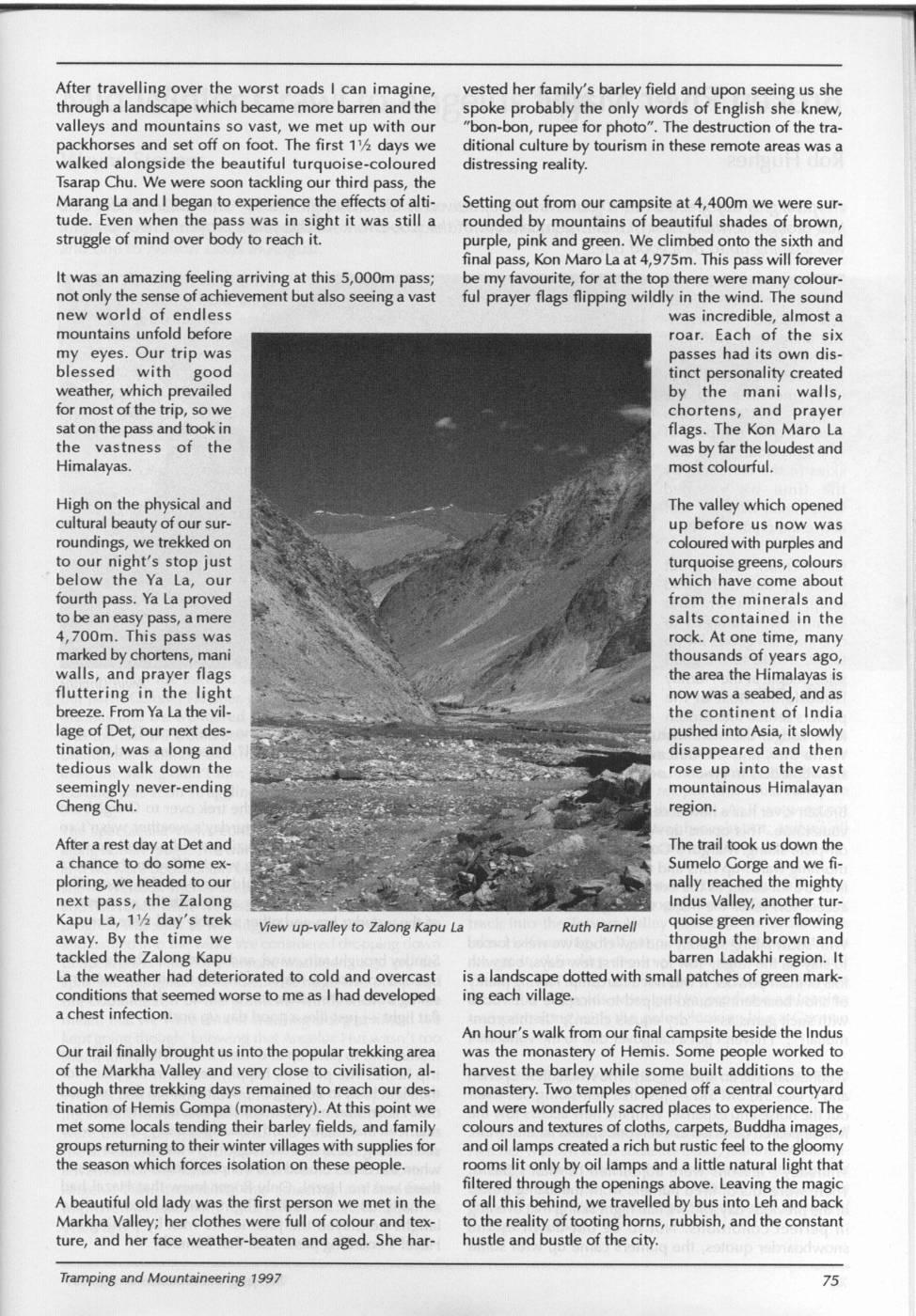
After travelling over the worst roads I can imagine, vested her family's barley field and upon seeing us she through a landscape which became more barren and the spoke probably the only words of English she knew, valleys and mountains SO vast, we met up with our "bon-bon, rupee for photo". The destruction of the trapackhorses and set off on foot. The first 1% days we ditional culture by tourism in these remote areas was a walked alongside the beautiful turquoise-coloured distressing reality. Tsarap Chu. We were soon tackling our third pass, the Marang La and began to experience the effects of alti- Setting out from our campsite at 4,400m we were surtude. Even when the pass was in sight it was still a rounded by mountains of beautiful shades of brown, struggle of mind over body to reach it. purple, pink and green. We climbed onto the sixth and final pass, Kon Maro La at 4,975m. This pass will forever It was an amazing feeling arriving at this 5,000m pass; be myt favourite, for at the top there were many colournot only the sense of achievement but also seeing a vast ful prayer flags flipping wildly in the wind. The sound new world of endless was incredible, almost a mountains unfold before roar. Each of the six my eyes. Our trip was passes had its own disblessed with good tinct personality created weather, which prevailed by the mani walls, for most of the trip, so we chortens, and prayer sat on the pass and took in flags. The Kon Maro La the vastness of the was by far thel loudest and Himalayas. most colourful. High on the physical and The valley which opened cultural beauty of our surup before us now was roundings, we trekked on coloured with purples and to our night's stop just turquoise greens, colours below the Ya La, our which have come about fourth pass. Ya La proved from the minerals and to be an easy pass, a mere salts contained in the 4,700m. This pass was rock. At one time, many marked by chortens, mani thousands of years ago, walls, and prayer flags the area the Himalayas is fluttering in the light now was a seabed, and as breeze. From Ya La the vilthe continent of India lage of Det, our next despushed into Asia, it slowly tination, was a long and disappeared and then tedious walk down the rose up into the vast seemingly never-ending mountainous Himalayan Cheng Chu. region. After a rest day at Det and The trail took us down the a chance to do some ex- Sumelo Gorge and we fiploring, we headed to our nally reached the mighty next pass, the Zalong Indus Valley, another tur- Kapu La, 1% day's trek View up-valley to Zalong Kapu La Ruth Parnell quoise green river flowing away. By the time we through the brown and tackled the Zalong Kapu barren Ladakhi region. It La the weather had deteriorated to cold and overcast is a landscape dotted with small patches of green markconditions that seemed worse to me as - I had developed ing each village. a chest infection. An hour's walk from our final campsite beside the Indus Ouri trail finally brought us into the popular trekking area was the monastery of Hemis. Some people worked to of the Markha Valley and very close to civilisation, al- harvest the barley while some built additions to the though three trekking days remained to reach our des- monastery. Two temples opened off a central courtyard tination of Hemis Gompa (monastery). At this point we and were wonderfully sacred places to experience. The met some locals tending their barley fields, and family colours and textures of cloths, carpets, Buddha images, groups returning to their winter villages with supplies for and oil lamps created a rich but rustic feel to the gloomy the season which forces isolation on these people. rooms lit only by oil lamps and a little natural light that filtered through the openings above. Leaving the magic A beautiful old lady was the first person we met in the of all this behind, we travelled by bus into Leh and back Markha Valley; her clothes were full of colour and tex- to the reality of tooting horns, rubbish, and the constant ture, and her face weather-beaten and aged. She har- hustle and bustle of the city. Tramping and Mountaineering 1997
Comments
Comments are not open yet.