
This report is shown as scanned pages until a volunteer types it up. Skip to the machine-read text (unproofread), which a screen reader can read.
Machine-read text (unproofread)
Read from the scans by software, so it contains mistakes. Typing it up properly would help blind readers: use Suggest an edit.
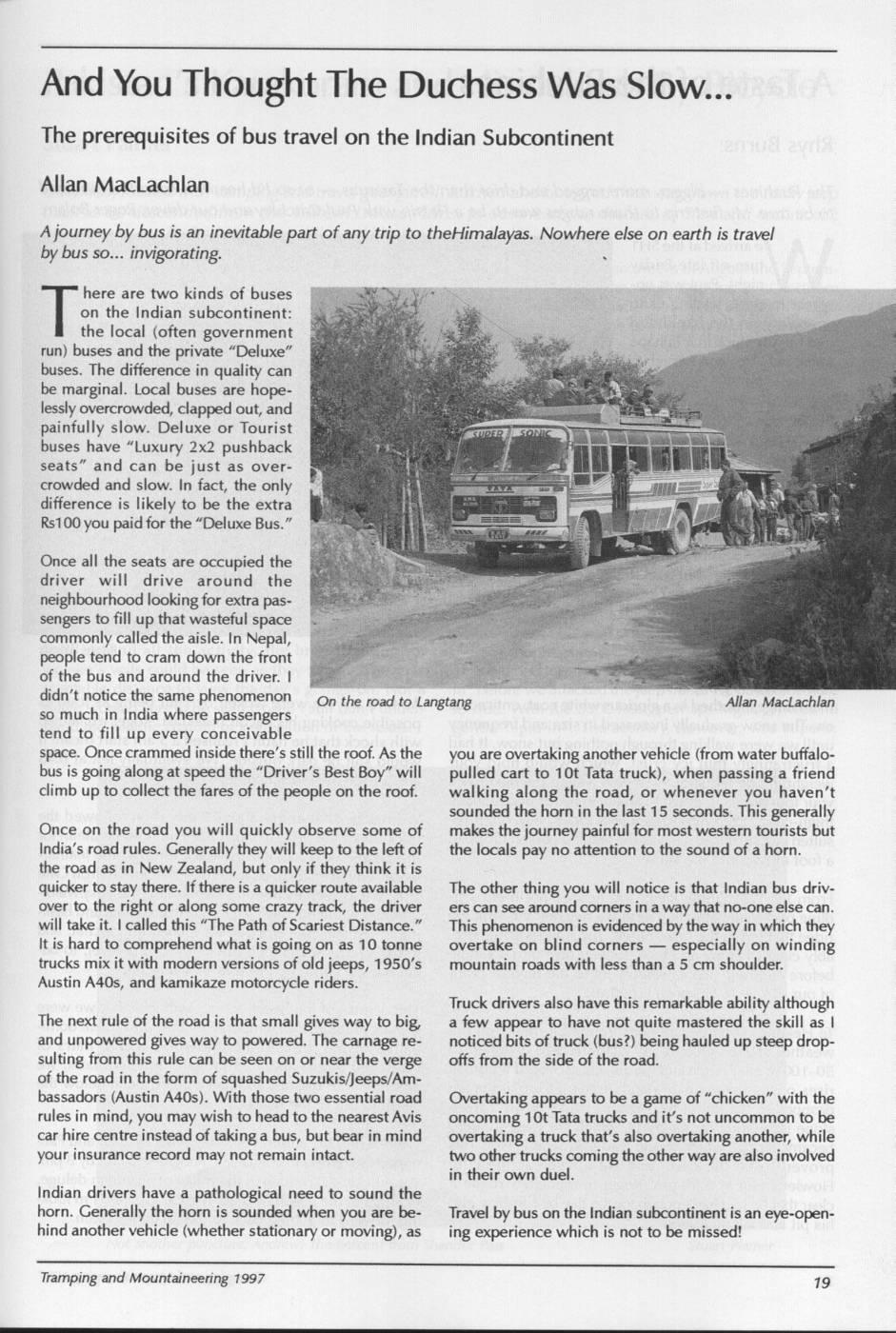
And You Thought The Duchess Was Slow... The prerequisites of bus travel on the Indian Subcontinent Allan MacLachlan Ajourney by bus is an inevitable part of any trip to theHimalayas. Nowhere else on earth is travel by bus SO... invigorating. here are two kinds of buses on the Indian subcontinent: the local (often government run) buses and the private "Deluxe" buses. The difference in quality can be marginal. Local buses are hopelessly overcrowded, clapped out, and painfully slow. Deluxe or Tourist buses have "Luxury 2x2 pushback seats" and can be just as overcrowded and slow. In fact, the only ALA difference is likely to be the extra a Rs100 you paid for the "Deluxe Bus." a Once all the seats are occupied the driver will drive around the neighbourhood looking for extra passengers to fill up that wasteful space commonly called the aisle. In Nepal, people tend to cram down the front of the bus and around the driver. I didn't notice the same phenomenon On the road to Langtang Allan MacLachlan so much in India where passengers tend to fill up every conceivable space. Once crammed inside there's still the roof. As the you are overtaking another vehicle (from water buffalobus is going along at speed the "Driver's Best Boy" will pulled cart to 10t Tata truck), when passing a friend climb up to collect the fares of the people on the roof. walking along the road, or whenever you haven't sounded the horn in thel last 15 seconds. This generally Once on the road you will quickly observe some of makes thej journey painful for most western tourists but India's road rules. Generally they will keep to the left of the locals pay no attention to the sound of a horn. the road as in New Zealand, but only if they think it is quicker to stay there. Ift there is a quicker route available The other thing you will notice is that Indian bus drivover to the right or along some crazy track, the driver ers can see around corners in a way that no-one else can. will take it. called this "The Path of Scariest Distance." This phenomenon is evidenced by the way in which they It is hard to comprehend what is going on as 10 tonne overtake on blind corners especially on winding trucks mix it with modern versions of old jeeps, 1950's mountain roads with less than a 5 cm shoulder. Austin A40s, and kamikaze motorcycle riders. Truck drivers also have this remarkable ability although The next rule of the road is that small gives way to big, a few appear to have not quite mastered the skill as I and unpowered gives way to powered. The carnage re- noticed bits of truck (bus?) being hauled up steep dropsulting from this rule can be seen on or near the verge offs from the side of the road. of the road in the form of squashed Suzukis/Jeeps/Ambassadors (Austin A40s). With those two essential road Overtaking appears to be a game of "chicken"with the rules in mind, you may wish to head to the nearest Avis oncoming 10t Tata trucks and it's not uncommon to be car hire centre instead of taking a bus, but bear in mind overtaking a truck that's also overtaking another, while your insurance record may not remain intact. two other trucks coming the other way are also involved in their own duel. Indian drivers have a pathological need to sound the horn. Generally the horn is sounded when you are be- Travel byl bus on the Indian subcontinent is an eye-openhind another vehicle (whether stationary or moving), as ing experience which is not to be missed! Tramping and Mountaineering 1997
Comments
Comments are not open yet.