
This report is shown as scanned pages until a volunteer types it up. Skip to the machine-read text (unproofread), which a screen reader can read.
Machine-read text (unproofread)
Read from the scans by software, so it contains mistakes. Typing it up properly would help blind readers: use Suggest an edit.
Escape from Rabbit Pass Ray Walker The first time I became aware of the existence of Rabbit Pass was when Iwas flicking through an old copy ofWilderness magazine. I came across an article about a group of trampers who did a winter crossing of the pass. Included within the article was a photo of a campsite on the pass, complete with an alpine tent that looked as ifi it was about to be blown apart by gale force winds! abbit pass is located in Mount Aspiring National Finally the day! had arrived to head for Rabbit Pass. We Park and provides a route between the Upper had readj just about every guidebook that included details Wilkin and the Matukituki valleys. The pass itself oft this trip. They all described this part of the trip as being comprises a short but quite steep climb from the Wilkin fart from easy so it was with some trepidation that we set side called Waterfall Face. This is followed byal kilometre off. We found that thet track was quite overgrown in places or SO of easy walking, and then at the other end of the and not as easy as the previous day's side trip. After a pass, a climb of about 200 metres around some bluffs couple ofl fhours we came to a knoll overlooking the basin followed by a rather steep descent into the Matukituki at the foot of the Waterfall Face. The scenery was awe- Valley. By WT&MC standards, it would probably rate as some. We could see a couple of tents in the middle of the al Medium trip, but only due to the Waterfall Face and the basin. A short time later we found that these belonged to descent into the Matukituki. a group of HVTC trampers. We shared a billy of tea with Hazel and - I had decided to do the Rabbit Pass trip in them before setting off The Waterfall Face was quite steep, early January this year. The trip started with the shortest but not as bad as what all our literature had led us to aircraft flight Ihad ever been on six minutes in all! We believe. Although I must sayi it would have been much flew from the airstrip opposite the campground at more difficult ift the weather had been less friendly. It must Makarora to Kerin Forks. Very few people actually do this have taken less than half an hour to get to the top. part of the trip on foot - most either fly or take the jet The pass itself was about a kilometre long and easy boat. (Remarkably, flyingis actually cheaper than the jet walking. It had been our intention to camp in this area boat option.) for one night before continuing on down to the After landing at Kerin Forks we made our way up to the Matukituki Valley. That night the weather took a turn for hut and had some lunch before carrying on to Top Forks the worse. It rained heavily and the wind blew like crazy; Hut in the afternoon. The plan was to go to Top Forks that I was sure the tent was going to get airborne at any day, then do a side trip to Lake Lucidus the following day, moment. At times Ifound myself grasping the tent poles and if the weather was good, to go on to Rabbit Pass on firmly while hoping that they wouldn'tbe damagedi by the the third day. wind. Needless to say didn't get a lot of sleep that night. We set off to Top Forks on quite a warm January after- Ther rain continued through until late morning. thought noon. We had been along this part of the track the previ- it would never stop. Ifound myself in desperate need to ous year as a side trip while doing the Young-Wilkin cir- go to the toilet. I knew that by going off to relieve myself cuit. Unfortunately we had to abandon that trip before when it was raining this hard would be less than desirgetting to Top Forks due primarily to a bad blister I had able. thoughtl I'djust grin andl bear it until ther rain stopped. that refused to heal. Iwas confident that wouldn'tl have Wishful thinking the rain didn'tstop, and was getting the same problem this time. The route was fairly easy going. more uncomfortable by the minute. Suddenly had a cun- The only two noteworthy things that come to mind was ning plan! (In Rowan Atkinson parlance: "It twas SO cunthe presence of a veryl big slip about halfway to the hut ning you could put a tail on it and call it a weasel!")Icould and another airstrip located about three-quarters of the use a spare plastic container and dispose of the contents way. Top Forks Huti is located on a wide grassy flat above later I put the idea to Hazel; she was not at all impressed the confluence of the North and South branches of the by my cunning idea! So unfortunately I had no other op- Wilkin River. It provided a splendid view off thes snowcovered tion but to brave the elements and outside. summit of Mt Pollux. From memory the hut would have Finally, when Iwas beginning to that therain would odence had about 15 bunks and was reasonably new. A group of never stop, it eased off and then ceased altogether. Itwas climbers from Christchurch had arrived the previous day. late morning when we finally emerged from our sodden Their mission was to climb Mt Pollux the following day. tent. We decided to take a look over Pearson Saddle while The next day arrived and we set off on the side trip to thet tent was drying out. We returned to our campsite and Lake Lucidus. This was an easy and relaxing day. Once packed everything up and headed off. again the weather was remarkably warm. The same day A short time later we reached the end of the pass. We the climbing party made a successful ascent of Mt Pollux. had noticed that there was quite a strong wind behind us. We met up with them back at the hut that night where To get down the pass it was necessary to ascend about they related their exploits of the day to us; they seemed 200 metres above some bluffs before going down to the very pleased to have conquered this "bump". valley floor. By now the wind was very strong and as the Tramping and Mountaineering 1999
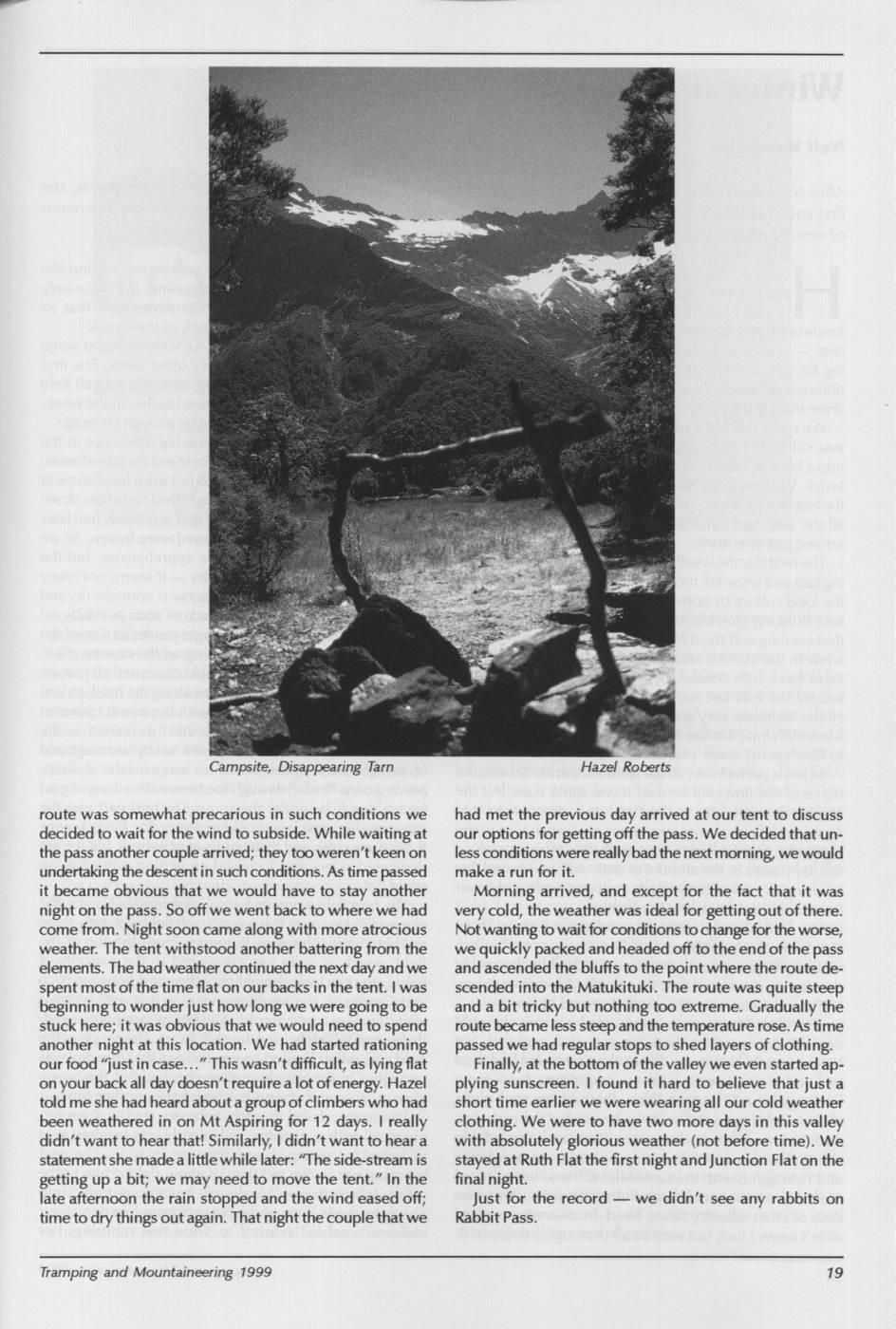
Campsite, Disappearing Tarn Hazel Roberts route was somewhat precarious in such conditions we had met the previous day arrived at our tent to discuss decided to wait for the wind to subside. While waiting at our options for getting off the pass. We decided that unthe pass another couple arrived; they too weren't keen on less conditions were really bad the next morning, we would undertaking the descentins such conditions. As time passed make a run for it. it became obvious that we would have to stay another Morning arrived, and except for the fact that it was night on the pass. So off we went back to where we had very cold, the weather was ideal for getting out of there. come from. Night soon came along with more atrocious Not wanting to wait for conditions to change for the worse, weather. The tent withstood another battering from the we quickly packed and headed off to the end of the pass elements. The bad weather continued the next daya and we and ascended the bluffs to the point where the route despent most of the time flat on our backs in the tent. Iwas scended into the Matukituki. The route was quite steep beginning to wonder just how long we were going to be and a bit tricky but nothing too extreme. Gradually the stuck here; it was obvious that we would need to spend routel became less steep and the temperature rose. As time another night at this location. We had started rationing passed we had regular stops to shed layers of clothing. our food "justi in case.. "This wasn't difficult, as lying flat Finally, at the bottom of the valley we even started apon your back all day doesn'trequire a lot of energy. Hazel plying sunscreen. I found it hard to believe that just a told me she hadl heard about a groupof climbers who had short time earlier we were wearing all our cold weather been weathered in on Mt Aspiring for 12 days. I really clothing. We were to have two more days in this valley didn'twant to hear that! Similarly, Ididn'twant to hear a with absolutely glorious weather (not before time). We statement she made a little while later: "The side-stream is stayed at Ruth Flat the first night and Junction Flat on the getting up a bit; we may need to move the tent.' " In the final night. late afternoon the rain stopped and the wind eased off; Just for the record - we didn't see any rabbits on time to dry things out again. That night the couple that we Rabbit Pass. Tramping and Mountaineering 1999
Comments
Comments are not open yet.