
This report is shown as scanned pages until a volunteer types it up. Skip to the machine-read text (unproofread), which a screen reader can read.
Machine-read text (unproofread)
Read from the scans by software, so it contains mistakes. Typing it up properly would help blind readers: use Suggest an edit.
Northland Revisited John Rhodes Sixty kilograms oftent, sleeping bags, stove, food, fuel, tools and tandem made for tough pedalling through Auckland's Waitakere Ranges. It was getting dark, the bush came to the edge of the road, and there was nowhere to camp. efeated by the gradient, Ann and Iwere pushing and stayed three months for repairs, was Edward Gibbon Apollo while Dave rode ahead. Then a patch of Wakefield's Tory, on its way to Wellington. The passenflat grass appeared. Beside it, a shed and a gers and crew of a French ship, wrecked on the seaward light. We knocked. "Please, may we campl here?" side of the Poutu peninsula north of the entrance, were "Of course! And there's a toilet and lal kitchen, and you cared for by Maoris, then reached Auckland by land. It can sleepinside if fyou like, and have a shower. But sorry, took them six weeks. we've got no shampoo or conditioner!" And SO Heaven As the forest came off thel hills around the Kaipara, erosent us Peter andi Mike, and supplied all our weary needs. sion increased, the once clear rivers ran brown, and the As we unpacked, a siren roared overhead, extinguish- harbour silted. But by then, big ships weren'tneeded lany ing conversation. People rushed up in cars and hurried more. Today, the only other vessel on the water was a away again in a red truck. This was the Waiatarua Volun- barge taking Kaipara sand to Helensville for the Auckland teer Fire Brigade, one of the smallest in the country. market. In the morning our hosts took us in their ute to Piha Kewpie Too called at Shelly Beach to pick up a bus-load and to lovely Karekare, where the surf pounds the beach of Probus club members on tour from Tauranga and deand thel backdrop of sandhills, rock andl ibush is as wilda as liver them to Dargaville. Grey heads took photographs it was a thousand years ago. We farewelled Peter and Mike and welcomed Gaye's unlimited offerings of tea and cofand descended to lush, rolling pastures near Kumeu. It fee. Then we bounced across the harbour opening into was Sunday, everything was green and pleasant, and the shelter of the northern peninsula. The harbour nargrown-up boys were flying model helicopters in the sun- rowed into river, with mangroves and lonely, desertedj jetshine. "These are harder to control than real ones,' If said ties. We slid upstream to waiting Dargaville, where grathe pilots. One dropped nose-first out of the sky, wreck- cious wooden hotels mourn the vanished river trade, and ing its fuselage. Its owner: "never mind, there's a spare you can rent a brown-sailed schooner for fishing trips. one at home". Next day, in Dargaville's maritime museum, we found Kaipara Harbour takes a great bite out of western relics of ships losti in the jaws oft the Kaipara bar wheels, Northland. The long road around it pushes travellers far compasses, bits of spar and sail, a slab of a ship's side to the east, almost turning Northland's "Twin Coast Dis- with timber half a metre thick, and photographs of covery"into "Bottleneck Discovery". But we'dt figured the earthmoving machinery digging dead sailing vessels out harbour must be navigable, and had got in touch with ofthe sand. Kaipara Cruises in Helensville. We pedalled north, and it was as though our voyage up Kewpie Too appeared around a corner in the river and the Kaipara had brought us into a different world, where tied up at the wharf at Parakai. Terry and Gaye Somers we could no longer feel the throb of Auckland. hoisted our bikes aboard and lashed them to the upper Outside a tiny restored and repainted church, Stl Mary's, deck railing. Terry has been sailing the Kaipara all his life, atMamaranui, a man was making enclosures of manuka and Kewpie Too is his way of sharing it with others. brush to shelter newly planted shrubs. The renovation had We motored down-river past banks lined with man- been a full-time project for 9 months, he said proudly. groves, watching for crocodiles, and came out onto the This was his home; his marae was down the road, andl he great Kaipara, the largest harbour in the Southern Hemi- loved itl here. But no other work was to be had, and soon sphere. Maybe this wasn'tcycling, but it was certainly the he must go back to the city. His old ute nearby was neiway to see the Kaipara. The Somers' bought Kewpie Too ther registered nor warranted. We wonderedi ifs fsuch lapses in the Bay of Islands and sailed her here around North might be the norm, SO far from the seat of officialdom. Cape. The authorities cautioned Terry about the Kaipara That eveningwe strolledamong rimu and matai trees at Bar, but he knew all about that. Trounson Park. Then appeared the vast boles of kauri, The name seemed familiar. Ofcourse! Kewpie Too took grey giants in a land of dwarfs. The sun went down, birds me on thel Bay ofl Islands "Cream Trip" 'on mylast Northland flocked to roostin the treetops, and we walked in silence, bike trip, in 1959. She's as neat and ship-shape now as like people visiting a cathedral. then, when she was new. Ther road took us through Donnelly's Crossing, where Ahundred years ago, said Terry, thel harbour was alive trains once came and the wooden ticket office and waiting with shipping taking out millions offeet of sawn kauri and room still celebrate in decaying drooping splendour their logs. It was common to see thirty ships waiting for the escape (so far) from arsonists. right conditions to cross the Kaipara bar, which claimed Along climb, then a descent to more kauri, the digni- 115 of them. One which goti in safely but touched bottom fied eminences grises of Waipoua. In '591 slept beside a Tramping and Mountaineering 1999
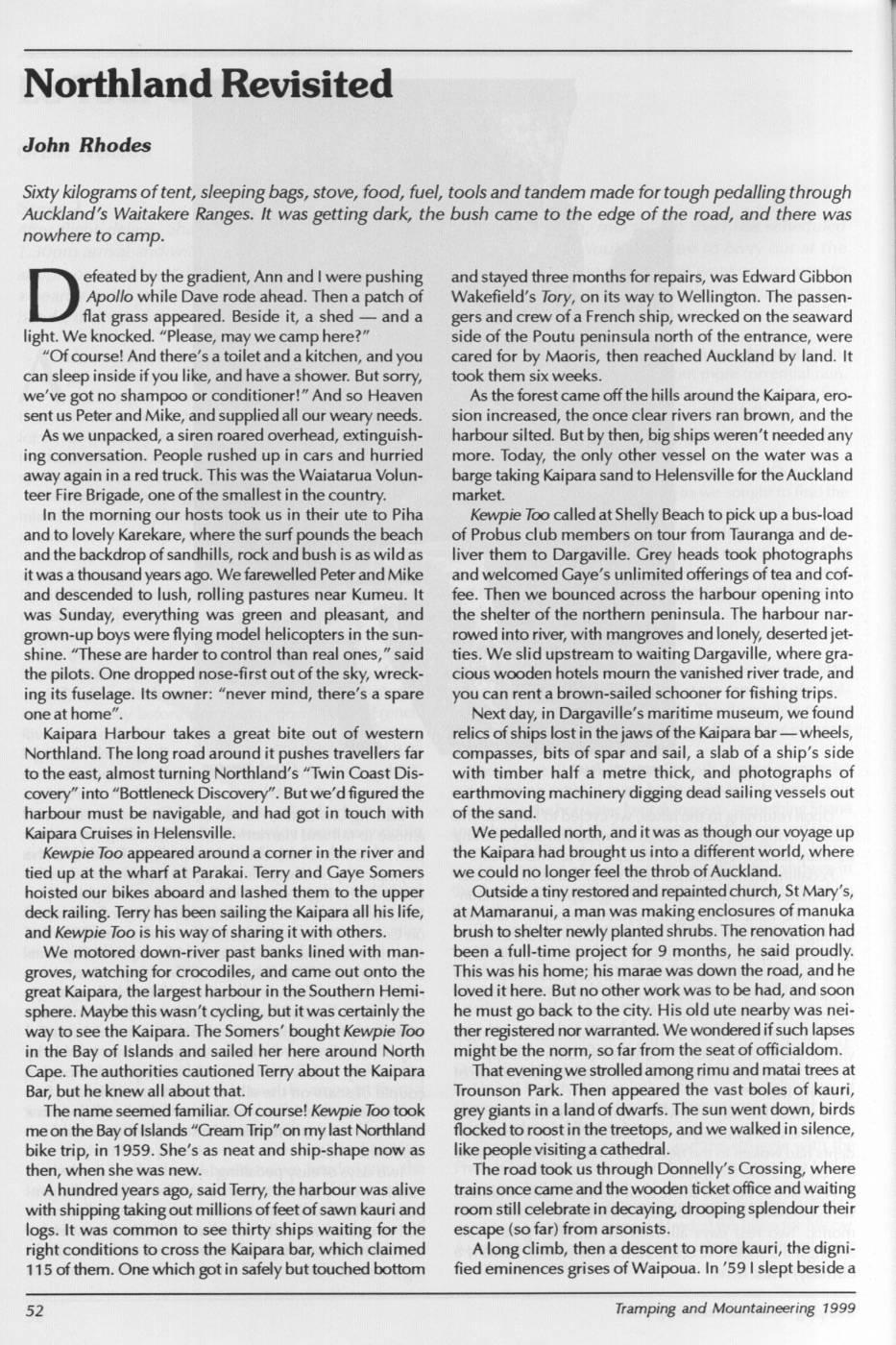
Te Paki Stream Ann Rhodes roadman' s hut in the forest here, little imagining that a Where life is, there is death. At the roadside by the visitor centre would spring up nearby. The climb from the marae at Mangamuka, people in dark suits and black valleywas a roadside profusion of green fern and foliage, dresses performed a sombre ceremony as onlookers stood with huge trunks, like pillars of wisdom, rising out of it. in silence and traffic slowed to a crawl. A young man had The big hill before Omapere was too much and we crashed his car there days before. walked the tandem. After forty years the waiting view was The Mangamuka Ranges treated us to a rain-sodden still fixed in memory. At the top, before us stretched the night; we rode on past modest farmhouses with peeling placid Hokianga, guarded to the south by dark bluffs and paint which spoke of a region left behind by the gods of to the north byits great sandhill, as though an immense the market and the high priests oft fthe knowledge economy. cream labrador lay at the door and would admit nobody In Kaitaia we dried lout and bought our provisions among without its master's approval. the Friday crowds at Pak 'N Save. Times may be tough; but Kaitaia makes the best ofi its situation, and the mood The main street of Rawene, which we reached next is optimistic. Ends are made to meet. The butcher will sell morning, heads straight down to the harbour and disap- you fifty cents worth of sausage meat if you want it, and pears into the water. Every! half-hour, this is explained: the many do. However, theNorthland. Age warned of future Hokianga ferry, a modern steel no-nonsense affair very mental health problems resulting from over-use of drugs different from the dilapidated punt of the fifties, arrives by today's youngsters; and we heard it said that in the for another load of cars. bank one might see people depositing their drug dollars in Rawene has recreated itself as an historic town. Its old the tens of thousands. courthouse houses a superb library, created and run by In Kaitaia' 's Saturday morning market you could buy volunteers. A raised walkway took us among the man- pickles and vegetable plants and used clothing and coffee groves, whose aerial roots pushed up like black fingers, and cakes andl household goods that nobody wanted, and and the brown skeleton of a dinghy rested where it had sausages with white bread and margarine. Nearby, chillain down to die in the mud. dren sat expectantly in rows while a man in a suit gave Across thel Hokianga, the back streets of tiny Kohukohu them blue cardboard eye-shades advertising takeaways. revealed gracious oldi houses with faded paintwork, creeper- Then RonaldMcDonald, in yellow and red stripes andoverhung verandahs and cascades of greenery down their front size boots, arrived in a police wagon and made magic and steps, holding memories of past greatness. We pedalled talked in rhyme and delighted everyone. We were unsure on through air thick with the scent ofj jasmine and wiste- whether to be disgusted at the gross consumerism, or ria, and stole ripe loquats from an overhanging tree. The charmed at the sheer fun and happiness of itall. branches of the flame trees, still leafless, held up their crimson blooms; tree ferns sprouted like weeds along the Chris came from Masterton and we were four. We flew roadsides, and the land overflowed with all the greenery, on from Kaitaia under a cloudy sky with a cool southerly lushness and goodness of spring. at our backs. Tramping and Mountaineering 1999
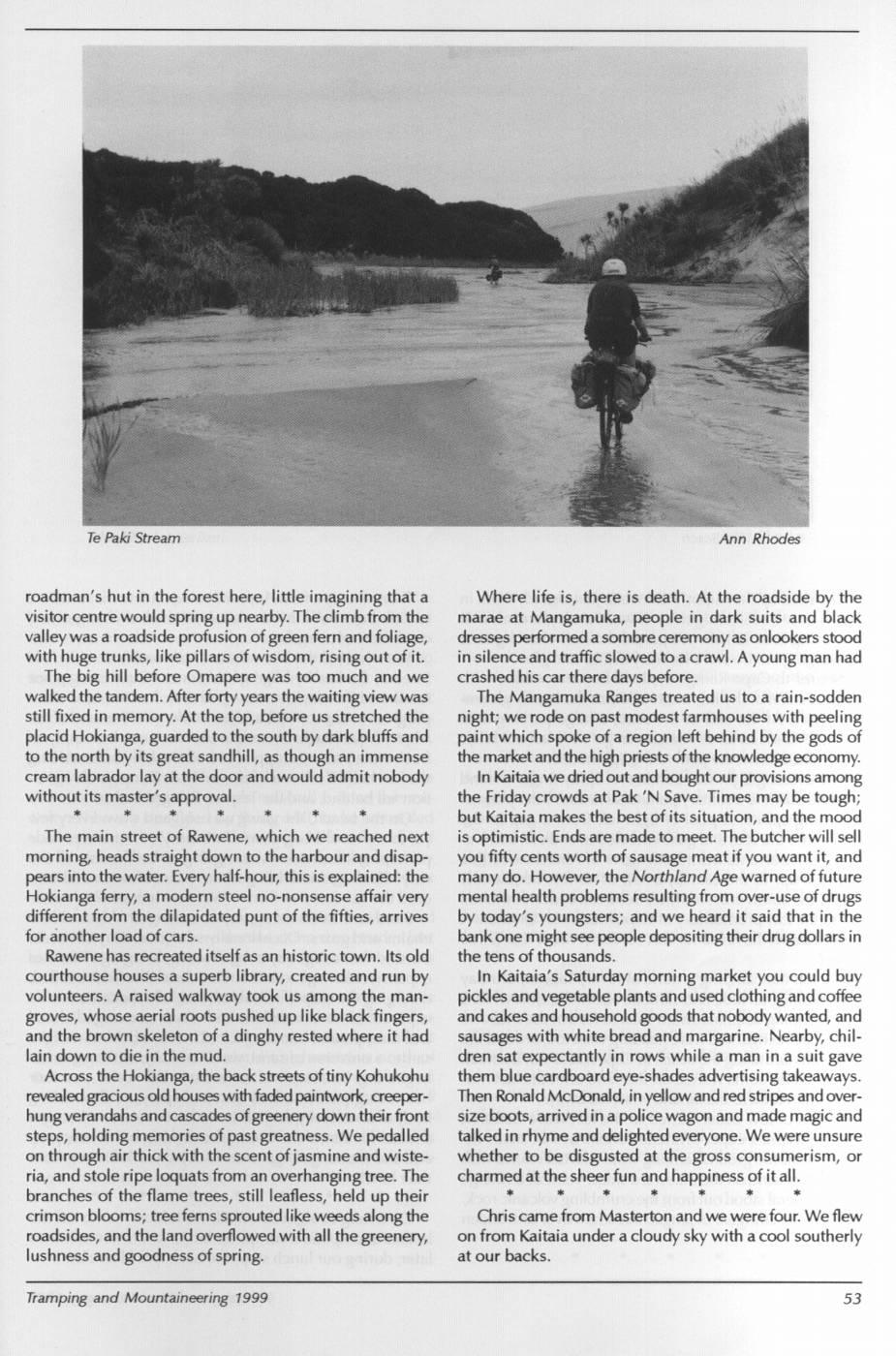
Ninety Mile Beach John Rhodes The road up the Aupori Peninsula, just a sandy track in From the tip ofthe Aupori Peninsula there is nowhere '59, is now a sealed highway. It was Sunday, and church to ride but south. Miraculously, the wind changed and was going in at Te Kao. Wej joined the non-churchgoers, came behind us again. converging on the store for fizzy drinks and pies. We wheeled thel bikes down the broad floor of Te Paki Nearer to Cape Reinga the land became wilder, with Stream, flanked by huge white dunes. Our resting place glimpses of marshyinlets cut off from the sea by gleam- for the night was uncertain, for we had no idea what ing dunes. At the end of the road, a large parking area progress to expectwith a laden tandem on the sand of the implied "this is as far as wheels can go". Wel left our bikes Ninety Mile Beach. Uncertain too was our next supply of and walked down the path to thel lighthouse. fresh water, so we stopped to boil the billy before riding The evening light was sombre. A spiny finger of land the last half-kilometre of stream bed. Dunes and vegetareached down to a solitary pohutukawa above the place of tion fell behind, and the Tasman Sea greeted us. departing spirits. A pool of light fell from a gap in the On the beach, the going was soft and slow. Every few cloud onto the sea, and gulls wheeled over disturbed wa- yards we would bog down. In twenty minutes we made ter where currents from both sides of Aotearoa collide perhaps a kilometre. Was it going to be like this all the and well up. To the east lay a row of remote headlands; way? Then we tried riding where a film of water still COVand to the south-west a white, deserted beach stretched ered the sand. It was firmer We werei in business! out to the low promontory of Cape Maria Van Dieman. A Sand and salt water sprayed around ankles and into hazy shadow hovered far out to sea. Was it the Three chains and gears. Occasionally someone strayed too far Kings? out and was caught bya rogue wave, bringing visions of We left the camping ground at lovely Tapotupotu Bay expensive damage to bottom brackets. The tide receded, next morning on foot, and climbed above the cliffs while a enlarging the strip of rideable beach till it became a wide dozen leaping dolphins swam west to feed in thes shallows expanse. Lines of sandhills and waves converged ahead near Cape Reinga. We werel heading west too, around the and disappeared into the haze. The view behind was the headlands andalong thel beach to Cape Maria Van Dieman. same: a universe of sand, water and sky, with no end or Black-beaked terns waited on the sand until the last mo- beginning. The smallest variation in the scene a tour ment, then took to the air and wheeled away. bus racing past in a bow wave of spray, or the rusting A neck of low desert jutted to the last wave-battered body of an unlucky car half-buried in the sand - became knob of Maria's cape. Whitened shells of flax snails lit- a focus for attention. One of the rushing buses stopped, tered the sterile ground, among wind-blasted stones with and the passengers gave us sticky buns left over from little tails of sand on their leeward sides. Veins of a strange their lunch. dense mineral stood out from the crumbling volcanic rock, and delicate stringers of pingao stretched over untrodden On al long straight downhill, we left our hands off the dunes. brakes and Apollo's computer hit 77 km/h. Ten minutes later, during our lunch stop, the back tyre blew out. Tramping and Mountaineering 1999
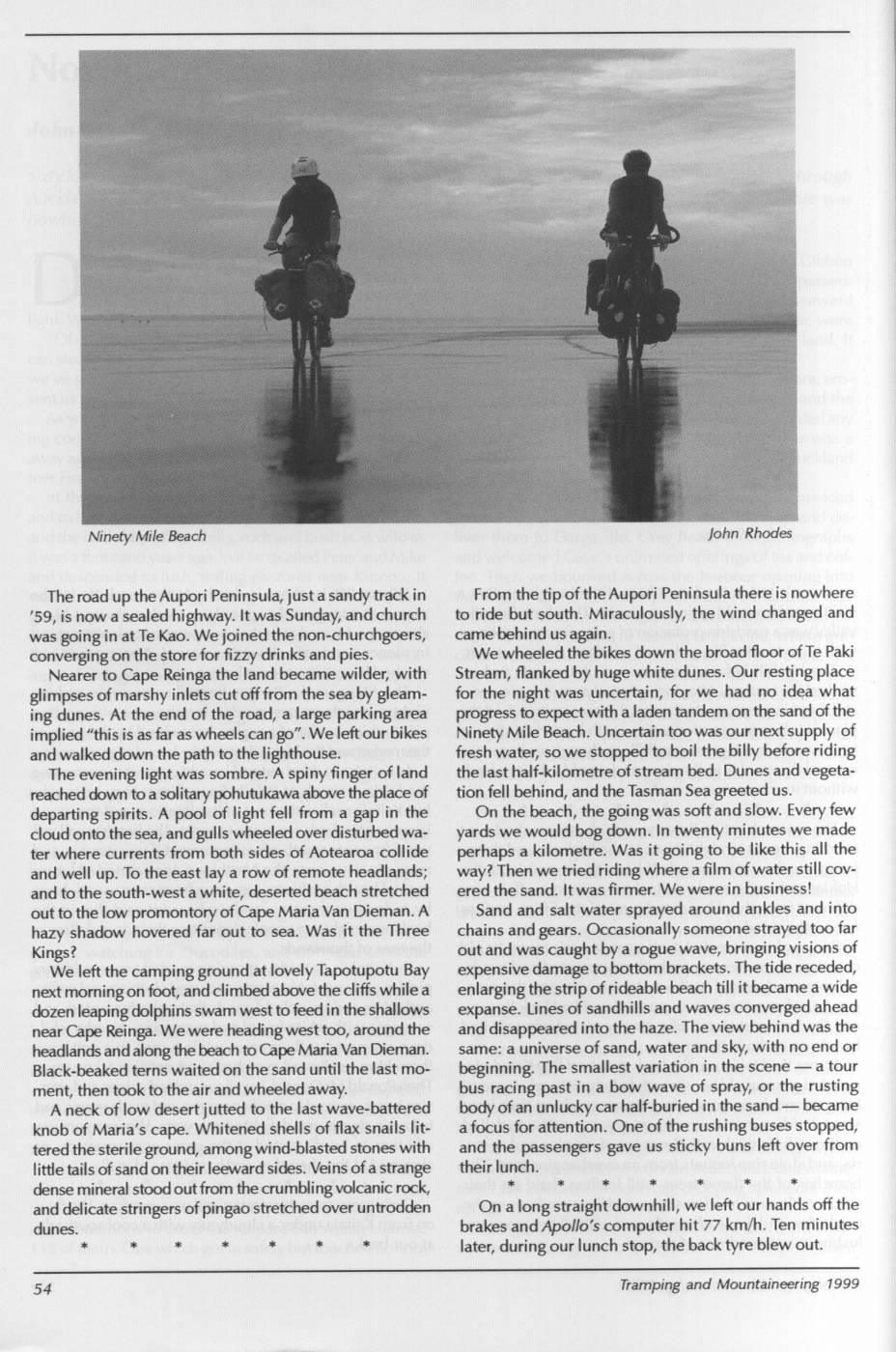
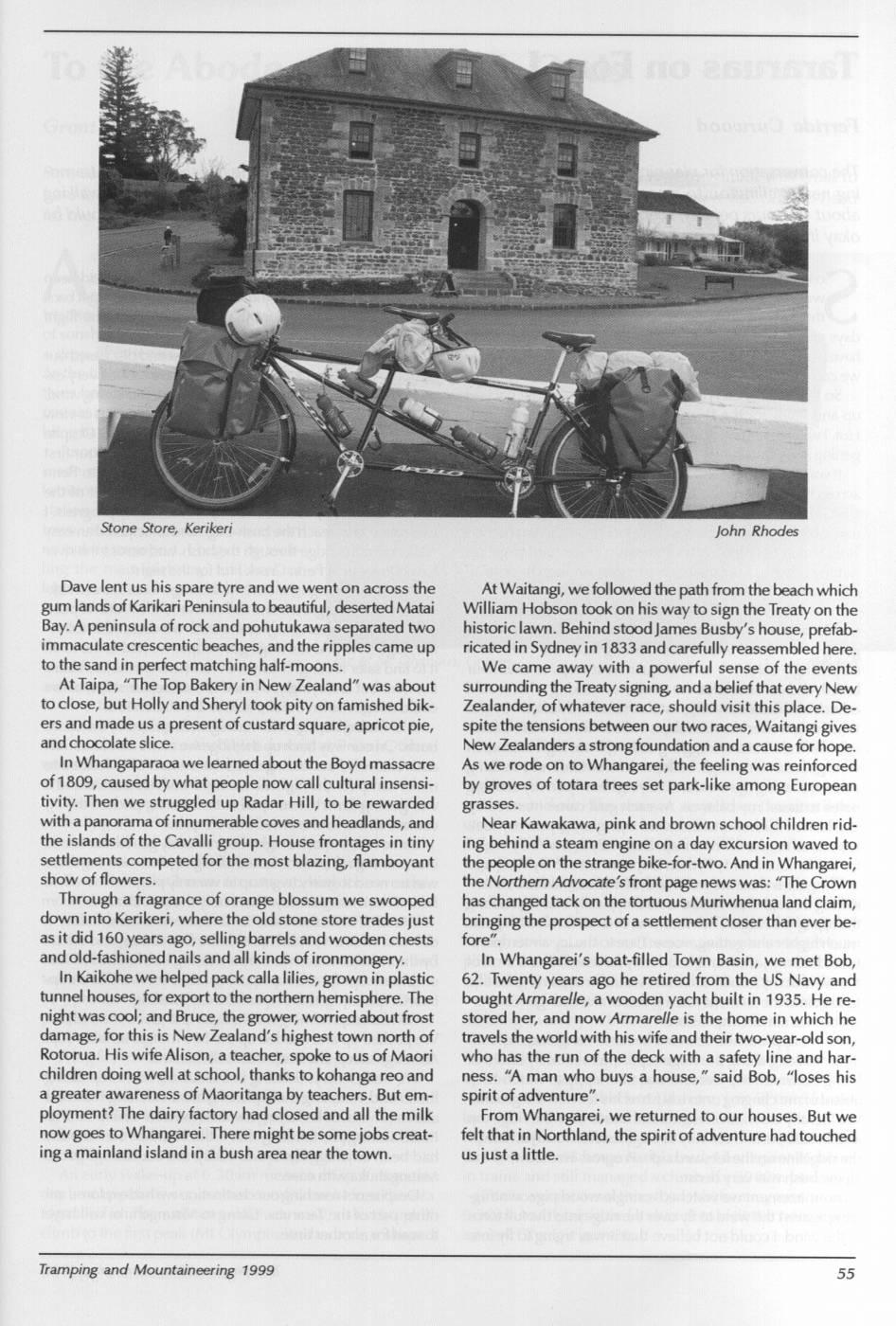
Stone Store, Kerikeri John Rhodes Dave lent us his sparet tyre and we went on across the At Waitangi, wet followed the path from thel beach which gum lands ofl Karikari Peninsula tol beautiful, deserted Matai William Hobson took on his way to sign the Treaty on the Bay. Ap peninsula of rock and pohutukawa separated two historic lawn. Behind stoodj James Busby's house, prefabimmaculate crescentic beaches, and the ripples came up ricated in Sydneyi in 1833 and carefully reassembled here. to the sandi in perfect matching half-moons. We came away with a powerful sense of the events At Taipa, "The Top Bakery in New Zealand" was about surrounding the Treaty: signing andal belief that everyl New to close, but Holly and Sheryl took pity on famished bik- Zealander, ofwhatever race, should visit this place. Deers and made us a present of custard square, apricot pie, spite the tensions between our two races, Waitangi gives and chocolate slice. New Zealanders a strongt foundation and a cause for hope. In Whangaparaoa wel learned about thel Boyd massacre As we rode on to Whangarei, the feeling was reinforced of1809, caused bywhat people now call cultural insensi- by groves of totara trees set park-like among European tivity. Then we struggled up Radar Hill, to be rewarded grasses. with a panorama ofi innumerable coves andheadlands, and Near Kawakawa, pink and brown school children ridthei islands of the Cavalli group. House frontages in tiny ing behind a steam engine on a day excursion waved to settlements competed for the most blazing, flamboyant the people on the strange bike-for-two. Andi in Whangarei, show of flowers. theNorthern Advocate'st front page news was: "The Crown Through a fragrance of orange blossum we swooped has changed tack on thet tortuous Muriwhenua land claim, down into Kerikeri, where the old stone store tradesj just bringing the prospect of a settlement closer than ever beas it did 160y years ago, selling barrels and wooden chests fore". and old-fashioned nails and all kinds of ironmongery. In Whangarei's boat-filled Town Basin, we met Bob, In Kaikohe we helped pack calla lilies, grownin plastic 62. Twenty years ago he retired from the US Navy and tunnel houses, for export to the northern hemisphere. The bought Armarelle, a wooden yacht built in 1935. He renight was cool; and Bruce, the grower, worried about frost stored her, and now Armarelle is the home in which he damage, for this is New Zealand's S highest town north of travels the world with his wife and their two-year-old son, Rotorua. His wife Alison, a teacher, spoke to us of Maori who has the run of the deck with a safety line and harchildren doing well at school, thanks to kohanga reo and ness. "A man who buys a house, = said Bob, "loses his ag greater awareness of Maoritangal by teachers. But em- spirit of adventure". ployment? The dairy factory had closed and all the milk From Whangarei, we returned to our houses. But we now goes to Whangarei. There might be somej jobs creat- felt that in Northland, the spirit of adventure had touched ing a mainland islandi in a bush area near the town. usj just a little. Tramping and Mountaineering 1999
Comments
Comments are not open yet.