
Text taken from the club newsletter.
GREAT EXPECTATIONS by MEGAN SETY
It wasn’t what we expected, and that is what made the adventure. When Tony and I started pondering about the next big trip I’m not sure what made me think of the Frank Church River of No Return Wilderness in Idaho. I had never tramped there, but I vaguely remembered my brother’s story of a trip he did there some twenty years ago. It is the largest wilderness (a special designation to protect the pristine nature of wilderness areas in the US), located in Idaho, the state where I grew up and my family still resides. It is also home to the Salmon River, one of the longest uninterrupted rivers in the US, and its many tributaries. Remembering my brother’s story and my own experiences rafting the river I had the idea to link a long tramp with a rafting adventure.
Whenever you start a trip you always have expectations. In preparing for our thirteen day tramp followed by a six day rafting trip we read books, surfed the internet, scoured maps, talked to rangers and hassled my brother for information and tips. We had all these ideas about what the trip might be like but when we actually got on the trail we frequently discovered something different. It was exciting to begin each day not knowing what the terrain would be or what our campsite might look like. Here’s a sampling of our great expectations and the real experience.
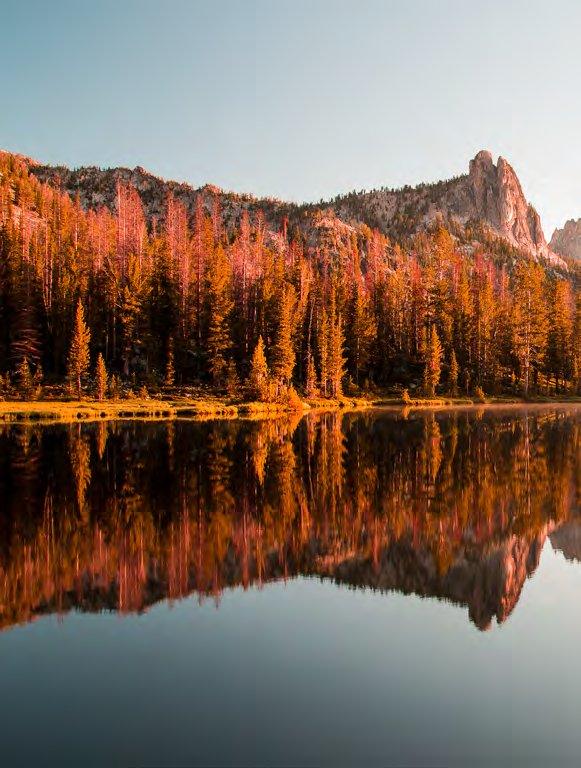
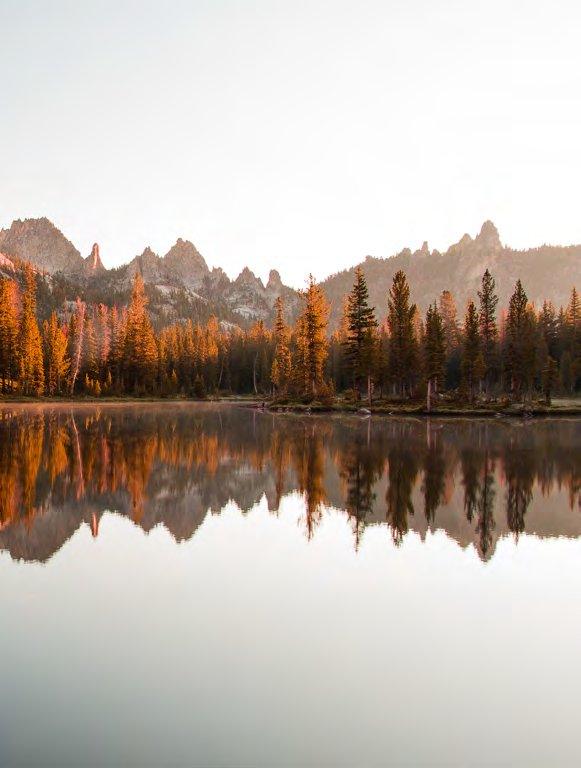
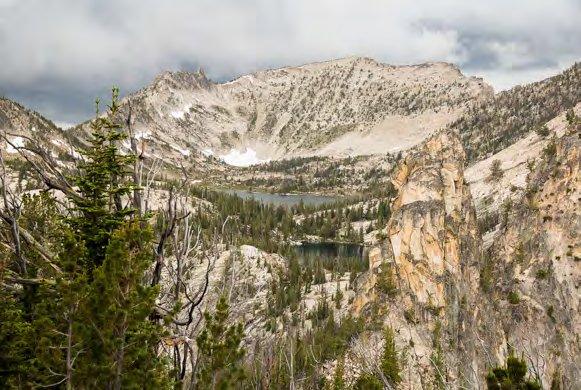
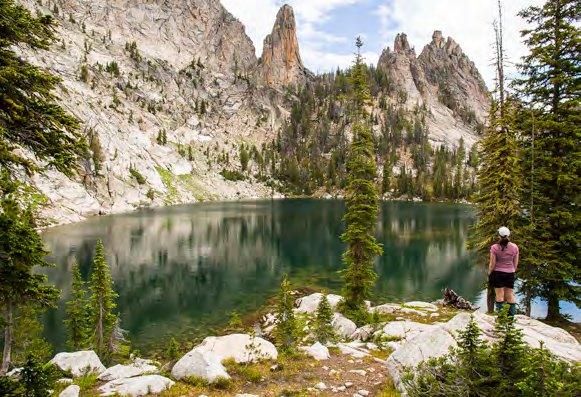
When there is thunder and lightning, there will be rain When I picked up Tony at Boise airport at 7 pm the temperature was 42 degrees centigrade. Idaho was having one of its hottest summers on record and we had expected sunny weather for the whole trip. We were just hoping it would be a little bit cooler in the mountains. We started our first day at the Big Horn Crags campground, wandered up and through endless rock formations and jagged alpine summits, constantly surprised at how often we would see a single tree way above the bush line at the very apex of a jagged rocky peak.
As we stopped for lunch taking in the 360 degree view we started to hear loud booming thunder, often lasting for several seconds followed by huge strikes of lightning. We could see the rain off in the distance. As we packed up lunch we made sure our parkas were near the top of the pack in case the storm rolled in before we could get to our first campsite at Welcome Lake. However, the rain never did arrive. In fact for the next several days we continued to have dry thunder and lightening every afternoon. On the tramping part of the trip we only had one light ten minute shower. Of course, the night we arrived to meet our rafting buddies when we were tasked with dinner while they rigged the boats we had a thunderous two hour hail storm!
Elevation changes of 1,600 metres in one day will make for long hard tramps We spent our first three days wandering around the alpine lakes of the Big Horn Crags, visiting more than eight lakes, bumping up and over ridges here and there. Finally on day four we started down Waterfall Creek Trail which we had anticipated to be a long and potentially difficult day, travelling 18 km and descending 1,700 metres in the last few kilometres. However, we found the walking comparable to a footpath. In fact throughout the entire trip we discovered the US Forest Service, the government department responsible for building and maintaining most of the trails in the area, had a maximum gradient for trails. To create gentle descents extensive switchbacks were used.
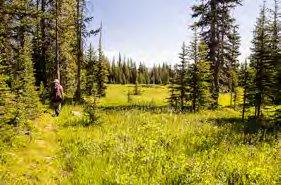
This particular trail was not only gentle but it seemed that nearly all the rocks had been hand-picked and set aside. For the steepest descent we traipsed through metre-tall meadow grass. While the grass had covered the path it was easy enough to find the trail by simply putting your foot down on the only part of ground that had been levelled. We wondered if this trail was unique but as the days passed we continually found the trails to be built at gentle gradients and well cleared of debris making our other days of big climbs or downhills not only easy but enjoyable.
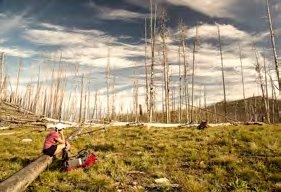
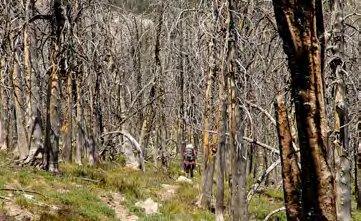
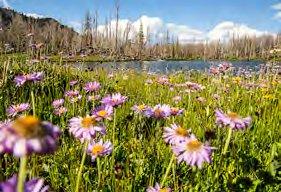
This wilderness will be full of tall pine trees The landscape changed daily and was impossible to predict, allowing us to start each morning eager to discover what the trail and next campsite would look like. We encountered alpine lakes, hillside meadows, small streams and creeks, desert bush, and fast flowing rivers. However, there was one feature that was always present—extensive damage from forest fires. For decades the US government had a policy of extinguishing every forest fire the moment it started. Over the years this created dense pockets of trees and brush which dried out in the hot summer months and became ripe fuel for severe fires. The approach is now to just let fires burn.
Though some of the fires had occurred more than 20 years ago hundreds of dead trees still remained. Trees are always falling given strong winds, heavy winter snows, and just because. These fallen trees became a real pain and slowed us down as we crawled over log after log. Nearly every day we walked through once forested areas that had been devastated by fires in the past. Some days we would see charred areas that stretched for miles. We often wondered if our next campsite was sitting in a buffer zone that had somehow escaped the flames, or if it was an area full of precarious dead trees waiting to topple on our tent. At least once we relocated our camp after a tree fell down a nearby hillside without even a tiny gust of wind.
The only way to get deep in to this wilderness is to walk We weren’t sure if we would meet people along the way on our trip as the wilderness is described as fairly remote. But over the first few days we met people who were only walking to the closest lake and using horses either as transport or to pack in their own supplies. As we travelled deeper in to the forest we expected to see fewer, if any, people but we had forgotten that this wilderness has more than twenty light aircraft landing strips.
As we travelled along Big Creek in our first week we met a few people who had flown in, but it wasn’t until we arrived at Cabin Creek that we discovered a traffic jam. We spent the night there and the next morning eagerly awaited the arrival of our food drop, in particular the fresh salmon and cold beers for that night’s dinner. Four planes landed that morning bringing anglers who would rather not have to walk and carry their gear, before our plane finally arrived. Then the following seven days we never saw another person. Although in our entire trip we met many people, not one person was carrying their gear for more than one day.
We will need a rest day We had planned to spend the entire day just lazing about at Cabin Creek after we had received our food drop, but giving the increasing air traffic, the ease of walking and our excitement to start another day we decided to get moving. A rest day had seemed like a good idea on a thirteen day trip and we were surprised not to need it. However, when I reflect back on the trip instead of only resting on one day actually we rested every day.
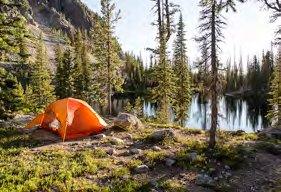
As the travel was easy, we would often finish our day’s walking in about four to five hours, arriving at camp just in time for a late lunch. This turned out to be a very good thing as the hottest part of the day, rather strangely, was usually from 2 to about 6 pm. With temperatures over 40 degrees, it was just too hot to tramp. So we spent our afternoons napping, swimming, reading, or photographing the wonderful sights around us.
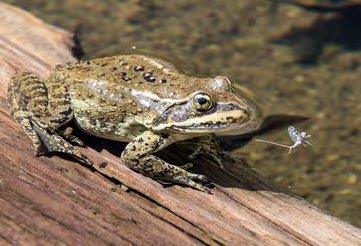
We will see big wild animals As we told people about our trip, their eyes would grow wide and they would tell us of all the large wild animals that we could expect to see daily, such as bears, deer, elk, moose and maybe even the elusive recently re-introduced wolf. On the tramping trip we saw one deer at our first camp and one deer running away on our last day. We had many theories about this, but the one that rang most true was suggested by a veteran professor who worked at Taylor Ranch, a University research centre located right in the middle of the wilderness. He told us with the re-introduction of the wolf (obviously a natural predator to big game), that the elk and likely other animals had become more ‘invisible.’ We did, however, see lots of fish, tadpoles, frogs, birds, insects and a couple of snakes.
Our travel on the river was slightly different. Probably the most memorable sighting was a deer that visited one of our river camps as we were sipping pre-dinner cocktails. He seemed quite tame and likely had been fed by previous rafters. All the same we were still shocked when the deer decided to eat a hot-pink singlet one of our crew left out to dry on a tree. It wasn’t until just about ten centimetres of the shirt were all that was left hanging from the deer’s mouth we realised he really was going to eat the whole thing. A good twenty minutes of chasing the deer around the campsite and the shirt was eventually spat out.
Hazards include bears, rattlesnakes, poison ivy and maybe even cougars Students from Taylor Ranch told us they had already spotted 22 rattlesnakes in the last six weeks and come around a corner on the trail to a black bear romping through the meadow. However, the only snake we saw was a giant non-venomous bull snake who appeared just as I was about to take advantage of the hole I had dug for my toilet one afternoon. After my initial panic I realised it was far more terrified of me and we stopped to watch him desperately try to hide his yellow and brown checkered skin in the green bushes.
At the lower elevations along Big Creek where the berries were in full bloom we saw many large piles of bear scat. When camping in these areas we made sure to walk a few hundred metres away to hang our bear bag, but we never did see any adult bears on the tramp. I was lucky enough to catch a brief glimpse from the raft of a black bear cub madly running up the canyon walls.
Thankfully, on the tramp when we frequently traipsed through thick and tall bushes we only saw one very easily avoidable bush of poison ivy, a plant that causes a terrible itchy rash. However, the trails along the river were covered with it, which meant taking extra precaution when we stopped to look at pictographs or stumbled away from the campsite at night to the toilet.
As for other creatures by far the worst were the mosquitoes and large biting horse flies!
Many of the trails are unmaintained and we will spend much of our time navigating because the trails have disappeared In the planning stages I was surprised to have a hard time finding a forest service ranger who could provide any information about trail conditions. We weren’t sure what lay ahead but we knew that starting on day seven the trails we were planning to use weren’t being maintained. We thought these areas would be less visited and there would be a good chance that trails would be overgrown. We were looking forward to having some fun navigating and exploring. We had been warned that the biggest challenge would be logs which had fallen across the trail.
We were pleasantly surprised to discover the trail along Cow Creek, a climb of more than 1,200 metres, had been cleared by private outfitters who guide hunters and fishers. For the remaining week we frequently found trails were being maintained by the outfitters for their own private use. In fact only ten minutes off the track on our planned exploration to Papoose Lake we landed right in the middle of trail that ended at a perfect campsite. This was a good learning exercise as on our last day we were looking for a trail junction that was on the map but not on the ground. We decided to bush-bash to where the trail was meant to be. We had a feeling that the outfitters were maintaining the track, but just not the last 100 metres to prevent their trails from being accidentally discovered. Indeed, another fifteen minutes and there was the perfect trail, saving us a good two hours.
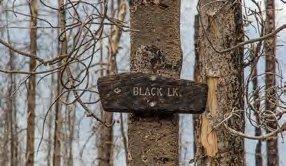
Walking off track will be easy because we are just walking through a forest of tall trees These little forays into off-track travel have given us confidence that further explorations away from the trail would continue to be relatively easy. We had found that the tall thick trees had keep sun from reaching the ground preventing much if any ground-level bush. The only impediment to walking was usually stepping over fallen logs. So on day eleven we decided to spend the entire day off the trail. We dropped down the 700 metres or so into the small Peak Creek Canyon planning to follow the creek’s path to Black Lake where we would camp for the night.
As we started down from the ridge, the travel was so easy, I slipped my hands in to my pockets. Eventually the terrain become steeper and we entered in to an area of extensive forest fires. Logs were down everywhere you looked. It wasn’t too challenging though, we would just slow down to clamber over the logs. Interestingly we realised that one must be more cautious stepping over dry and burned logs. Once the branches are gone there is sharp stubs and the lingering bark and surface of the log is like sand paper. It was easy to get scraped up and an accidental fall could mean getting skewered on a sharp stump of a branch.
What we hadn’t taken into account is that at lower elevations near running water the soil is richer with nutrients and bush grows more easily. Within 100 metres of the creek the bush was at least a metre tall, lush and thick. We often couldn’t see where we put our next step and seemed to either find ourselves sinking into muddy bogs or twisting ankles on old logs. When we got a breather from this we would look up to see a pile of giant burned logs as if they had spilled from a pick-up- stix game. We would carefully thread our way up, down, under, and on top of logs. Those same fallen logs also ruled out the creek as an alternative option—it simply turned into an obstacle course.
It was a rough day and we both had plenty of bruises and scrapes. We learned our lesson to confine off-track travel to higher elevations. And we were thankful this was the only day on the entire trip that turned out to be that challenging.
Maps, the GPS and guidebooks would be accurate While it was mostly easy to follow and find the trails, we were often surprised to discover that the paths on the ground were sometimes not the same as the ones on the map. In particular, when we left our Black Lake campsite we were looking forward to a well-cut trail as we had an 800 metre climb in just a few short kilometres. The travel was once again easy and we stopped paying attention and started chatting. Suddenly, twenty minutes had passed and we stepped in to a swamp. The trail disappeared and we checked our GPS which showed us miles away from where the trail was supposed to be. We compared our maps to the topography of the land and yup, we were in the wrong place. How had that happened when we just followed the trail?
We back-tracked until the last junction where a brand new sign indicated we were headed in the right direction. Sure enough the trail did not go where the GPS, guidebook, map from 1962 or map from the 1980s said it was supposed to go. We contemplated our options and decided we would bush-bash where the trail was meant to be, hoping to pick it up or else determined to prove that all our guiding tools were wrong. They were wrong and it was long uphill slog. It was amazing but this wasn’t the only time we followed the trail glibly chatting, only to discover the trail on the ground had taken us some place other than the trail on the map and we then had to self-correct by travelling off-track. But overall navigation was not too difficult and we made only a few wrong decisions that were quickly corrected and not too much time was lost.
The tramp ended with a long zigzag descent to the Salmon River where we sat on the sandy beach and took off our boots for the last time.
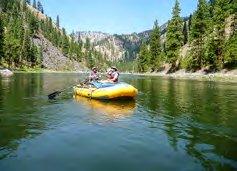
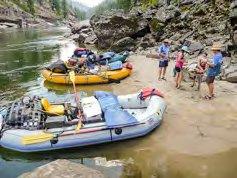
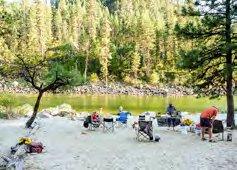
On the river we will sleep in, sit lazily on the boat, swim, take in the sights, have fantastic meals around big campfires Our river rafting adventure was the one part of the trip that turned out just as expected. We had all the comforts you could possibly imagine. Each day we would wake from sleeping under the stars, since the dry environment kept away condensation. After sleeping in we would ease back into folding camp chairs for a mug of tea or coffee. After morning chats we would have pancakes, eggs and bacon, or fresh fruit with yogurt and muesli.
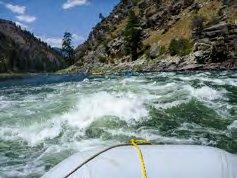
We would load up the boats and float gently down the river, getting excited at the occasional rapid. All the while we took in the history of the pioneering people who had attempted to make a living in this isolated canyon. We stopped to look at pictographs left behind thousands of years ago by Nez Perce and Sheep Eaters (indigenous tribes), rocks where early miners carved their names, cabins where whole families lived in one room, and Buckskin Bill’s infamous rock turret to defend himself from the US government. We took a longer stop at Yellow Pine Ranch where the caretakers showed us their museum and extensive garden, and also shared a slice of chocolate banana loaf fresh from the sun oven. We would pull up on white sandy beaches for lunch and more sun cream. Then have a few more hours floating and in some cases the captains even let us row (Tony’s past paddling skills giving him an advantage in keeping a straight line and even navigating some rapids). Hours before the late sunset we would find our campsite usually with another white beach and set up the tables and chairs for cocktails. We took turns cooking dinners of steak, spaghetti, enchiladas, teriyaki chicken and pork ribs. By far the most popular dessert was the Tim Tams we brought.
It was a fantastic trip and while many things weren’t as we imagined them in our mind it was all the more exciting to approach each day with no expectations and instead with a sense of curiosity.
Comments
Comments are not open yet.