
Text taken from the club newsletter.
THE WAY WE WERE
A yesteryear’s Xmas trip by TONY GAZLEY
It seems a long time ago that trampers carried hideously uncomfortable Mountain Mule packs, walked in heavy ill-fitting boots, and wore japara parkas that seemed to be designed especially to get you wet—and, because dehy food was mostly inedible, even took a rifle on Xmas trips to get the food for some evening meals. But with all of the above, eight young blokes from the club set out some years back on a trip to the Wiatoto Valley— one of the more rugged and least visited areas of South Westland.
Their idea was to climb out of the head of the valley and sidle beneath Mt Aspiring to the Bonar Glacier and then down to the West Matukituki Valley where there would be a food drop at Aspiring Hut. Then over Arawhata Saddle and up the Joe River, and finally over O’Leary Pass and down the Dart River to Glenorchy to complete the 14 day trip. Mostly it all went to plan— with the exception of a few unexpected adventures on the way.
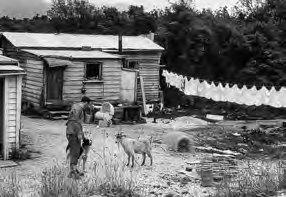
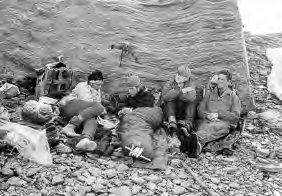
They arrived at Wiatoto—a settlement of about half a dozen houses where residents survived thanks to venison and whitebait—and were a bit surprised to find the jetboat that was to take them through the first gorge was lying submerged on the bottom of the river. So the first job was to refloat the boat and for the mechanics in the party to help the owner take the motor apart, dry it out, and get it going again. Eventually though after two boat trips they all arrived with their 30 kg packs on the first grassy flats and set off up-river.
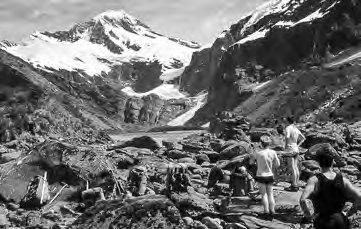
ABOVE: The head of the Waiatoto with Mt Aspiring behind
RIGHT TOP: Dennis with some of the Waiatoto locals
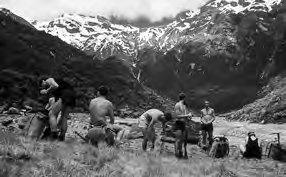
RIGHT BOTTOM: Taking a rest near the head of the Wiatoto
The travel was typical West Coast river-bashing with awkward boulders along the sides and thick bush on the terraces. It was a hard slog for the first few days but they mostly made good time to eventually emerge just a bit battered at the head of the valley.
And this was an extraordinarily dramatic place. A large cirque with glaciers leering over the tops of high vertical cliffs, waterfalls that were feathered in the wind before reaching the valley floor, and just a few grassy areas beside the old moraine walls. Then to complete the picture standing head and shoulders over everything with its summit above the clouds was Mt Aspiring. Nearly everywhere they looked was either very steep or vertical—no wonder they had not been able to find out from anybody if it was possible to climb out of the place—probably no-one had ever tried.
They pitched their tents, prepared a meal and then lay back trying to figure out a way they could get out the valley and onto the Volta neve, and then under the western buttresses of Aspiring. It all seemed very difficult but they thought there may be a couple of possibilities.
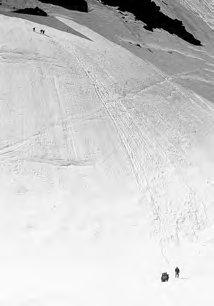
Next morning they headed up the slopes they hoped would get them to the neve. As it turned out they had picked a good route and though steep was not too desperate. Later in the day they stood on the crest above the neve with grand views across to Aspiring and in the other direction out to the coast at Haast. They glissaded down to the neve itself, pitched their tents then went to check out the slopes beneath the rocky ridges of Aspiring.
It didn’t take long for them to realise that the snow was steep, very unstable, and that they wouldn’t safely be going that way. But they didn’t have another plan—so their big problem now was how to get off the neve!
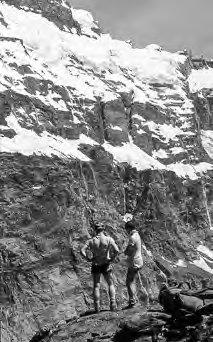
They pondered over the map and next morning plugged their way around to the col above Wilmot Saddle where they thought it may be possible to climb down to Ruth Stream. But one look over the edge to the near vertical slopes below and that idea was ditched. So they went further around to Ruth Spur. This looked only marginally better but they had to get down somewhere so down they went. It took them many hours of down- climbing very steep and scary rock and snowgrass, with a few abseils for good measure, before they arrived at Ruth Flats. The flat terraces seemed like heaven with climb to the Volta neve. Aspiring behind ridge to the Volta neve warm sunshine, a sparkling river, soft grass for their tents and enough scrub for a fire to cook tea.
ABOVE: Resting on a rock ledge part way up the
RIGHT TOP: Looking down to the Wiatoto River below
RIGHT BOTTOM: Glissading down from the
But although they may have been over the worst problems they certainly still had a major one to sort out. For at the time of their trip there was no track down the East Matukituki Valley and the gorge below them had a fearsome reputation. But there was no alternative except to head down the river next morning and just take whatever they found. Fortunately they were all happy enough with big rivers and linked up in two groups of four they formed strong teams that could get through all the tricky crossings of the swift and gorgy river though not without a struggle on a few nasty ones.
Thinking that reaching the end of the gorge was the end of their problems for the day they relaxed as they headed down towards the West Matukituki and their food drop. But they hadn’t gone too far when they came across a solitary tramper lying unconscious in the hot sun covered in bites from swarming sandflies. They tended to their patient while the runner in the group left his pack and took off across the river flats to the Aspinall’s homestead thankfully at that stage only about 4 km away.
Fortunately one of the sons was home helping on the farm and he drove a tractor and trailer back to the group, picked up the tramper who had now regained semi-consciousness and much later they all arrived at the farmhouse. By this time Mrs Aspinall had the kettle boiling and the scones with jam and cream on the table. And if that wasn’t enough the Aspinall family put them all up in the shearer’s cottages for the night after giving them a hearty famer’s tea.
They had an easy wander up to Aspiring Hut the next day and picked up their food for the next 7 days before heading up to Liverpool Biv for the night. At this point they found the leg of ham they were carrying for the evening meals when they didn’t have venison had become fly-blown and some time had to be spent getting rid of the maggots before they could eat their tea.
Next day was the climb to Arawhata Saddle which although it meant climbing long steep snow slopes was easier for them than for travellers today now that the snow has receded over the years leaving crumbly rocky cliffs. Then down to the spacious Arawhata rock biv for the night. Next day was the first lazy start on the trip and it was a fairly easy wander down to Williamsons Flats with its big area of golden grass looking very welcoming in the warm sunshine. Then the following day up the Joe
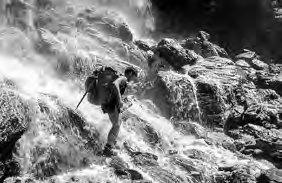
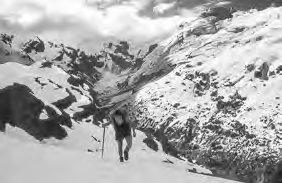
TOP: A quick game of chess and a smoke while waiting for the weather to clear
MIDDLE: On the way up to O’Leary Pass
BOTTOM: Climbing out of the Joe River
River on the deer trails through the bush to camp on the grassy flats below O’Leary Pass.
There were many stories told of crossings of the pass—from parties that had made it relatively easily to others who had had desperate struggles. It seemed that unless you followed the tricky route exactly there were likely to be significant difficulties. The club party were not sure if they followed the route correctly or not but there certainly were significant difficulties anyway— from the expected very steep snowgrass to the waterfall where you went behind the water as it poured over the cliff above, and much more besides.
They were all relieved to make the top safely and agreed that it was definitely a onetime crossing—there would be no going back to ever do it again. They camped behind the rock walls built on the ridge with only a couple more days before the trip would be over.
Next day was down to the Dart rock biv where everyone was by now getting very hungry, so in the afternoon some of the group headed up to Dart Hut to check if any spare food was lying about while the hunter went out looking for tea on the hoof.
No-one was successful so it was a hungry night before the long drag down valley to Glenorchy next morning. A restful trip down Lake Wakatipu on the steamer Earnslaw—where there was food available—to Queenstown and over the next couple of days the long trip back home.
It had been a wonderful adventure travelling through some of the most challenging tramping country in NZ. There had been that satisfying sense of camaraderie that comes with everyone sharing a common goal and everyone being confident and capable enough to be able to contribute to the party’s wellbeing. There were lots of laughs and not a single angry word—well maybe just a few directed at some of the scariest countryside.
Those who shared the wonderful adventure were: Allan Higgens, Noel Thomas, Dennis Gazley, Pete Goodwin, Murray Brown, Graham Westerby, Kevin Moynihan and Tony Gazley.
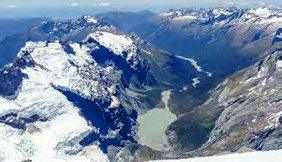
PS. Quite some time after the Wiatoto trip one of the group climbed Mt Aspiring and could look down into the valley they had tramped up some 30 years before. The changes at the head of the valley were rather staggering. All the flats where they had camped were gone, simply drowned by a large terminal lake that had formed where once there had been a much smaller pond. The glaciers flowing into the head of the valley had either retreated or disappeared completely. Altogether it looked a sorry wreck of what it once had been. Although of course when they first saw it then it was already a wreck of what it had been sometime before that.
The top photo is looking down from the summit of
Mt Aspiring into the Wiatoto Valley. The large terminal lake was not there when the Xmas trip passed by. The party camped somewhere where the lake is now and then climbed up the slabs near the bottom right of the photo.
The bottom photo is taken just to the right of the top one and is looking down onto the Volta neve. The Xmas trip party climbed up to the ridge at the bottom left of the photo and then dropped down the snow slopes to camp on the neve below. Next day they traversed along the length of the neve and around the corner to Ruth Spur to get down to Ruth Stream and the East Matukituki Valley.
Both photos above by Jackie Foster.
Comments
Comments are not open yet.