
Text taken from the club newsletter.
7 BROCKEN SPECTRES IN ONE DAY by JENNY COSSEY photos JENNY COSSEY and PAULA MacFARLAND
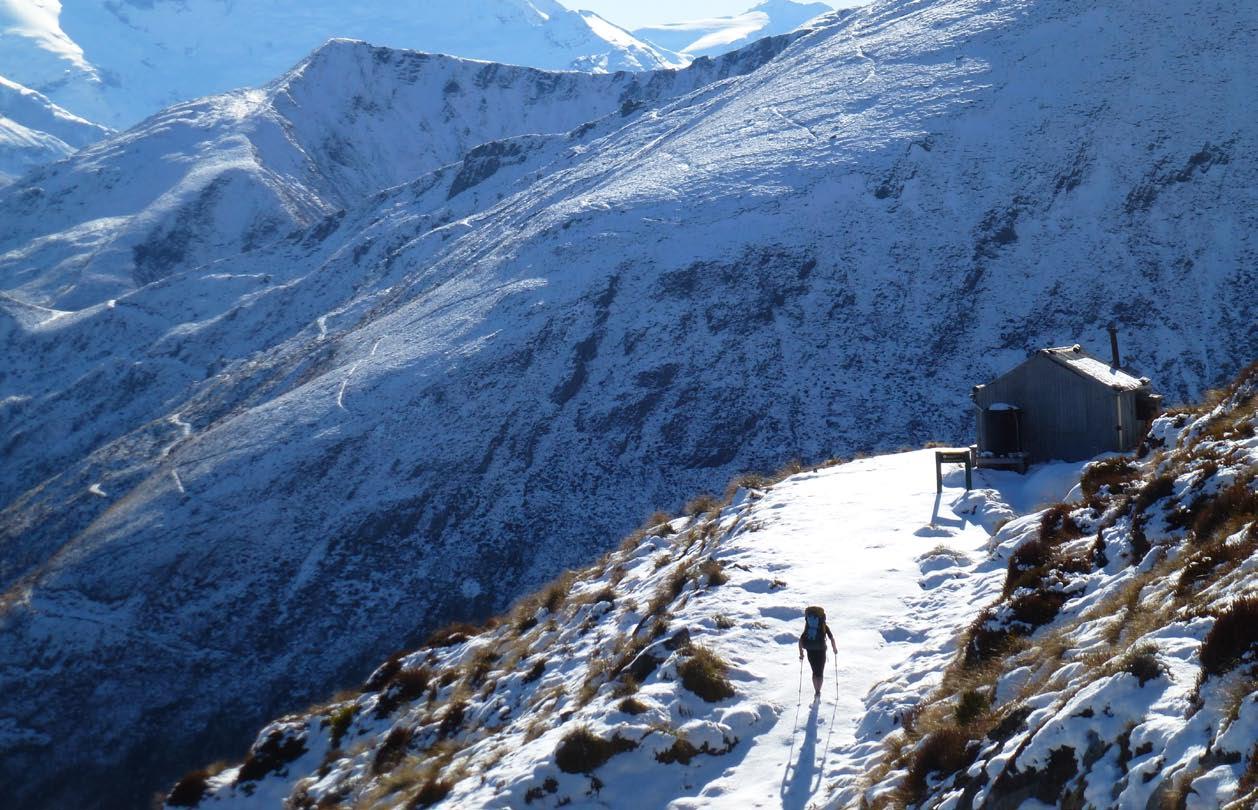
Heather Jock Hut
To avoid the congestion, bustle and noise of Queen- stown in the school holidays, a wee gem of a trip is a short 30 minute drive west of the town along Lake Wakatipu. Three kilometres before Glenorchy is the Mt Judah Track heading into the Richardson Ranges, Whakaari Conservation Area. During the Land Tenure Re- view process the area was deemed to be of national historic importance and in 2009 DOC obtained seven huts and the Judah/McIntosh mines, perched on the mountainsides 1000 metres above sea level. DOC has preserved the huts. The slowly re-vegetating workings remain as a reminder of the ingenuity of the scheelite mining industry miners who lived in the area until the 1960s hand-picking or dangerously blasting the ore from the land before dragging it by horse sledges and tractors down to the valley floor. (Scheelite is a mineral used for hardening steel gun barrels). Of the seven huts, four are now deemed historic (suitable for day use only) and three are suitable for overnight stays, although none have heating. Each of the seven huts has its own quirky features and can be visited on foot or by mountain bike in a weekend. Seven huts in two days was a good hut bagging goal for Paula and myself.
From the car park a climb leads up onto the old Mt Judah road, which sidles around the northern side of Mt Judah passing the remains of the Glenorchy Scheelite Bat- tery and the State Mine, last operated in the 1960s. Con- tinuing up the road, past The Junction, the track crosses the Bonnie Jean Creek to the historic Jean Hut (day use only) with it rocks ‘dripping off’ the roof to stop the tin flying away.
A marked track follows an old mining road up a zig-zag to the Heather Jock Hut (three bunks) with its eight pane glass front door. We left our packs here and wandered up the four-wheel drive track until it petered out.
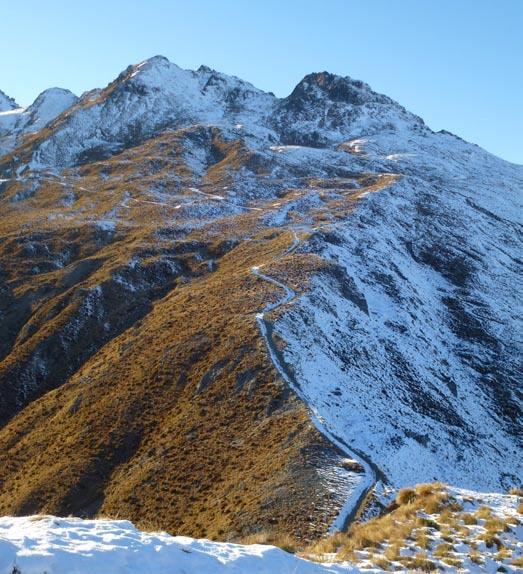
With ice axes in hand, we climbed the snowy ridge to Mt Alaska with stunning views to Mt Larkins and the snow filled western basins used by heli-skiers. As we did
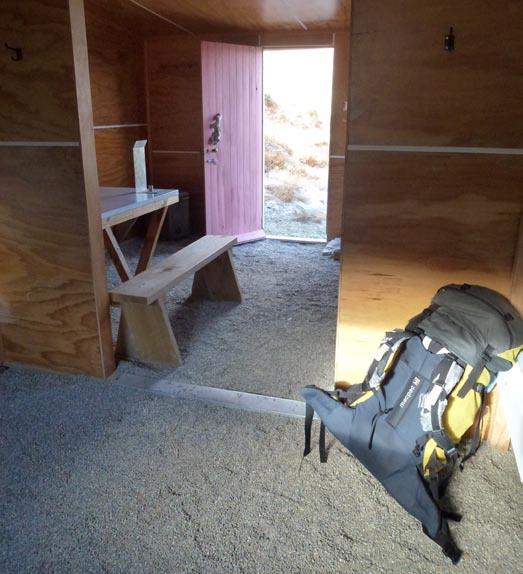
Mount Alaska McIntyre Hut’s pea-stone gravel floor not have a rope I was quite glad we decided to turn back rather than continue along the arête ridge to the higher peak of Mt Larkin. We returned to a cold night in the hut. Dinner ensured our full bellies stoked our internal heat- ing systems until the sun rose the next morning to warm us, but not the frozen water tank which required the icy surface to be smashed by ice axes. We were very glad we had filled the billy and water bottles the previous evening for the morning brew.
The following day we descended the same track before sidling down and across to the Bonnie Jean Hut (day use only) with its adjacent tractor shed, untouched since the 1960s. All the mementoes left as found, a museum behind iron bars.
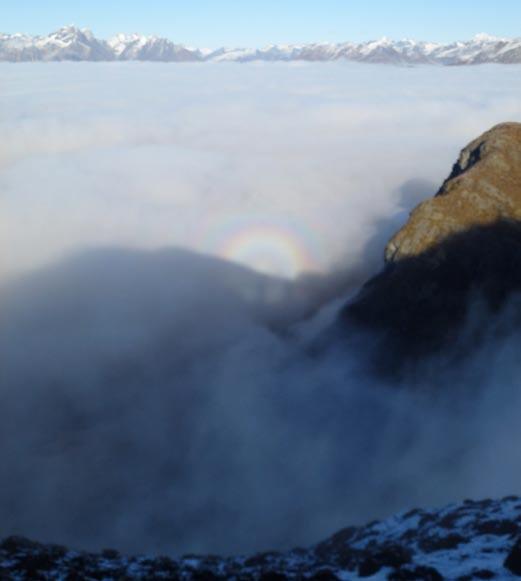
A Brocken spectre (German Brockengespenst), also called Brocken bow or mountain spectre, is the ap- parently enormous and magnified shadow of an observer, cast upon the upper surfaces of clouds opposite the sun. The phenomenon can appear on any misty mountainside or cloud bank, or even from an aeroplane, but the frequent fogs and low-altitude accessibility of the Brocken, a peak in the Harz Mountains in Ger- many, have created a local legend from which the phenomenon draws its name. The Brocken spectre was observed and described by Johann Silberschlag in 1780, and has since been recorded often in literature about the region. However, it can be seen in any mountain region. (Definition from Wikipedia)
Descending to Boozer Hut (aptly named after its last inhabitant) we found a dead kid outside on the grass with a nanny bleating near-by. This hut was moved by DOC from its previous site 100m uphill as it was deemed to be in a landslip area. The historic items inside the hut were carefully replaced in the same position after the relocation.
From The Junction we follow the steeply dropping marked track down to the Buckler Burn with its huge icicle covered walls of rock. A steady climb up an old min- ing road led to McIntyre Hut (three bunks). The external pink paintwork matched the pink hue in the sunset. This was my first visit to a hut with a pea-stone gravel floor. Neatly raked, it required no sweeping and no condemna- tion from anyone about wearing crampons inside. How-
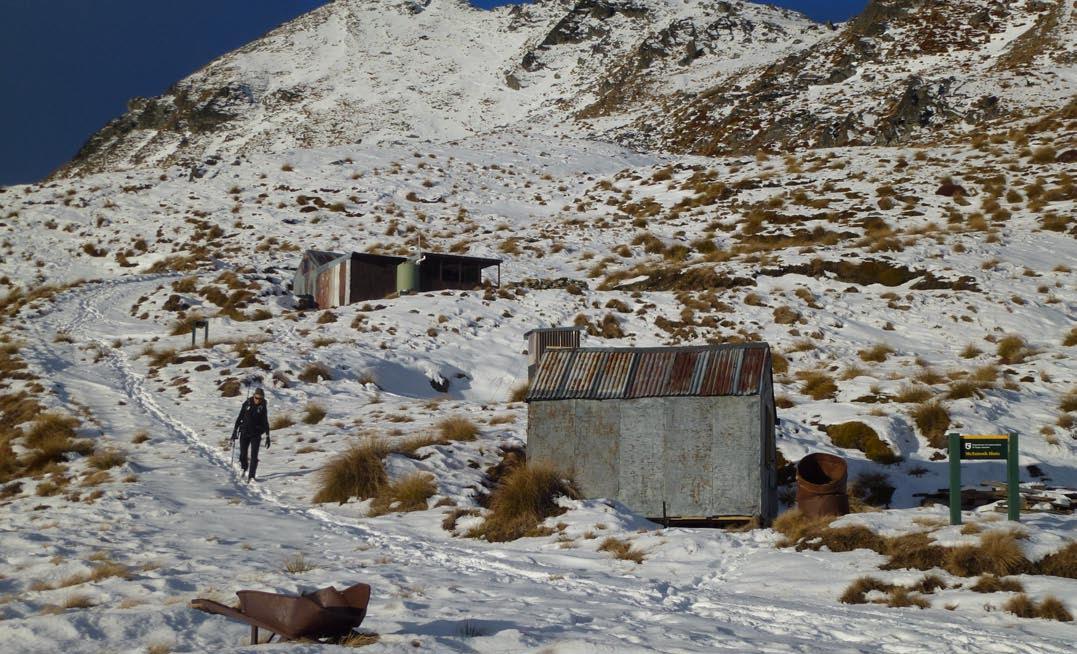
McIntosh Hut and McIntosh Peak
Brocken spectre ever, late night visitors heading to the toilet would wake everyone with the loud crunch crunching, however quietly they tried to tip-toe.
Further up the hill below McIntosh are the two McIntosh Huts. One is historic and draughty, the other a four-bunk hut with a bar and wonderful sink. We left our packs there to ascend McIntosh with axes, crampons being required for the summit 10 metres.
Collecting our packs we descended to Long Gully Saddle and a steep climb along the ridge gave superb views of Lake Wakatipu, Mt Earnslaw/Pikirakatahi, and the Dart Valley. The descent from here back to the Glenorchy road and the car is not recommended for mountain bikes as it is steep and unformed and follows a ridge fence line with steep drop-offs which would not be desirable in steep snow. But on this day as our shadows danced on the val- ley cloud, our first Brocken spectre appeared. Slowly four more complete rings circled our dancing shadows and a further three broken arcs surrounded us, seven brocken spectre rings in one moment with the distant peaks be- yond in blue skies.

Comments
Comments are not open yet.