
Text taken from the club newsletter.
THE WTMC QUEST TO FIND HAPUA KORARI
A navigation adventure in the Tararuas by HOLGA FIEDLER
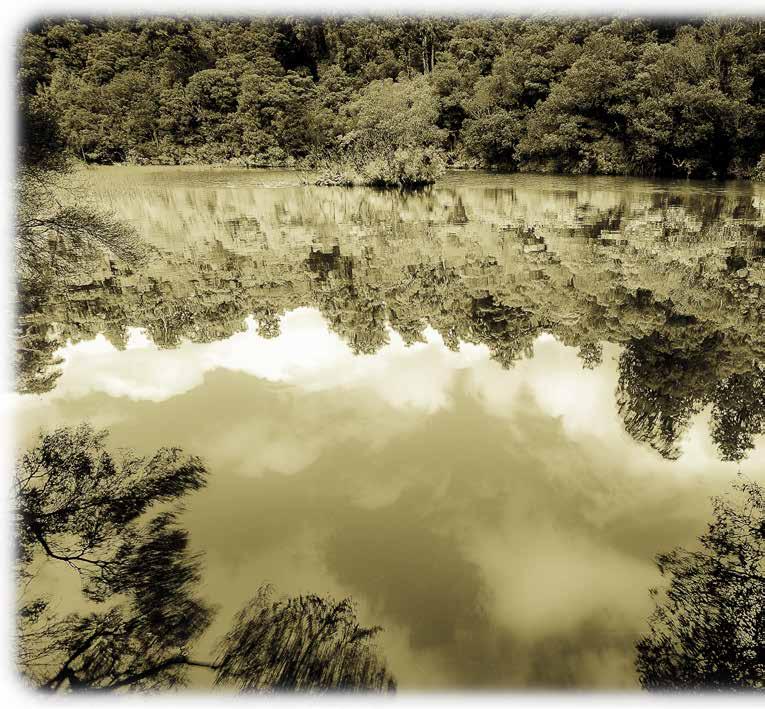
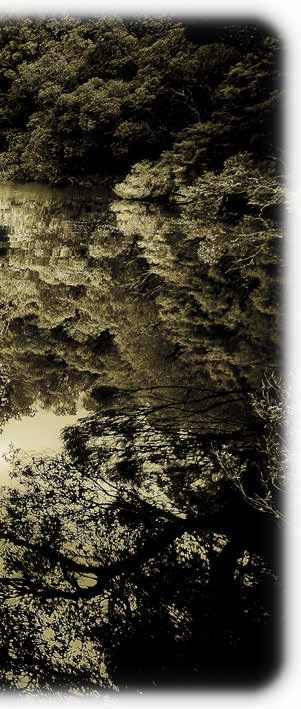
Hapua Korari
In Maori mythology Hapua Korari was a sacred lake in the Tararuas, hidden in the dense forest with the huge rimu trees, and where the legendary bird, the hokio, lived in the company of kotuhu, huia, kereru and kaka. The lake was a retreat of the Tohunga who would go there to commune with the Atua and gather the rare plants that grew there for medicinal purposes.
During the 19th century there were the first Pakeha attempts to find the lake—since the lake was sacred the tohunga would not disclose its location. The government even offered a £200 reward to the discoverers. In 1885 Charles Bannister and his two friends Mundy and Akitu set out on an expedition to find the lake—but were unsuccessful. One of the difficulties the explorers faced was deciding in what area of the Tararuas the lake could be. Maori on the eastern side of the Tararuas thought the lake lay near the headwaters of the Ruamahanga River, while Maori on the western side thought it was somewhere between the headwaters of the Otaki and Ohau Rivers. In 1898 Duckett and Harris found a small lake hidden in dense bush near Ruamahanga Forks. This lake had a small island which fitted perfectly the description given by the eastern Maori, and the mystery of Hapua Korari seemed solved. But in 1920 a party of explorers found what appeared to be the remains of a small lake on Oriwa Ridge, and although apparently drained it was located where the western Maori had described it, just south of Wiaopehu overlooking the Horowhenua. It is now known that a fault line under the lake has moved in historic times opening a fissure that remains today and that there would certainly have once been a lake filling the hollow.
So if from the stories told about the lake it appeared to have had a dual personality it was because there were actually two lakes that were both known as Hapua Korari. But there are differences—the eastern lake has an island the western didn’t. More importantly the western lake has large flax bushes and the eastern doesn’t. Since Hapua Korari means hapua (lake/ pond in a hollow) and korari (flax sticks) then the western lake would seem to be the real Hapua Korari. But all this doesn’t really matter—the two histories can be accepted and simply be separated and each part attributed to the correct lake.
Bannister’s diary of his attempt to find the lake still exists today and makes for fascinating reading. He started from the Waingawa Valley with his two friends carrying between them a rifle, 2 billies, 2 pounds of rice, a dozen shallots, and some home-made scones. They travelled over Baldy (called Baldhead then) to South King and then to Dorset Creek where they tried panning for gold. Then to the Waiohine River and up the Park Valley to Pukematawai arriving after 5 days travel. The next day they headed for Arete (named Hanga Ohia Tangata then) only to find stormy clouds heading their way over Dundas. The Maori guide Atiku was certain (correctly) that the lake was not far away but with almost no food remaining and bad weather approaching they turned around and headed towards Girdlestone before dropping down a spur (probably Pinnacle Spur) to the Waingawa River and camping at a major junction (Arete Forks). They shot a blue duck here but found it almost inedible. Then on up Table Ridge, and down to Mitre Flats via the spur next to North Mitre Stream. Here they caught and cooked pigeons, weka, huia, kaka, and a large eel. Eventually they returned to civilisation via the Mikimiki. Bannister swore he would never go to the Tararuas again—but he was back again the following summer. [Ed.]
The ultimate goal of this trip was to practice navigation in the Tararuas, so Megan came up with the idea to search for the hidden lake ‘Hapuakorari’. We all met at the Wellington Railway Station on Friday evening, map and compass at hand, to head off on our adventure. After a short dinner stop in Carterton, we drove on to the DOC Kiriwhakapapa campsite for the night. Most of us decided not to bother with pitching flys and instead to sleep inside the shelter while four brave people camped outside the shelter under the trees. Just after we were ready for a good night and the fly was set up the rain started. The fly survived! After the rain stopped, the beautiful night sky became visible but the wind started to pick up, getting stronger and stronger, even lifting up the sleeping bags inside the shelter. It must have been around this time that the action on the camp ground started because the brave people had to abandon their damaged fly and move into the shelter.
The next morning we started with a relaxing breakfast and headed off to the Putara road end to finally get our feet moving. Here we were greeted by an enthusiastic, barking, farmer’s dog. We checked our map and found that there was a small lake marked in the midst of the Tararua forest, not too far from the track towards Roaring Stag Hut, and we concluded that this had to be Megan’s hidden lake. So we started to follow the Roaring Stag track and after approximately two hours we reached the junction towards Herepai. Here we got a more detailed introduction on the use of the map and compass and made the decision to minimize the off-track travelling distance by picking the shortest way between the track and the lake. After another hour of tramping along the path and an extended lunch we turned right, heading straight into the untracked Tararua forest.
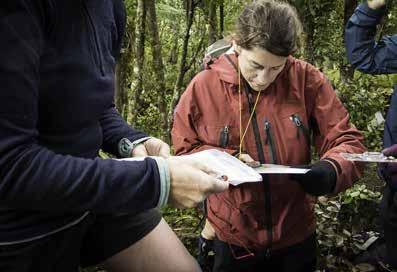
Navigating through the forest
Pondering
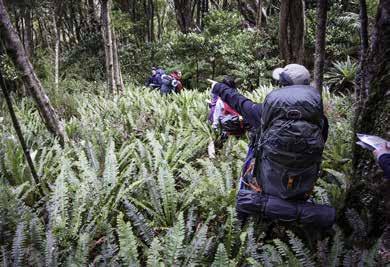
Through the lush forest we went, with the leaders at the back letting us roam freely, curious where we would take them. We chose to follow a little creek to drop down to Ruapae Stream which according to Tony was an interesting approach since instead of choosing the easy forest to either side to walk in we preferred squeezing through the narrow, steep and crumbling rocky creek-bed until we finally reached the stream! Across the stream we went following further the compass bearing, climbing small ridges not indicated on the map and dropping down from them again, until Adrian, peering through the thick bush, exclaimed, ‘there’s a big hole down here so we’ll have to go around’! To which Tony replied, ‘right—and what are big holes often filled with?’
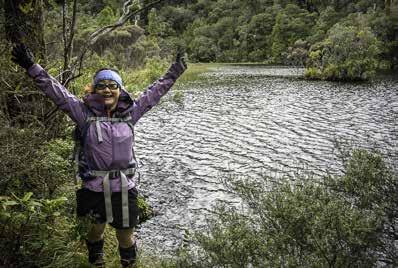
We’d found the well-hidden lake, ‘Hapuakorari’, in the midst of the Tararua forest! We were pleased with
Jue celebrates finding Hapuakorari ourselves and stayed here for quite a while enjoying the moment and taking photos.
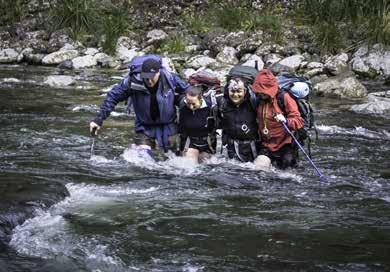
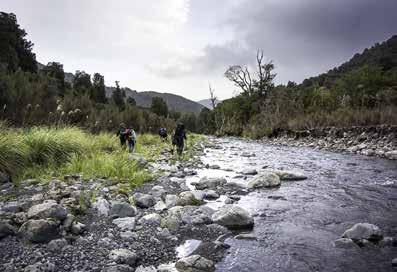
From the lake we tramped on the ridge between Ruapae Stream and the Ruamahanga River towards the Ruamahanga Forks. Following the true left of the river, we finally saw the hut. However, here the river filled the complete valley. Initially we attempted to sidle along the tops of the river bank and thus managed to circumvent the first narrows of the river valley. With the Roaring Stag Hut only about 200 m away as the bird flies, we were left with two possibilities. Either we climb up to the nearby ridge and go down from there to the hut or we cross the river, travel through flat forest terrain and then cross back taking the bridge of the Cattle Ridge track. We wanted to practise river crossings anyway on the weekend, hence we choose the latter option,
Ruapae Stream linked-up and finally arrived the Roaring Stag Hut after approximately 8 hours of enjoyable tramping.
Surprisingly, the Medium-Fit group were here as well. When we started to cook our three-course dinner, they were already enjoying their packets of dehydrated meals after a strenuous 3 hour track walk!
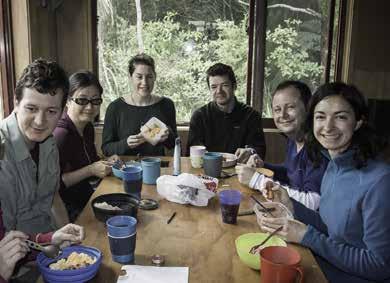
We had a relaxing sleep-in on Sunday with Tony and Megan awakening us with a surprise—a luxurious egg and potato fritter breakfast before we set out for a 4 hour stroll back to the van at the Putara road end. Again we were greeted enthusiastically by the dog before we headed back to Wellington. A special thanks to Megan and Tony, as well as the fellow trampers, for making this amazing trip so special and memorable.
Those on the trip to the Hidden Lake were Bram, Marieke, Jue, Andy, Adrian, Chloe, Holger, Jo, Tony (photos), and Megan Sety (leader).
Crossing the Ruamahunga River
Sunday breakfast—freshly scrambled eggs, potato fritters and plunger coffee
Comments
Comments are not open yet.