
Text taken from the club newsletter.
INTERMEDIATE BUSHCRAFT
Mama Mia! How to boost your survival skills and have a good time by VIOLA BALZARETTI
When I first arrived in New Zealand in early March 2018, someone reassured me that here there were no dangerous or poisonous animals trying to kill you. No, in New Zealand it’s the land you need to be aware of!
My first tramp with the club (Mick-ey Mouse Business in the Tararuas) was enough of an experience to understand how little I knew about the outdoors and to realise that ‘I am not in Italy any more’. It is fair to say that the Mick tramp was a particularly unfortunate navigation exercise in the Tararuas which was planned as Easy-Medium and ended up being a 12-hour day. So it may not be a representative example—nevertheless, I felt I needed more familiarity with some basic concepts and procedures.
With this in mind, I was glad when Kevin redirected my initial curiosity for the leadership course to the Intermediate Bushcraf instead. To be honest, I didn’t know exactly what to expect when I signed up. I had glanced at the agenda and spotted the basics that would have been necessary to get around tramping in the New Zealand bush. In other words, it sounded the right place to start. At this point, I could not foresee how much more I was going to get from it.
Te course developed over three weeks, inclusive of two indoor lessons and two practical sessions. It was led by Kevin Cole and Richard House, with the support of Uta and Matthew as co-leaders and lecturers.
I started eager to learn and full of expectations, but afer the first indoor lesson I had a few doubts. Te programme for the indoor Wednesday classes covered a number of key aspects such as weather, how to interpret and read forecasts and maps, the basics of navigation and a few useful knots. Still, I wasn’t entirely convinced about the time allocation to each topic and I had a general feeling that we were skipping too quickly on some aspects (such as survival tips), while lingering too long on others (such as navigation).
It all became clearer when Matthew led the first practical navigation exercise afer the second indoor class. So glad the test was run in town! Navigation is not complicated, but it does require a little practice. It took me a few tries to fully understand the process, and I eventually passed the exercise and made it home without getting lost in the nearby supermarket’s parking lot. Afer that experience, taking bearings became simpler and faster.
On the very first day we had been provided the DOC bushcraf manual. A useful pocket-size guide to keep around. I have to admit I procrastinated the manual reading until the inevitable last night before bushcraf weekend. Moreover, if it hadn’t been by chance, I would have failed completely to read it. Te manual was not going to fit in my pack and it was unnecessary weight so I lef it on a table. While I was packing my extra three litres of water (why I carried so much unnecessary weight, I still ask myself, why!) I inadvertently knocked off the manual and it opened on a random page. I couldn’t help but look at it and start reading the page (gear). Uhm I thought, ‘this might be useful before closing the pack’. It was captivating and I kept on reading. On one hand I wanted to get the best out of the incoming weekend, on the other I didn’t want to be the ‘bad student’ who doesn’t finish homework, and kept reading.
I ended up reading a ridiculous number of hours (that you could count off the fingers of one hand) but I was happy I could finally connect the dots with the lessons, and appreciate how these were meant to fill the gaps in the manual or further specify the generalist chapters. If only I read the manual when it was given to me!
The bushcraft weekend
I grew up in Italy, where the first things they carve in your brain cortex about tramping are, in this order: 1) do not wander in the dark; 2) cancel your trip in case of rain; 3) never go off track. But this is New Zealand, and this is intermediate bushcraf. Bear this in mind while you keep reading.
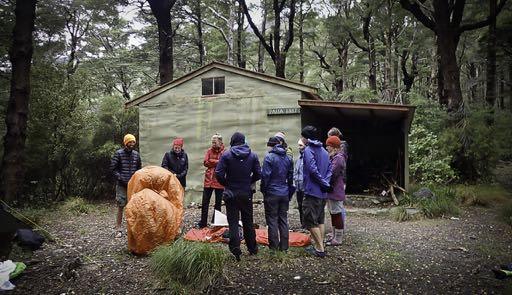
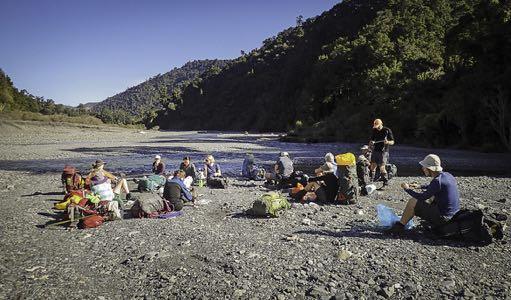
Te bushcraf weekend was wonderfully organized by our two leaders Kevin and Richard and two co-leaders Uta and Matthew in the Remutaka Forest, along the Orongorongo Track and at the doorstep of Paua Hut from May 4th to May 6th.
Te 11 attendees were split into two teams: Red (Matt, Holly, Emily, Fons and me) and Blue (Jess, Juan, Rosanne, Maj-Britt, Heather and Beth).
Exorcising the fear of the dark
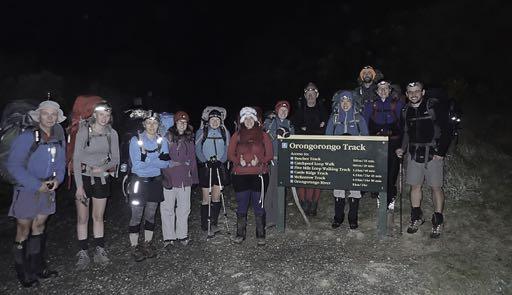
Te first rule I was taught as a kid is ‘no hiking in the dark’. Tis was totally busted the moment we set foot off the club van. I still believe it to be a good rule of thumb on most backcountry tracks, however, to be fair the Orongorongo Track is very clearly marked and paved. It would take a considerable lack of attention and a serious intention to get lost on it, even in the darkness.
The importance of selfie
If you have ever been on a tramp with me, you will have noticed that I have a tacky tourist spirit, and at one point or another, I will call for a ‘selfie time’! Well, I learned that selfies may not (only) be idiotic or ludicrous time killers on a tramp. In certain circumstances they perfectly serve the purpose of tracking time, routes taken and people. No worries, it doesn’t spoil the fun of making silly faces or posing.
Gimme shelter
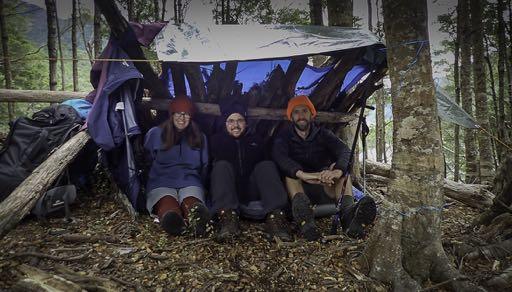
If walking a few hours in the night was not enough, once we reached Paua Hut we had to swallow the hard truth—we were not sleeping in the hut. Te first challenge on Friday night was to set up the small flies and set camp around the hut. We ‘cheated’ just about enough to have a hot drink inside the hut but other than that we were outside.
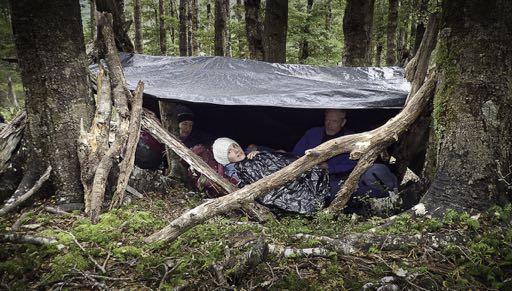
I had never slept under a fly before. I was a bit concerned about atmospheric agents, humidity, and skeptical that I could actually rest. To my surprise I had a nice and comfy night! Te second night was even more surprisingly good, considering we caught a bit of rain before dawn. But in the bush you need to be prepared for the worst. What if you have to create your own shelter from scratch? Tis had been the topic for our morning task on the next day.
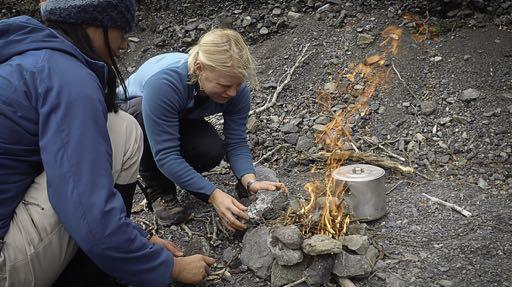
Is it a rolling boil yet?
As part of our training we were supposed to light a fire (matches allowed) and bring a billy of water to a rolling boil. It wasn’t super windy, but enough to challenge some of our rudimental wind shields.
The battle of the gear—part 1
If you have been on bushcraf with Kevin and Richard you will understand immediately the reason for the cap- tion, and why I referred to it as a battle. Te gear showcase was one of the funniest moments of the entire weekend. I have never assisted to such a fun debate on ground sheets, tents, flies and sleeping bags. It was not just a mat- ter of performance versus weight, it was also a matter of traditional versus high tech.
Because Kiwis like to get their feet wet
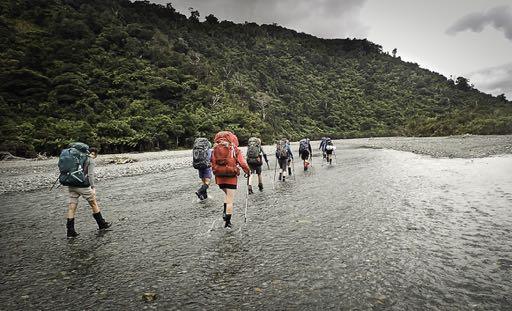
Te first time we got our feet wet was inevitably Friday night, on our way to Paua Hut. Crossing waterways can be considered the fourth element on the Italian hiking beginners ‘don’t do it’ list, going hand in hand with wearing wet boots and socks! But this is Intermediate Bushcraf, and we were expected to.
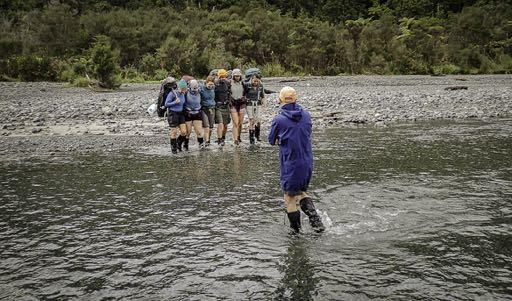
On Saturday morning, we had a little river crossing special session, and no need to say it, it was so much fun! We learned some basic safety rules and practised different procedures to cross rivers as a group.
The battle of the gear—part 2
Second part of the gear showcase was down to the technicalities of the different types of fuel and stove. From Kevin’s self-made penny stove, to Richard’s brass one. Once again, this session was both useful and hilarious.
Emergency kit
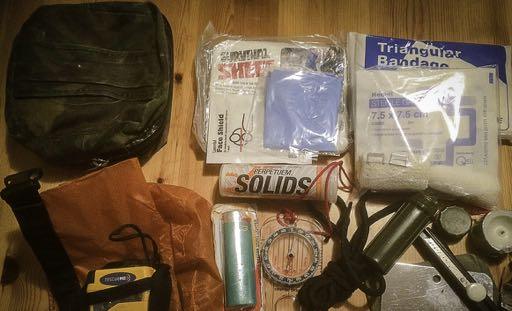
It can be summarized in one caption—bring one Heather to get two emergency kits, just in case.
For those who missed the actual scene, we had a little ‘show and tell’ of our emergency kits and no matter what the item was, Heather seemed not only to be 100% onboard with the items, but to have a double, just in case -. Afer the weekend she kindly shared her emergency kit list with the group—soon to be included as an appendix to the next issue of the DOC bushcraf manual.
Food—lessons learnt
Regardless of your food preferences, being Italian is like having a mystical experience with food. I learned all my unpreparedness when I realised that my food supplies for a weekend tramp added up to about 3 kg (what the heck!). I will share this example of how poorly I arranged my food supplies. I love oats for breakfast, especially with a bit of cacao powder and dried cranberries. Tis is also a really good tramping breakfast—if you bring it dry and add hot water at the moment. In my naïve and unexperienced enthusiasm, I carried the equivalent of four large breakfasts (intentionally extra, as emergency food) already cooked ….
Lesson learnt. Since then my food packing has improved three-to-four fold nutrition-wise and halved in weight!
Saturday night we had a nice communal dinner under the large fly at the camping site—four billies going, two per team, and we went to bed early.
Scenario and simulation—take it with a smile
What if you found yourself in an emergency situation? Afer Sunday’s lunch our leaders organized a timed simulation to test our abilities to take care of emergency shelter, food, first aid, and emergency communication skills. Each team had to complete all tasks efficiently in a given time and clear up aferward. I loved that the selected emergency signaling to be portrayed was a 3m x 3m smiley.
Closing the circle
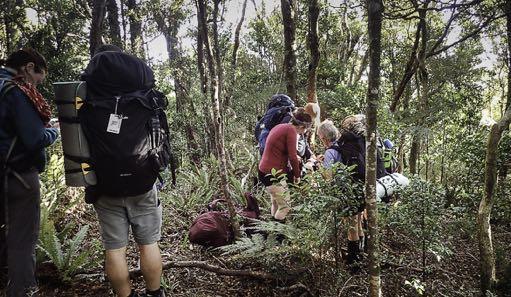
To close the circle, the last bit of our weekend basically went back to the beginning—navigation and bushbashing. Afer a slow start with the exercise in the urban environment, I was surprised to see I actually got the grip of it!
We lef the Orongorongo Track for an alternative path and tried in turns, to navigate small groups. In the end, we all got back to the Catchpool carpark, so we can call it a successful exercise.
On the way back I only heard positive feedback. I personally enjoyed it very much and hope the leaders and co-leaders know I had a great time. I can only recommend it to the next generation of trampers. Key takeaways from the weekend for me: Learn how to navigate first; read the manual beforehand and, in case of emergency, bring at least one Heather.
Comments
Comments are not open yet.