
Text taken from the club newsletter.
SOUTH GEORGIA by KATJA RIEDEL
The most amazing island on Earth—bar none
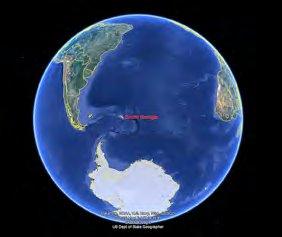
South Georgia sits at the fringes of Antarctica, a chunk of land thrown into the middle of the Southern Ocean. Wild ice-covered peaks rise into the sky, albatrosses soar the ever-blowing wind, massive glaciers calve into the sea and waves pound beaches filled with wildlife so dense that it is hard to find a place to walk. In summer thousands of fur seals, elephant seals, and king penguins congregate here to fight, mate and rear their young.
For me South Georgia was always a dream, my Ultimate Thule. I read books about Shackleton’s harrowing journey after his ship the Endurance got crushed by ice, from Elephant Island to South Georgia, 800 nautical miles across the Southern Ocean in a small boat that I wouldn’t want to take outside Wellington Harbour. Having landed on the uninhabited southern side of the island they then had to cross the unknown mountainous interior with nothing more than a carpenter’s axe and a few screws fixed to the soles of their leather boots. I was glued to my seat when Graham Charles talked about the first kayak circumnavigation of South Georgia, achieved by a Kiwi team in 2005—and for Colin Monteath, photographer, traveller and Antarctic guru, South Georgia is the ‘most beautiful island in the polar world—bar none’.
How could I have said no to the offer to work as guide and lecturer on a cruise ship sailing from Ushuaia in Terra del Fuego to the Falkland Islands and then on to South Georgia? Do you want to visit the most stunning place in the world and be paid for it? We left Ushuaia at the end of January 2012 and headed southwest—and though the Falklands were interesting, reminding me of New Zealand in some regards, I was waiting for the main act. On the fifth day of our journey land started to appear on the horizon—South Georgia—finally.
It’s hard to describe what I felt when we arrived— my long harboured dream finally coming true. Joy, excitement, but also a bit of anticipation—would the weather be kind to us? South Georgia is well known for its ferocious winds and how easily bad weather could make landings impossible. We got a taste of this on our first day when we tried to land in Right Whale Bay. Katabatic winds are cold down valley winds that accelerate down glaciers and ice caps, driven on by gravity. They are the strongest winds on Earth and we were about to experience them. The whole ship was buffeted by gusts. I was standing on deck and one moment I could see the gusts coming across the water, the next I had my breath knocked out of me as they hit. Water was flung up into the air, the whole sea a violent maelstrom. No way could we launch a zodiac in this.
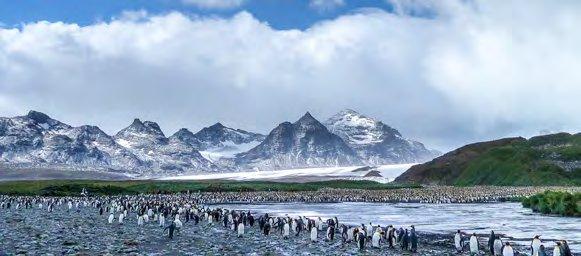
We left Right Whale Bay and anchored overnight in the Bay of Isles ready to visit Salisbury Plain in the morning where 60,000 king penguin pairs breed. Sometimes during the night the wind carried the strong smell of algae and sea bird guano to the ship. In the morning we readied the zodiacs and headed to shore. As guide you are always the first to land. When I set foot on South Georgia for the first time I felt like stepping into paradise. The beach was covered with fur seals and their pups, king penguins and their brown fluffy chicks.
The kings are so beautiful with their dark orange spots on the sides of the head and the orange and yellow feathers on their chests. So here they were and not only a few but thousands of them! I was blown away. Sounds of squawking and trumpeting and fishy smells were surrounding me. Gleaming penguins with beads of water on their feathers kept coming out of the ocean surf then waddling busily to find and feed their chicks.
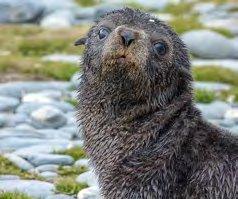
The amazing thing was that none of the animals showed any fear, more in contrast, the seals snarled at us and even the very young pups opened their mouths and bared their tiny teeth which made me laugh.
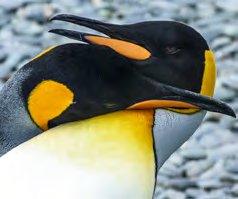
A king penguin couple courted right in front of me! The craning of necks and crossing of beaks was amazing to watch, from tender to forceful. They had only eyes for each other. A dedication and single mindedness that can make one jealous! After a few snow showers suddenly the sun broke through the clouds revealing dark 1,000 m peaks that fringe Salisbury Plain. I was dumbfounded by what I saw—sure I’d seen pictures, I heard about it but reality was—bar none! I sat down at the beach and watched and watched.
Soon passengers started to arrive and I had to work, helping to land the zodiacs while standing with my waders chest deep in icy water. Once everybody was ashore I was free to roam! I strolled over to the colony where brown fluffy chicks stood flipper deep in mud. King penguin chicks look so different from their parents that the early explorers took them for a different species. One chick took a special liking to me; it tried to cuddle up to my knees and pecked at my camera. Environmental protocol meant that we can’t approach wildlife closer than 5 m, but nobody told the wildlife…
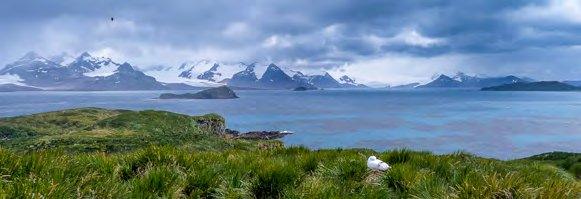
For the afternoon we got permission to land on Prion Island! This island is very special, it is the only place to see wandering albatrosses on their nests and only 20 people at the time are allowed ashore (a logistical nightmare for our expedition leader Delphine since we had 96 passengers on board). I love albatrosses—when other kids wanted to be dogs, lions or cats I always wanted to be a wandering albatross. I remember pouring for hours over the pages of my kids’ book on ‘Birds of the World’ that showed the wandering albatross with its 3 m wingspan. I was on the island for 90 short minutes, escorting passengers up and down the wooden steps, which have been built to protect the fragile ground. This was not nearly enough time, especially since passengers often got side tracked by fur seals and I wanted to yell at them ‘forget about the blasted seals! Go, run and see the albatrosses’! Once I made it to the viewing platform I was mesmerised. It was the first time that I had seen these huge birds so close, so intimate. Wandering albatrosses get whiter with age and right in front of me was a pure white bird sitting on its nest, from time to time getting up and stretching its legs and wings.
ABOVE: King penguin chick Photos: KATJA RIEDEL
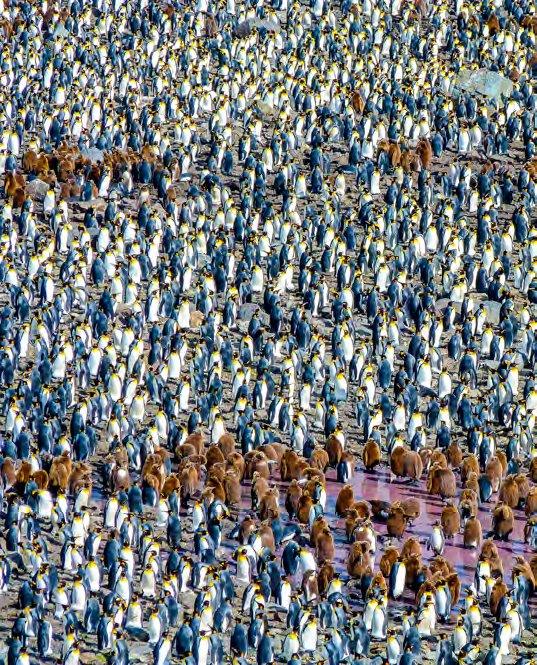
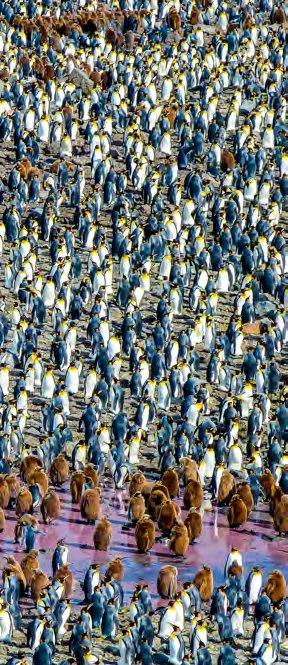
TOP: King penguin colony at St Andrews Bay
LEFT MIDDLE: Inquisitive fur seal pup
LEFT BOTTOM: Love is a battlefield for King penguins
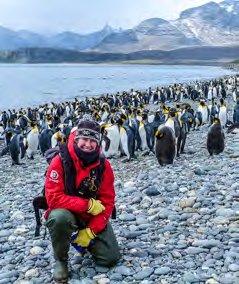
ABOVE: The author and friends
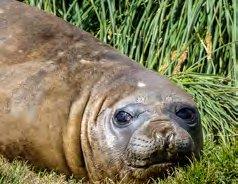
LEFT TOP: Female elephant seal hanging out in the tussock grass at Grytviken
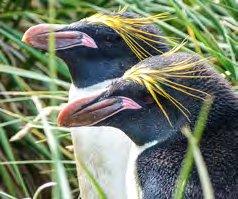
LEFT MIDDLE: Macaroni penguins with their silly hairdo
BELOW: King penguin colony at Salisbury Plains with 60,00 breeding pairs
The most amazing ritual to witness is the dance of the albatross, large wings are spread, beaks are pointed skywards and birds touch each other gently at the tips of their beaks. It is wonderful and each couple has its own unique sequence. Other birds were gracefully sweeping overhead and I so desperately wanted to soar with them.
‘The wind sails the open sea steered by the albatross that glides, falls, dances, climbs, hangs motionless in the fading light…the statue of the wind’. (Pablo Neruda).
My days in South Georgia were quite long. Like a kid on Christmas Day I woke up early each morning and jumped out of bed to see the sunrise at 4 am. One morning we landed in Grytviken, the oldest whaling station on the Island. It is also the place of Shackleton’s grave. He died here in 1922 of a heart attack, just when heading South again for another expedition. Rusty ships, derelict buildings and the big flensing plant talked about the whaling past. It was very moving to stand at Shackleton’s grave, but my feelings for Grytviken were very mixed. This place is soaked with the blood of whales. In the years between 1906 and 1931 a shocking 200,000 whales were killed around South Georgia in order to make soap, lamp oil, corsets, cat food and explosives. Men’s cruel efficiency! I was glad when we left this place of death.
South Georgia so far had been amazing but I would never have guessed what I was about to see when we landed at St Andrews Bay.
The coast, normally pounded by huge swells, was glassy calm. Heavily glaciated 2,000 m mountains rose from sea level and in front of me were 150,000 breeding pairs of king penguins. Together with non-breeders and chicks I was probably looking at half a million penguins. As far as the eye could see there was a sea of black, white and orange cut through with swathes of brown chicks.
It was unbelievable! I wandered around, sometimes sitting down and watching life unfold in front of me with all its little details. Penguins preening, feeding, courting, mating. The best view was from the top of a moraine which overlooked the rockery, this abundance of life. I sat there for hours just looking. It was the most amazing thing I’ve ever seen in my life and for the rest of the day I couldn’t get the grin off my face.
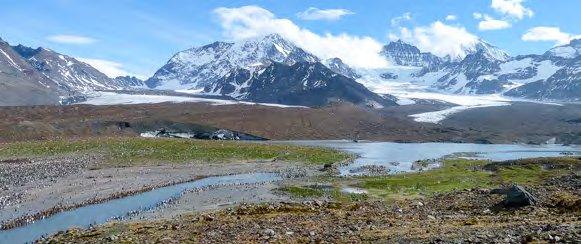
It was my job to round up the last passengers and herd them back to the landing site. Put the fox in charge of the henhouse. Nobody could better understand than me that people didn’t want to leave! There was so much to look at—glaciers, penguins, elephant and fur seals, and South Georgia reindeer (brought here by Norwegian whalers as meat source). By the time we were back at the landing site the sun was low and the light had turned soft and golden. We sent the last zodiac with passengers back to the ship and had 20 minutes of ‘staff time’ with just five of us at the beach. Everybody dispersed and sat quietly by themselves absorbing beauty. When I now close my eyes I still see this scene, with the river flowing out from the mountains, its shore lined with penguins which form the shape of a heart while the sun is slowly setting behind the mountains and lenticular clouds turn golden.
Soon after we got back on board the traditional BBQ on the back deck started. It was surreal in sight of St Andrews Bay with the faint sound and smell of the colony. I dancing through the night as I have never danced before, ready to embraced the whole wide world. A day in my life—bar none!
Over the last few days we had slowly worked our way along the northern coast of South Georgia, and now it was time to turn a corner and head for Cooper Bay at the eastern side. When the anchor chain clattered into the sea thick fog engulfed the ship. Mine was the second zodiac to leave—I was more feeling my way through the fog to shore, not without entering the ships position into my GPS so that I would be able to find our way back. Slowly it started to clear but some low clouds were caught in the cliffs creating an eerie atmosphere. The water around my zodiac was teaming with fur seals trying to race my boat, chinstrap and macaroni penguins were porposing along on their way to the colony. Macaronis got their name from their yellow feather bundles to both sides of their head. They reminded the sealers of an Italian gentlemen club with similar silly hats. On the beaches more fur seals and some elephant seals were hauled out. Two big males were fighting with loud groans and moans. The macaroni rockery was bustling with animals, sooty albatrosses soared overhead in perfect synchronised flight, shags were feeding their fluffy chicks on cliff tops, kelp created wonderful abstract patterns on the water and the sun was shining—life was good!
After a steep climb uphill, dodging several fur seals hidden in the tussock on the way, we reached the upper cliff level where macaroni penguins were sitting on chicks or showed off their wonderful courting display which consists of a lot of neck twisting and squawking, making me a little bit jealous with their display of affection.
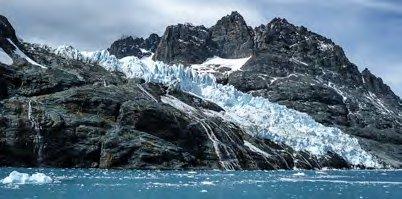
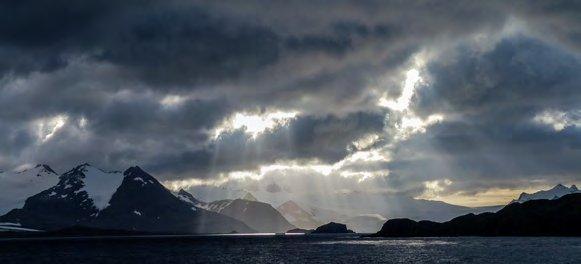
In the afternoon the captain manoeuvred the ship into the 14 km long narrow Drygalski Fjord. Mighty peaks rise directly out of the sea to over 2,000 m, shattered steep glaciers and icefalls fringe the fjord with ice towers and seracs ready to tumble into the deep blue water. Beautiful pure white snow petrels with friendly dark button eyes and hectic Antarctic terns were wheeling around in search of food. It got interesting when the fjord became so narrow that the ship had to do a three-point turn in order to get out again.
As far as I was concerned time could have stopped there and then. I didn’t want to leave, I wanted these moments to last forever and when I saw the southern coast with its rugged mountains slowly disappear in the distance I was sad. South Georgia is well and truly the most stunning place on earth!
ABOVE: Nesting wandering albatross,
Prion Island
RIGHT: Jagged glaciers in
Drygalski Fjiord under a moody sky
BELOW: South Georgia
Comments
Comments are not open yet.