
Text taken from the club newsletter.
TAMED BY THE GHOST
A scary story with a happy ending by SARAH FISHER with SHARRON CAME
I debated for a long time whether to actually write this article. I was embarrassed at first about what had happened; but then a couple of very wise friends pointed out to me that I had absolutely nothing to be embarrassed about and what happened is not in any part a reflection on my ability as a trail runner. These friends reminded me that anyone can have a fall and the bad luck (and it is just luck) is how you land—and in my case luck just did not swing in my favour. I hope that by sharing my story it will show just how important it is for us trail runners to be well prepared every time we hit the trails, even if it’s a trail we run routinely as you just never know when something can happen to you or a friend.
In January Sharron and I were completing a trail running holiday. We have done a number of these multi-day adventures as well as undertaking shared day runs on remote trails many times. We decided that this summer we’d head down to the West Coast Region and run the Abel Tasman Coastal, Heaphy and Oparara Basin/Fenian Caves tracks. These runs were all pretty epic but those are another story.
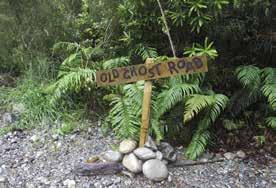
On the fifth day of our trail running holiday we headed out to Seddonville to begin what we expected to be the highlight of our holiday, the Old Ghost Road Trail that officially opened in December 2015. Our plan was to split the run into two stretches and overnight at Stern Valley Hut then run to the finish at Lyell the next day.
After continuous hot, fine weather the weather gods had a change in store for us. We left Seddonville in torrential rain, or “droplets of sunshine”, as our bus driver creatively termed it when he dropped us off in the middle of nowhere. Despite the heavy rain, nothing could dampen our spirits. It was an absolutely beautiful trail—well graded, lush bush and amazing views into the Mokihinui River gorge below. We also seemed to have the trail entirely to ourselves as we hadn’t seen a soul all day.
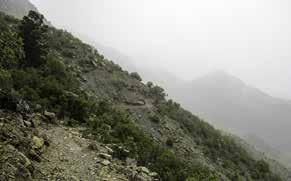
Nearing the end of the running day we completed the climb up to ‘Solemn Saddle’ and to the ‘Boneyard’ where we got rewarded with a nice descent with plenty of fun switchbacks to take us into Earnest Valley. Just through the rainy mist we could make out the twin lakes, Lake Cheerful and Lake Grim.
It was not far off the sign indicating Lake Cheerful that our trail running holiday started to get a bit more drama laden than we expected. While running down the track to Lake Cheerful I suddenly found myself flying through the air after my foot got caught under one of the rocks on the track. Unfortunately being a bit of an overachiever, I nailed my accuracy and landed pretty heavily on some sharp rocks, knee first, while one of my hands made a valiant but unsuccessful attempt to break my fall. Trying to shake off the shock from the fall I got up thinking I would continue to the hut which I knew wasn’t far away, thinking of assessing the damage when I wasn’t getting pelted by rain but I quickly realised that wasn’t going to happen. On taking my first step I immediately felt searing pain in my left knee. Looking down I realised I had a very deep gash right across my kneecap. Blood was spilling everywhere.
I experienced a surge of pain and with it feelings of panic and I collapsed back onto the trail, grabbing my first-aid kit from my bag, quickly applying some pressure to my bleeding knee with some gauze pads and a crepe bandage. By then I was shivering from both coldness and shock so I put on another merino layer. As I was applying some more bandages Sharron caught up with me. Sharron was very calm and offered reassurance and words of comfort before asking me whether I thought I would be able to get up and walk. We both knew Stern Valley hut was not far away and that getting to shelter was important. I felt I could move on the leg once I had gotten my knee firmly bandaged up. We then started the painful and slow slog to the hut to get warm and into dry clothes so we could reassess the situation.
We are both experienced trampers and mountain runners who have had injuries before so we were aware that initially the injured person experiences an adrenaline surge which we felt we could utilise to get me to the hut. I managed to painfully hobble along trying to avoid bending my knee at all costs; and with my balance thrown off centre by trying to compensate with my other leg I nearly fell a few more times. While I thought I was going along at quite a good pace I was in fact moving along at a snail’s pace and I suspected Sharron was rapidly cooling down. These considerations really helped motivate me to get to the hut to keep us both safe.
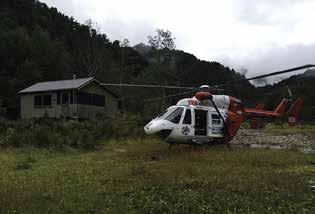
Photo: Nelson Marlborough Rescue Helicopter Trust
I have never been so glad to see a hut. After getting into some dry clothes I got my first-aid kit out along with the kit that was helpfully kept in all the Old Ghost Road huts. My knee was full of the gravel from the track (trying to take home a few souvenirs clearly!) but I cleaned it out as best as could with some saline. I knew it would need a proper washout at a medical centre as a lot of gravel was embedded pretty deeply and that the wound would need stitches. I also knew there would be a high risk of infection since the wound was so dirty and close to the bone.
After cleaning and dressing the wound as best I could we both ate some food and had another discussion about our options. We were carrying a personal locator beacon and we considered whether we should activate it or not. While my injury wasn’t life- threatening, my ability to walk on the injured leg was very limited. We had plenty of clothing, gear including first aid, sleeping bags and extra food so we were not in any immediate danger. We decided we would sleep on the matter and make a decision in the morning. This would give us a chance to rest and see how the injury was after another 12 hours. We were also aware that even if we set off the beacon at night no rescue was likely to be commenced until daylight. At this stage I was thinking that with some pain killers and my knee bandaged up I may still be able to hobble out the last 45 km really slowly. We knew there was cellphone reception along the track at various high points from Ghost Lake Hut so we could re-arrange transport if necessary and we had enough supplies to last us an extra day or so.
I didn’t get much sleep that night as pain was my constant companion. By the time morning rolled around my knee had swollen up so that moving was both extremely difficult and painful. While I wanted to walk out under my own steam, I realised that the right decision, to keep us both safe, may involve getting some help because even if by some miracle I did manage to hobble the 45 km in either direction to the end of the trail, it was a pretty large distance to cover on an injury and the huts weren’t particularly close together. Choosing to continue could get us into a more risky situation and I was also worried about doing more damage to my knee. Sometimes our pride can be our own worst enemy. I think trampers and trail runners are a very driven and self-sufficient bunch of people so sometimes it can be difficult to realise that we may need to ensure we don’t let our pride and determination to reach our goals take priority over our own personal safety and that of others in our group. There is absolutely nothing wrong with getting help and it was something that I had to be very aware of that day—not letting my pride and determination get in the way of common sense. I was desperate to complete the entire Old Ghost Road Trail as I had been looking forward to the trip for months but at what cost?
The advice that NZ Search and Rescue give is that if you are unsure about when to activate a beacon, it’s better to activate and get help rather than wait until a situation has deteriorated and it’s too late. We knew that Search and Rescue may take a while to get to us as the cloud cover was low and the weather generally unsettled so flying conditions were far from ideal. We were also aware that the forecast was not due to improve over the next few days so waiting out the weather before activating the beacon wasn’t much of an option either. We knew that our beacon would give our GPS location as Stern Valley Hut so Search and Rescue would know that we had shelter which would be an important consideration in their decision making. We had also left our trip intentions with our emergency contacts—these people were also the registered emergency contacts for the personal locator beacon so they could pass onto Search and Rescue our intentions and that we were well prepared in terms of gear. Decision made, Sharron activated our distress beacon outside the hut just after 7 am.
Then we settled down to wait. Sharron managed to read the Old Ghost Road story in the trail book left in the hut and I had my Kindle to provide some sort of distraction. We also took the opportunity to pack up our gear. Approximately 2 hours after activating the PLB the Nelson Marlborough Rescue Helicopter Trust Crew arrived in the form of Barry, Carl and Carlton. Paramedic Carlton quickly ascertained what the injury was and asked if I was OK to get straight into the helicopter as they had a small window in the weather to fly out in. They were a wonderful team—very professional and great humour. Carlton was also a trail runner and had completed Tarawera 100 a few years prior so there was some good trail talk while he assessed me. They joked they would drop me off along one of the ridges so I could just run to the hospital instead! That offer was so very enticing!
In the poor weather conditions we were flown straight to Nelson Hospital and I was in the Emergency Department for about 5 hours while the medical team patched me up. The medical team were particularly worried about how dirty the wound was and how deep it was, knowing that it had probably closed up a bit overnight. After completing an X-ray to see how deeply the gravel was embedded they decided that a wash-out of my knee under general anaesthetic probably wasn’t necessary as long as I was extremely vigilant for signs of infection. After some local anaesthetic
After the pain had settled down and I had adapted to using the crutches to walk, I began to reflect back on the experience. I stand by our decision to activate the distress beacon as I know I could not have safely walked out and my injury was more serious than I initially realised and I would have caused a lot more damage to myself. I was so glad we were both well prepared in terms of gear, including first-aid supplies; and having a reliable form of emergency communication. Without these, we would have had a very different outcome.
What I would love for people to learn from this trail adventure is the importance of always being prepared, whether you are running on one of your regular training haunts or something further away from home. Something that you consider to be a nice and easy run can suddenly turn into an adventure far more epic than you ever intended so never ever skimp on that vital gear, including first aid kit and a form of emergency communication like a personal locator beacon. None of us go out there with the intention of getting hurt and an injury/medical emergency can happen anywhere, even on the trails you run everyday. My fall on a well graded trail proves that. You have to plan for the worst and understand that things can get bad pretty quickly.
A key learning point from this is the importance of having a reliable source of emergency communication, like a personal locator beacon. These are very light and are your best friend in an emergency. One point I would make here is to be sure that you read all the instruction on your distress beacon before you are likely to need it and ensure you understand them. We had never operated a distress beacon before despite carrying one on tramping, running and climbing trips for years, and in a stressful situation following simple instructions can become much more difficult.
I have now been on both ends of a PLB activation—one activating a beacon after an injury and the other (as Club “Emergency Contact”) receiving the call from Rescue Coordination Centre after one of the tramping club’s PLBs was activated last year. I can say both situations were pretty stressful but being prepared made both manageable. While acting as the Club “Emergency Contact” I could quickly e-mail the group’s intentions when the Rescue Coordination Centre called. The Rescue Centre Coordination Staff were very impressed with the club’s detailed intentions form and the fact that they could get hold of someone straight away who could supply the important details.
To our club trip leaders, I think this is a good reminder about the importance of filling out the intentions form fully—this includes the medical conditions of punters and their emergency contacts. It makes the job of the “Emergency Contact” person so much easier and is vital to the role of search and rescue so they can better prepare the rescue team. The other key learning point that Sharron and I gained from this experience is to share your story so that other people can learn from it.
It took over two months for my knee to come right and with a lot of determination I managed to slowly run the Hillary Race at the end of February. I am forever thankful to the Nelson Marlborough Rescue Helicopter Trust crew as without the team that helped me that day it would have been a much slower journey to recovery and possibly a more serious outcome. While I may have been tamed by the Ghost in January I will definitely be back later this year to tame the ghost of Lake Cheerful that mysteriously took on the character of Lake Grim that day in January, and will finally complete the Old Ghost Road Trail.
my knee was cleaned and stitched back up. I was then given crutches and a Scott knee brace to prevent me from bending my knee. I was pretty gutted as not only did I miss the best bit of the Old Ghost Road Trail, I was also told that running the Hillary 80 km Race at the end of month would very likely be off the cards for me. It looked like I wouldn’t be running or walking anywhere for a while. For a simple trip it had all become a bit more serious.
Comments
Comments are not open yet.