
This report is shown as scanned pages until a volunteer types it up. Skip to the machine-read text (unproofread), which a screen reader can read.
Machine-read text (unproofread)
Read from the scans by software, so it contains mistakes. Typing it up properly would help blind readers: use Suggest an edit.
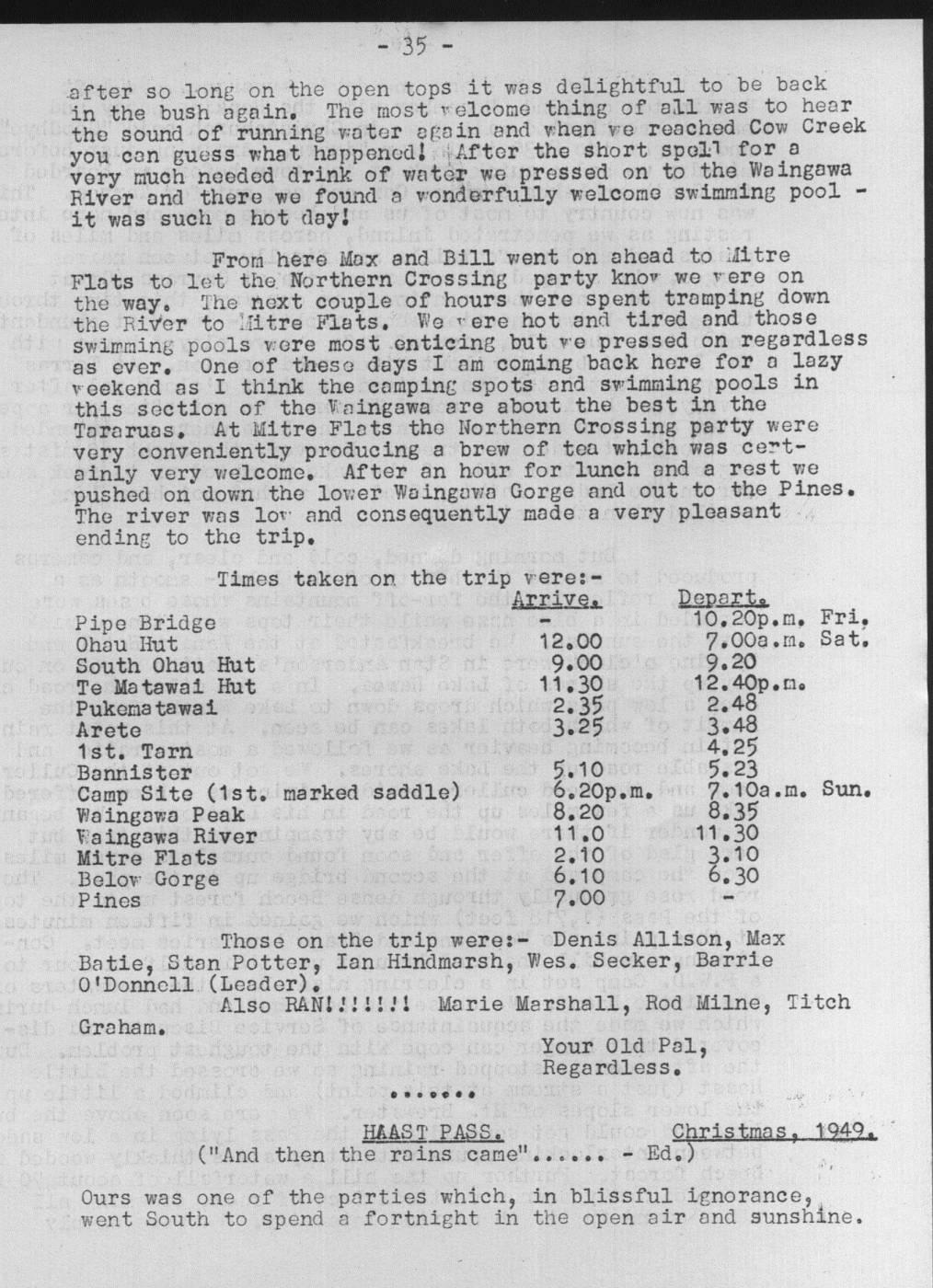
HAAST PASS. Christmas, 1949. ("And then the rains came" - Edo) Ours was one of the parties which, in blissful ignorance, went South to spend a fortnight in the open air and sunshine.
We got the open air I and one day's sunshine. We left Vellington on 22nd, December with the Hopkins party and having breakfasted with them in Christchurch said "Goodbye" and caught the 8.30 train for Timaru. Arriving just before mid-day we had a quick look ot the town before we boarded the Southern Lakes Service Car and set out for Torras. This was new country to most of us, and became nore and nore interesting as we penetratod inland, across niles and miles of plains and rolling foothills and finally betveen narrow gorges. Ve stopped for afternoon tea at Omarama (Great place - Ed.) and then continued on our way, this time through theparched brown interior where rabbits - the most abundant and often, the only, sign of life - have played havoc rith the land and brought about vidcspread erosion. At Tarras we waited until the bus arrived at Eight o'clock and after a very rough ride we reached Wanaka, Ve satisfied our appetites and then wandered down to the Lake where we intended to sleep out under the trees. Hovever, the sight of mist sweeping over the other side of the Lake prompted us to seek shelter in the Ladies Bathing Shed and we had not been long settled when the rain cameo But morning dawned, cold and clear, and cameras were produced to record the beauty of the Lake - smooth as a mirror, reflecting the far-off mountains vhose beses were shrouded in a blue haze while their tops were tinged pink with the sunrise. We breakfasted at the Wanaka Hotel and by nine o'clock vere in Stan Anderson's station vagon on our way up the shores of Lake Hawea. In a few miles the road climbs over a low pass which drops down to Lake Wanaka from the sunmit of which both lakes can be seen. At this point rain set in becoming heavier as we followed a most erratic and unstable road up the Lake shores. We got out at the Culler's camp and.the head culler, besides giving us a brew, offered to take us a few miles up the road in his Landrover. We began to.wonder if there would be aby tramping in this trip but rere glad of the offer and soon found ourselves seven miles from the camp and at the second bridge up to the pass. The road rose gradually through dense Beech forest up to the top of the Pass (1,718 feet) which we gained in fifteen minutes. At this point the Westland and Otago boundaries meet. Continuing downhill the road brought us within half an hour to a P.W.D. Camp set in a clearing high above the headwaters of the Little Haast. Ve chose the best hut and had lunch during which we made the acquaintance of Service Biscuits and discovered that hunger can cope with the toughest problem. During the afternoon it stopped raining so we crossed the Little Haast (just a stream at this point) and climbed a little up the lower slopes of Mt. Brewster. We F ere soon above the bushline and could get some idea of the Pass lying in a low saddle between interlocking spurs with steep sides thickly wooded in Beech forest. Further up the hill a waterfall of about 70 feet cascaded madly down.a vertical face of rock, drowning all other sound in its thundering intensity. Ve * ere deeply
: inpressed, but later, as we journeyed further down the Haast, waterfalis such as this became commonplace and nothing short of the Sutherland Falls would then have merited a second glance. Through the thicker mist around the tops we caught the gleam of snow and prayed for a fine day and clear skies that we might really see our surroundings in their true proportions and majesty. That prayer was never answered. In theiearly hours of the morning we rere rudely awakened by a deafening roar like that of a landslide bearing down on us. But this was thunder rolling up the valley, around the mountain tops and then crashing down over our heads. For the next half hour. vivid flashes of lightning and those unearthly rolls of thunder followed each other in quick succession. The hut shook and Bob's torch suddenly lit up. During this awe-inspiring performance I lay admiring the inside of my sleeping bag and then was accused of being scared! 2 (No more than the rest anyway.) Peace and sleep finally returned and the next time we roused it was to the strains of the West Coast Symphony, with another stormy interlude, during which we wished each other "Happy Christmas". All unnecessary activity was cancelled for the dey except when the Christmas pudding was produced. During the night snow foll dovn to a level of about 5,000' and rain continued to fall. However we had to push off to Burke Hut in the morning and once the rain eased off it was quite pleasant going, We followed down the true left of the Little Haast which had increased in volume during the night and came crashing down over tremendous slabs of fallen rock which obstructed it's course. By tena.m. we had reached the turn-off of the West Coast track and a notice which says "Four miles to the Aerodrome!" (The nearest aerordrome is away down near the Landsborough, several miles off, but we are now convinced that all West Coast miles are calculated people on horseback.) The road continues a few miles down tho valley before it ends abruptly in a sharp cliff face with a drop of some hundreds of feet to the river. The West Coast track drops dovn to the river where there is a fragile swing bridge and a ford which. looks as dangerous as the notice says. We crossed by the bridge and continued along the track arriving in a short time at the Wills River (an important tributary) over vhich there, is a stout-concrete . bridge. (Well built bridges and disconnected stretches of road are a common feature in South Westland but there is stilla suggestion that they may all be linked up one day.) The valley began to widen out and so did the track taking on the appearance of a main highway and never rising very much above the river. By 11.40 we réached Burke Hut which is on the edge of the bush surrounded by blackberries! There were already five chaps there waiting for the river to go down and two more followed.us ino But the river did not drop that day for Hughie continued to "send her down".
Dawn came; the showers came too and then ceased for a while and by mid-day the river had dropped sufficiently for us to cross safely. She ford is at a point about a mile and a quarter bolow Burke Hut and just above some rapids near a long stretch of toi-toi. The river here is about a hundred and fifty yards ride in two channels, the deeper one being near the opposito bank. The water came up to our waists and although it was freezing and very swift one of the boys insisted on standing in mid-stream to photograph the rest of the party crossing. Safely across (The photogropher too? - Edo) we lunched and then set off for Clarke Hut, the track keeping near the river. About half way between the ford and Clarke Hut the river makes a right-angled turn westwards almost opposite the point rhere the Landsborough meets it. We had to climb around a big bluff here before we dropped again to the river. In less than 3 hours after leaving the ford we arrived at Clarke Hut which stands well back towards the hill on a wide grassy flat with a few stands of Beech scattered around ito We stood at the door of the hut early that evening and watched the shades of the hidden sunset glowing on the 3 peaks of Mt. McFarlane on the opposite side of the Haast. The following day the showers continued. Our track went tarough bush and then across long river flats covered with grass and toi-toi. Now and again we saw Paradise Ducks with their young (striped brown and white) swimming on a backwash of the river. During the afternoon we kept losing the track and had to keep our eyes peeled looking for the footprints of the other party. (Who came to be knovn as Barney's crowd and who were a great help on several occasions.) Several times we went down in sinking sand on the river bed and as rain and hail hounded us on we became rather browned-off and discouraged but late in the afternoon we arrived at Halfway Hut where Barney's crowd were already entrenched. Let in the bush, near the river bank, the hut is only ten feet square, but tcn of us squeezed in that night despite the table, cupboard boxes and tvo bunks which already cluttered it somewhat. After a breakfast of venison, and after wishing Keith many happy returns on his 21st., we set off in fine but dull weather towards Haast reaching the limit of the road in less than an hour. Early in the afternoon we made a P.W.D. Camp whose two occupants gave us tea and cake then drove us down to Cron's house in their truck. We then went down to Haast (another couple of miles) picked up supplies, sent off telegrams and got our first view of a "One horse town" of five or six huts and a meeting hall. That is Haast. We then returned to Mr. Cron's and rére rowed across the river. That evening we made Cron's Hut, a few miles up the coast, and were plagued with mosquitos - the biggest we had ever seen. We could not leave Cron's early enough the next morning and we welcomed the clear skies and bright sunshine that we had not seen for days. The track follows up the coast for a couple of miles and turns inland near the Waita or Maori River - a small, but swift stream, which caused us sone difficulty in our crossing. Shortly after we had to plough through an extensive, deep and smelly bng following close. to the solitary telephone line. About mid-day we arrived at Copper Croek Hut which is set in open country just outside the bush rhich changes just below Copper Creek from the Rimu and Kahikatea of the swampy coast to the nixed Beech of the uplands. The track soon led us out of the brilliant sunshine into the cool welcome shade of the forest and we began climbing a long ridge. The slopes were gradual and we continued climbing all afternoon, welcoming the numerous creeks and patches of shde on the track. In the late afternoon we reached Maori Saddle after climbing around some bad slips near the top and a short distance down the other side we came upon a workman's hut where Jim Honley, the occupant, invited us in for the nichto Later on we were joined by three lads from Christchurch. New Year's Eve dawned fine but dull. The track from the Saddle to Blue River was all downhill through mixed bush and over more creeks. We arrived at Blue River Hut at 2p.m. and vere surprised to find a solitary cat in residence. Here also ve found another concrete bridge. It was only a short distance from Blue River to the Hostel where we stayed that nighto The track was flat all the way, and from Copper Creek onwards had broadened out to a considerable width, so that it was very easy going. Later that afternoon we were joined by four mtor cyclists who had intentions of pushing on to the Haast = until we described the route to themo The evening passed quietly and we were in the sack and asleep long before the New Year slipped in. New Year's Day was our last full day's trampo We arrived, wet and cold, at Lake Paringa at mid-day and perched on a row-boat in the boating shed while we had lunch. The Lake was smooth as a mirror but shrouded in the inevitable mist So we wasted no time in pushing off again and gained the end of the road in 2 niles. Here we found a house and a group of huts, all enpty except the one that contained Barney's crowd. The hut had 3 rooms, the middle one containg an open fireplace and an oven which we found useful for drying wet clothes, (It was teeming again.) Food was running short but with the addition of new potatoes "obtained" from a nearby garden we had a good neal. It was early to bed that night with mosquitos droning around us and it was early to rise too = 4.30 in fact = for we had to meet the bus at 6.30 at Paringa Bridge. Dawn saw us on the road, in rain again,and half an hour later we were at the bridge - another modern concrete structure, The bus was actually on time and with one breakdown got us to Waiho by mid-day. Here we said "Goodbye" to our 5 friends - really fine chaps - and went in search of food and shelter. Thanks to Keith's personality plus we had the use of Harry Ayer's cottage for the next four days. During the afternoon we went to look at the Glacier and that evening gorged ourselves on all the food we could find. The following day we net two Whakahaere girls and an Australian chap who accompanied us back to Christchurch. On the Wednesday we climbed Alex Knob (4,280') but were driven down rather abruptly by a thunderstorm. The folloving day we headed for Hokitika where we stayed a night before going on to Christchurch. We slept out at the Sumner Motor Camp on the Friday night and on Saturday of course had to sail down the sewerage system and take a look at the city before we set off for Lyttelton, homeward bound. Strange - it was doing its best to rain in Wellington next morning. Don't ask me why, but in spite of the rain we had a splendid trip and some fool is talking of getting soaked (Now, Dallas! = exactly VHAT did you EO down for? - Ed.) down there again next Christmaso The party comprised Bob Willians (Leader), Bill Potter, Keith Durrant, Dick Noble and Dallas Doramo Dallas.
Comments
Comments are not open yet.