
This report is shown as scanned pages until a volunteer types it up. Skip to the machine-read text (unproofread), which a screen reader can read.
Machine-read text (unproofread)
Read from the scans by software, so it contains mistakes. Typing it up properly would help blind readers: use Suggest an edit.
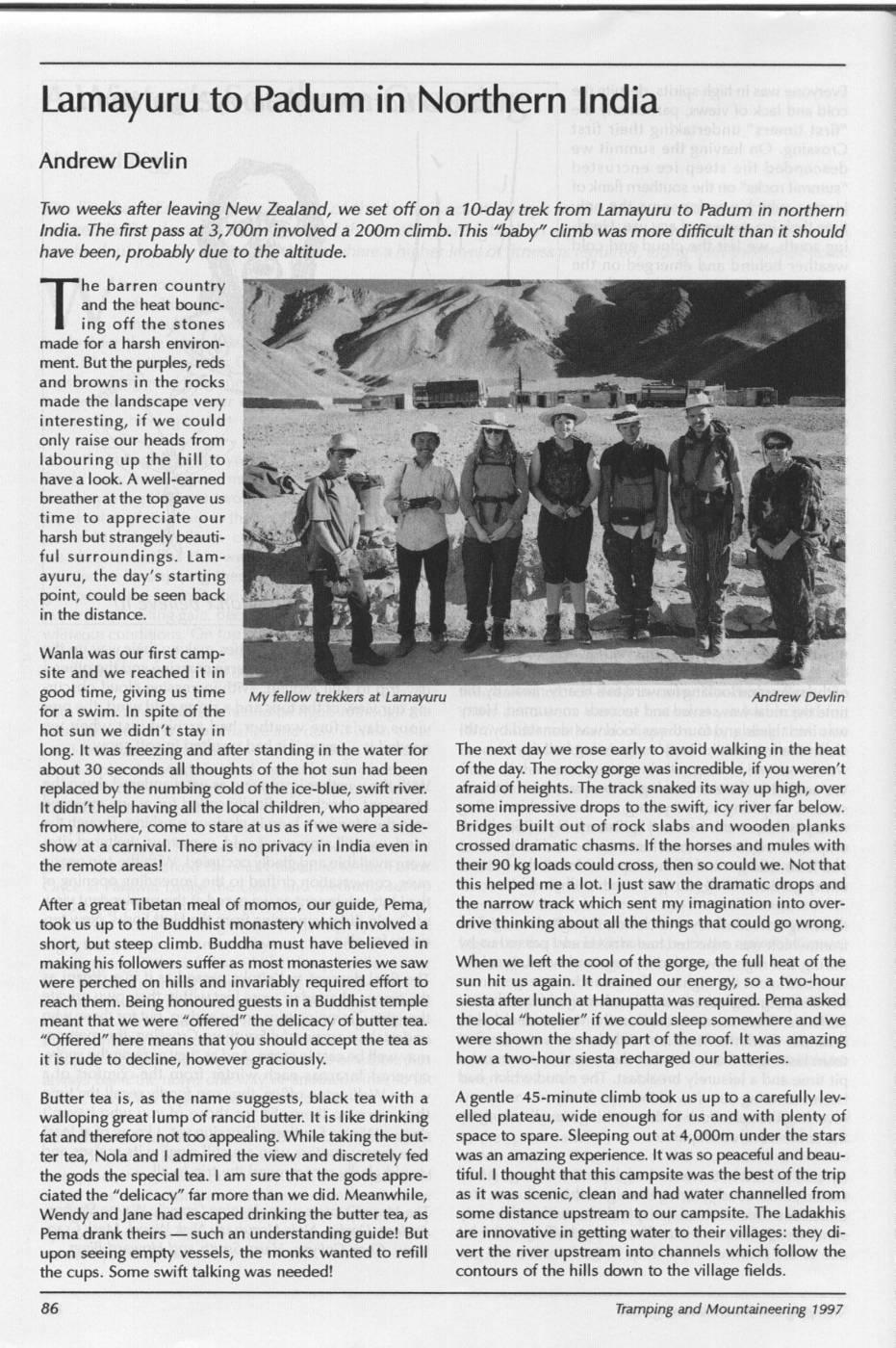
Lamayuru to Padum in Northern India Andrew Devlin Two weeks after leaving New Zealand, we set off on a 10-day trek from Lamayuru to Padum in northern India. The first pass at 3,700m involved a 200m climb. This "baby" climb was more difficult than it should have been, probably due to the altitude. "he barren country and the heat bouncing off the stones made for a harsh environment. But the purples, reds and browns in the rocks made the landscape very interesting, if we could only raise our heads from labouring up the hill to have a look. A well-earned breather at the top gave us time to appreciate our harsh but strangely beautiful surroundings. Lamayuru, the day's starting point, could be seen back in the distance. Wanla was our first campsite and we reached it in good time, giving us time My fellow trekkers at Lamayuru Andrew Devlin for a swim. In spite of the hot sun we didn't stay in long. It was freezing and after standing in the water for The next day we rose early to avoid walking in the heat about 30 seconds all thoughts of the hot sun had been off the day. The rocky gorge was incredible, ify you weren't replaced by the numbing cold of the ice-blue, swift river. afraid of heights. The track snaked its way up high, over It didn'th help having all the local children, who appeared some impressive drops to theswift, icy river far below. from nowhere, come to stare at us as ifwe were a side- Bridges built out of rock slabs and wooden planks show at a carnival. There is no privacy in India even in crossed dramatic chasms. If the horses and mules with the remote areas! their 90 kg loads could cross, then SO could we. Not that this helped me a lot. I just saw the dramatic drops and After a great Tibetan meal of momos, our guide, Pema, the narrow track which sent my imagination into overtook us up to the Buddhist monastery which involved a drive thinking about all the things that could go wrong. short, but steep climb. Buddha must have believed in making his followers suffer as most monasteries we saw When we left the cool of the gorge, the full heat of the were perched on hills and invariably required effort to sun hit us again. It drained our energy, sO a two-hour reach them. Being honoured guests in a Buddhist temple siesta after lunch at Hanupatta was required. Pema asked meant that we were "offered" the delicacy of butter tea. the local "hotelier" ify we could sleep somewhere and we "Offered" here means that you should accept the tea as were shown the shady part of the roof. It was amazing it is rude to decline, however graciously. how a two-hour siesta recharged our batteries. Butter tea is, as the name suggests, black tea with a Ag gentle 45-minute climb took us up to a carefully levwalloping great lump of rancid butter. Itis like drinking elled plateau, wide enough for us and with plenty of fat and therefore not too appealing. While taking the but- space to spare. Sleeping out at 4,000m under the stars ter tea, Nola and admired the view and discretely fed was an amazing experience. It was SO peaceful and beauthe gods the special tea. I am sure that the gods appre- tiful. I thought that this campsite was the best of the trip ciated the "delicacy" far more than we did. Meanwhile, as it was scenic, clean and had water channelled from Wendy and Jane had escaped drinking the butter tea, as some distance upstream to our campsite. The Ladakhis Pema drank theirs such an understanding guide! But are innovative in getting water to their villages: they diupon seeing empty vessels, the monks wanted to refill vert the river upstream into channels which follow the the cups. Some swift talking was needed! contours of the hills down to the village fields. Tramping and Mountaineering 1997
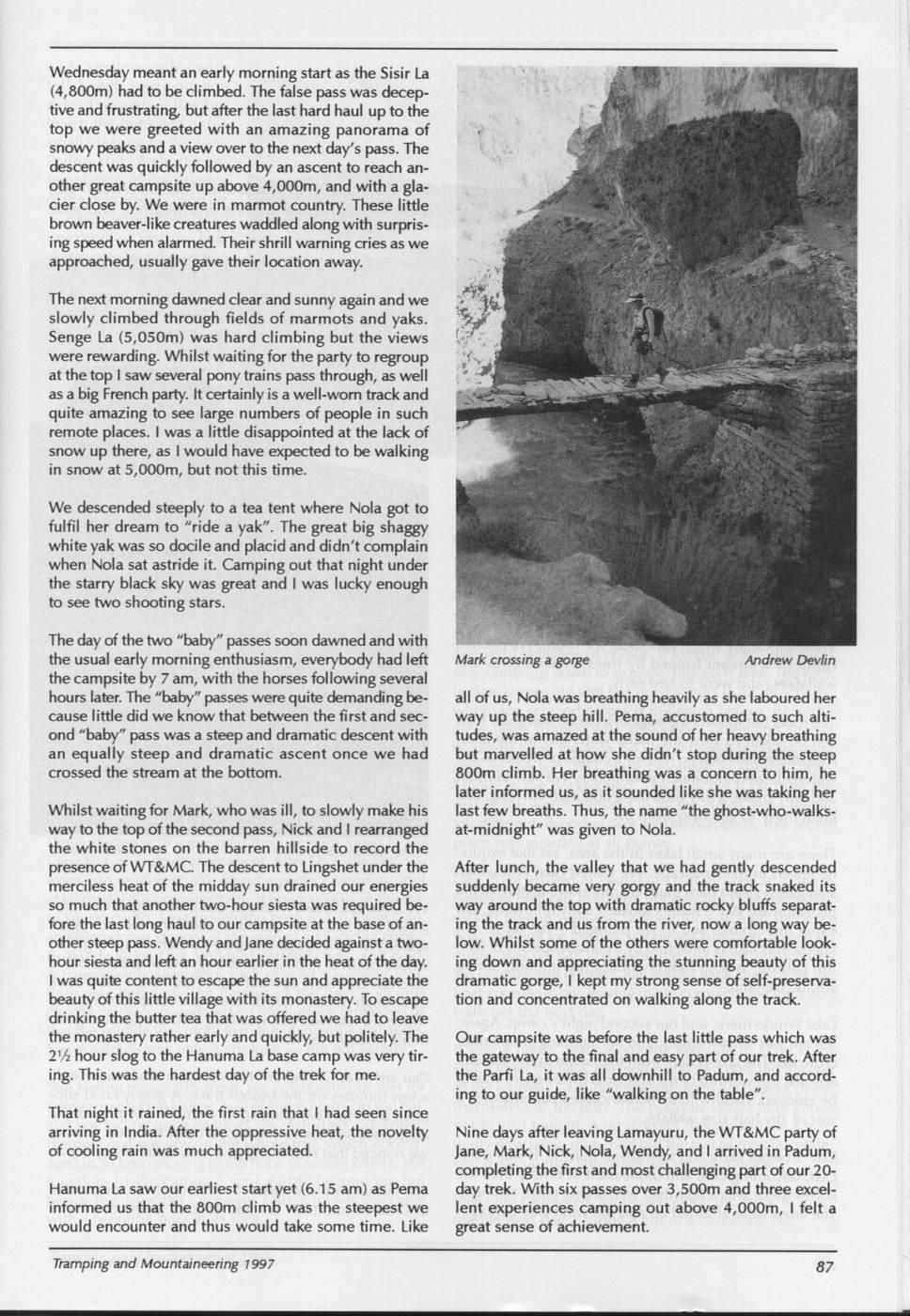
Wednesday meant an early morning start as the Sisir La (4,800m) had to be climbed. The false pass was deceptive and frustrating, but after thel last hard haul up to the top we were greeted with an amazing panorama of snowy peaks and a view over to the next day's pass. The descent was quickly followed by an ascent to reach another great campsite up above 4,000m, and with a glacier close by. We were in marmot country. These little brown beaver-like creatures waddled along with surprising speed when alarmed. Their shrill warning cries as we approached, usually gave their location away. The next morning dawned clear and sunny again and we slowly climbed through fields of marmots and yaks. Senge La (5,050m) was hard climbing but the views were rewarding. Whilst waiting for the party to regroup att thet topls saw several pony trains pass through, as well as al big French party. It certainlyisa a well-worn track and quite amazing to see large numbers of people in such remote places. I was a little disappointed at the lack of snow up there, as Iwould have expected to be walking in snow at 5,000m, but not this time. We descended steeply to a tea tent where Nola got to fulfil her dream to "ride a yak". The great big shaggy white yak was SO docile and placid and didn't complain when Nola sat astride it. Camping out that night under the starry black sky was great and I was lucky enough to see two shooting stars. The day of the two "baby" passes soon dawned and with the usual early morning enthusiasm, everybody had left Mark crossing a gorge Andrew Devlin the campsite by7 7 am, with thel horses following several hours later. The "baby" passes were quite demanding be- all of us, Nola was breathing heavily as she laboured her cause little did we know that between the first and sec- way up the steep hill. Pema, accustomed to such altiond "baby" pass was a steep and dramatic descent with tudes, was amazed at the sound of her heavy breathing an equally steep and dramatic ascent once we had but marvelled at how she didn't stop during the steep crossed the stream at the bottom. 800m climb. Her breathing was a concern to him, he later informed us, as it sounded like she was taking her Whilst waiting for Mark, who was ill, to slowly make his last few breaths. Thus, the name "the ghost-who-walksway tot the top of thes second pass, Nick and rearranged at-midnight" was given to Nola. the white stones on the barren hillside to record the presence of WT&MC. The descent to Lingshet under the After lunch, the valley that we had gently descended merciless heat of the midday sun drained our energies suddenly became gorgy and the track snaked its SO much that another two-hour siesta was required be- way around the top prvotre dramatic rocky bluffs separatfore thel last long haul to our campsite at the base of an- ing the track and us from the river, now a long way beother steep pass. Wendy andJ Jane decided against a two- low. Whilst some of the others were comfortable lookhour siesta and left an hour earlier in thel heat of the day. ing down and appreciating the stunning beauty of this Iwas quite content to escape the sun and appreciate the dramatic gorge, I kept my strong sense of self-preservabeauty of this little village with its monastery. To escape tion and concentrated on walking along the track. drinking the butter tea that was offered we had to leave the monastery rather early and quickly, but politely. The Our campsite was before the last little pass which was 2% hour slog to the Hanuma La base camp was very tir- the gateway to the final and easy part of our trek. After ing. This was the hardest day of the trek for me. the Parfi La, it was all downhill to Padum, and according to our guide, like "walking on the table". That night it rained, the first rain that I had seen since arriving in India. After the oppressive heat, the novelty Nine days after leaving Lamayuru, the WT&MC party of of cooling rain was much appreciated. Jane, Mark, Nick, Nola, Wendy, and arrived in Padum, completing the first and most challenging part of our 20- Hanuma La saw our earliest start yet (6.15 am) as Pema day trek. With six passes over 3,500m and three excelinformed us that the 800m climb was the steepest we lent experiences camping out above 4,000m, I felt a would encounter and thus would take some time. Like great sense of achievement. Tramping and Mountaineering 1997
Comments
Comments are not open yet.