
This report is shown as scanned pages until a volunteer types it up. Skip to the machine-read text (unproofread), which a screen reader can read.
Machine-read text (unproofread)
Read from the scans by software, so it contains mistakes. Typing it up properly would help blind readers: use Suggest an edit.
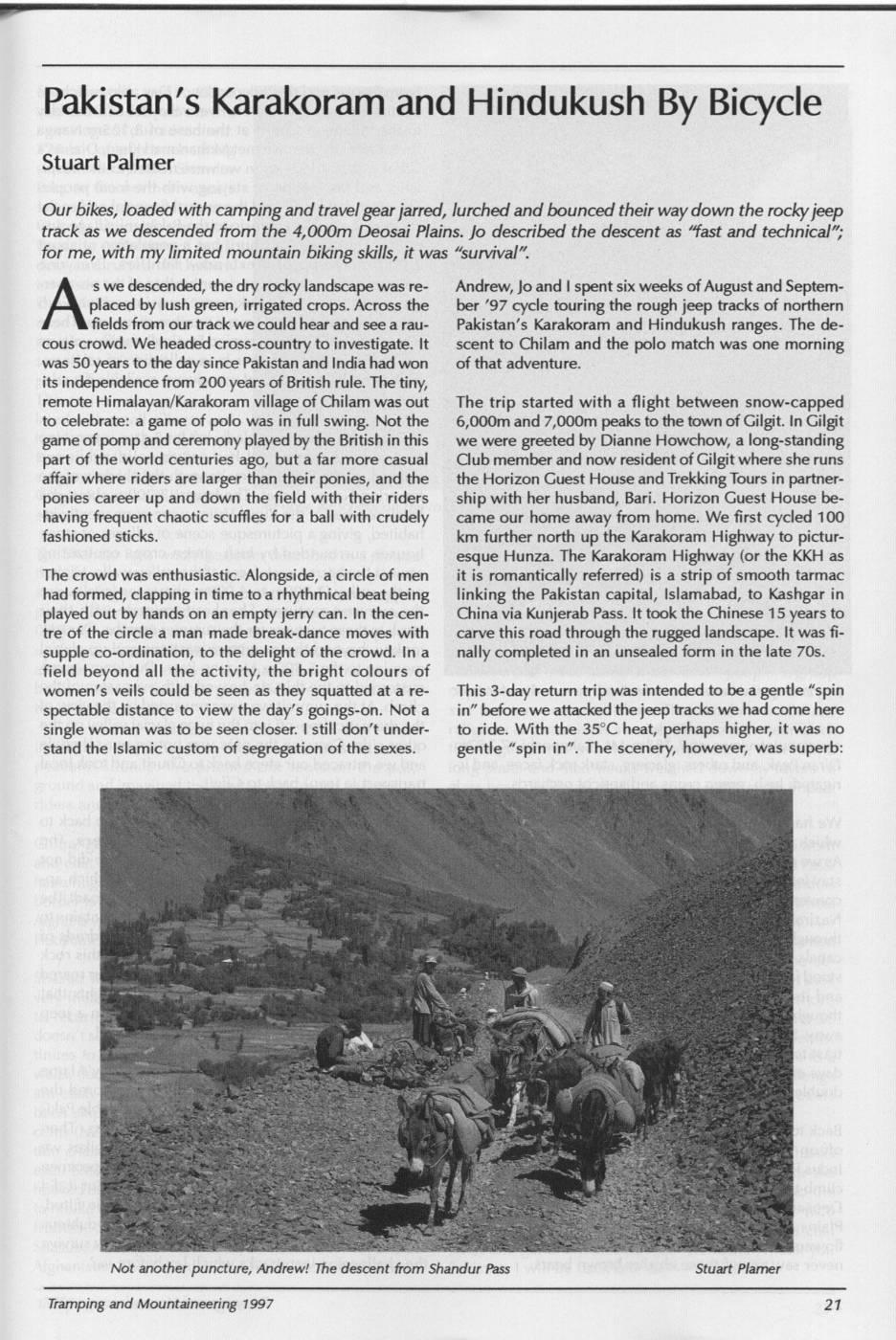
Pakistan's Karakoram and Hindukush By Bicycle Stuart Palmer Our bikes, loaded with camping and travel gear jarred, lurched and bounced their way down the rocky jeep track as we descended from the 4,000m Deosai Plains. Jo described the descent as "fast and technical"; for me, with my limited mountain biking skills, it was "survival". S we descended, the dry rocky landscape was re- Andrew, Jo and I spent six weeks of August and Septemplaced by lush green, irrigated crops. Across the ber '97 cycle touring the rough jeep tracks of northern fields from our track we could hear and see a rau- Pakistan's Karakoram and Hindukush ranges. The decous crowd. We headed cross-country to investigate. It scent to Chilam and the polo match was one morning was 50 years to the day sincel Pakistan and Indial had won of that adventure. its independence from 200 years of British rule. The tiny, remote Himalayan/Karakoram village of Chilam was out The trip started with a flight between snow-capped to celebrate: a game of polo was in full swing. Not the 6,000m and 7,000m peaks to the town of Gilgit. In Gilgit game of pomp and ceremony played by the British in this we were greeted by Dianne Howchow, a long-standing part of the world centuries ago, but a far more casual Club member and now resident of Gilgit where she runs affair where riders are larger than their ponies, and the the Horizon Guest House and Trekking Tours in partnerponies career up and down the field with their riders ship with her husband, Bari. Horizon Guest House behaving frequent chaotic scuffles for a ball with crudely came our home away from home. We first cycled 100 fashioned sticks. km further north up the Karakoram Highway to picturesque Hunza. The Karakoram Highway (or the KKH as The crowd was enthusiastic. Alongside, a circle of men it is romantically referred) is a strip of smooth tarmac had formed, clapping in time to a rhythmical beat being linking the Pakistan capital, Islamabad, to Kashgar in played out by hands on an empty jerry can. In the cen- China via Kunjerab Pass. It took the Chinese 15 years to tre of the circle a man made break-dance moves with carve this road through the rugged landscape. It was fisupple co-ordination, to the delight of the crowd. In a nally completed in an unsealed form in the late 70s. field beyond all the activity, the bright colours of women's veils could be seen as they squatted at a re- This 3-day return trip was intended to be a gentle "spin spectable distance to view the day's goings-on. Not a in" before we attacked thej jeep tracks we had come here single woman was to be seen closer. I still don't under- to ride. With the 35°C heat, perhaps higher, it was no stand the Islamic custom of segregation of the sexes. gentle "spin in". The scenery, however, was superb: Not another puncture, Andrew! The descent from Shandur Pass Stuart Plamer Tramping and Mountaineering 1997
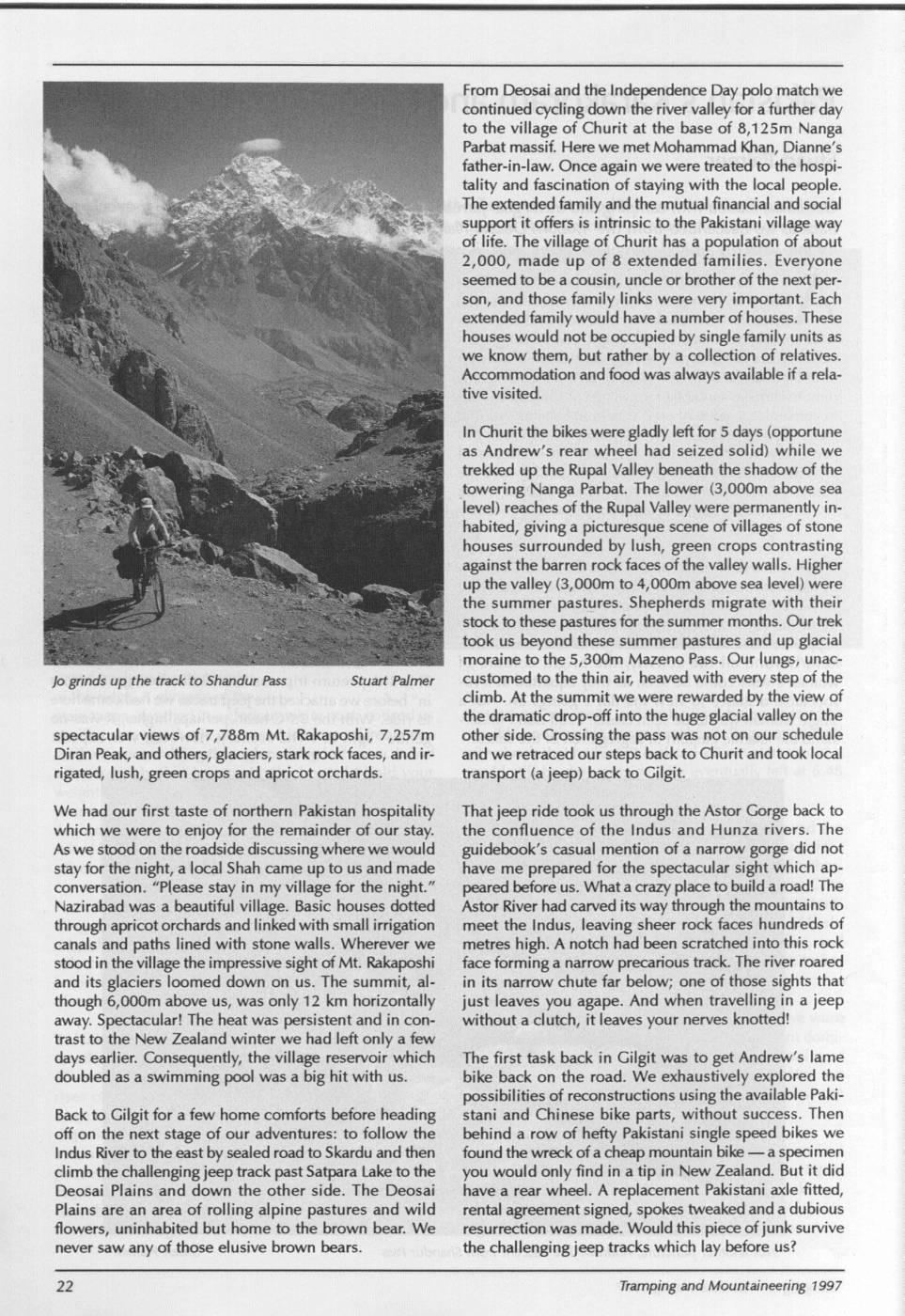
From Deosai and thel Independence Day polo match we continued cycling down the river valley for at further day to the village of Churit at the base of 8,125m Nanga Parbat massif. Here we met Mohammad Khan, Dianne's father-in-law. Once again we were treated to thel hospitality and fascination of staying with the local people. The extended family and the mutual financial and social support it offers is intrinsic to the Pakistani village way of life. The village of Churit has a population of about 2,000, made up of 8 extended families. Everyone seemed to be a cousin, uncle or brother of the next person, and those family links were very important. Each extended family would have a number of houses. These houses would not be occupied by single family units as we know them, but rather by a collection of relatives. Accommodation and food was always available if a relative visited. In Churit the bikes were gladly left for 5 days (opportune as Andrew's rear wheel had seized solid) while we trekked up the Rupal Valley beneath the shadow of the towering Nanga Parbat. The lower (3,000m above sea level) reaches of the Rupal Valley were permanently inhabited, giving a picturesque scene of villages of stone houses surrounded by lush, green crops contrasting against thel barren rock faces of the valley walls. Higher up the valley (3,000m to 4,000m above sea level) were the summer pastures. Shepherds migrate with their stock to these pastures for the summer months. Ouri trek took us beyond these summer pastures and up glacial moraine to the 5,300m Mazeno Pass. Our lungs, unac- Jo grinds up the track to. Shandur Pass Stuart Palmer customed to the thin air, heaved with every step of the climb. At the summit we were rewarded by the view of the dramatic drop-off into thel huge glacial valley on the spectacular views of 7,788m Mt. Rakaposhi, 7,257m other side. Crossing the pass was not on our schedule Diran Peak, and others, glaciers, stark rock faces, and ir- and we retraced our steps back to Churit and took local rigated, lush, green crops and apricot orchards. transport (a jeep) back to Gilgit. We had our first taste of northern Pakistan hospitality That jeep ride took us through the Astor Gorge back to which we were to enjoy for the remainder of our stay. the confluence of the Indus and Hunza rivers. The As we stood on the roadside discussing where we would guidebook's casual mention of a narrow gorge did not stay for the night, a local Shah came up to us and made have me prepared for the spectacular sight which apconversation. "Please stay in my village for the night." peared before us. What a crazy place to build a road! The Nazirabad was a beautiful village. Basic houses dotted Astor River had carved its way through the mountains to through apricot orchards and linked with small irrigation meet the Indus, leaving sheer rock faces hundreds of canals and paths lined with stone walls. Wherever we metres high. A notch had been scratched into this rock stoodi in the village thei impressive sight of Mt. Rakaposhi face forming a narrow precarious track. The river roared and its glaciers loomed down on us. The summit, al- in its narrow chute far below; one of those sights that though 6,000m above us, was only 12 km horizontally just leaves you agape. And when travelling in a jeep away. Spectacular! The heat was persistent and in con- without a clutch, it leaves your nerves knotted! trast to the New Zealand winter wel had left only a few days earlier. Consequently, the village reservoir which The first task back in Gilgit was to get Andrew's lame doubled as a swimming pool was a big hit with us. bike back on the road. We exhaustively explored the possibilities of reconstructions using the available Paki- Back to Gilgit for a few home comforts before heading stani and Chinese bike parts, without success. Then off on the next stage of our adventures: to follow the behind a row of hefty Pakistani single speed bikes we, Indus River to the eastl by sealedi road to Skardu and then found the wreck of fa cheap mountain bike I a specimen climb the challenging jeep track past Satpara Lake to the you would only find in a tip in New Zealand. But it did Deosai Plains and down the other side. The Deosai have a rear wheel. A replacement Pakistani axle fitted, Plains are an area of rolling alpine pastures and wild rental agreement signed, spokes tweaked and a dubious flowers, uninhabited but home to the brown bear. We resurrection was made. Would this piece of junk survive never saw any of those elusive brown bears. the challenging jeep tracks which lay before us? Tramping and Mountaineering 1997
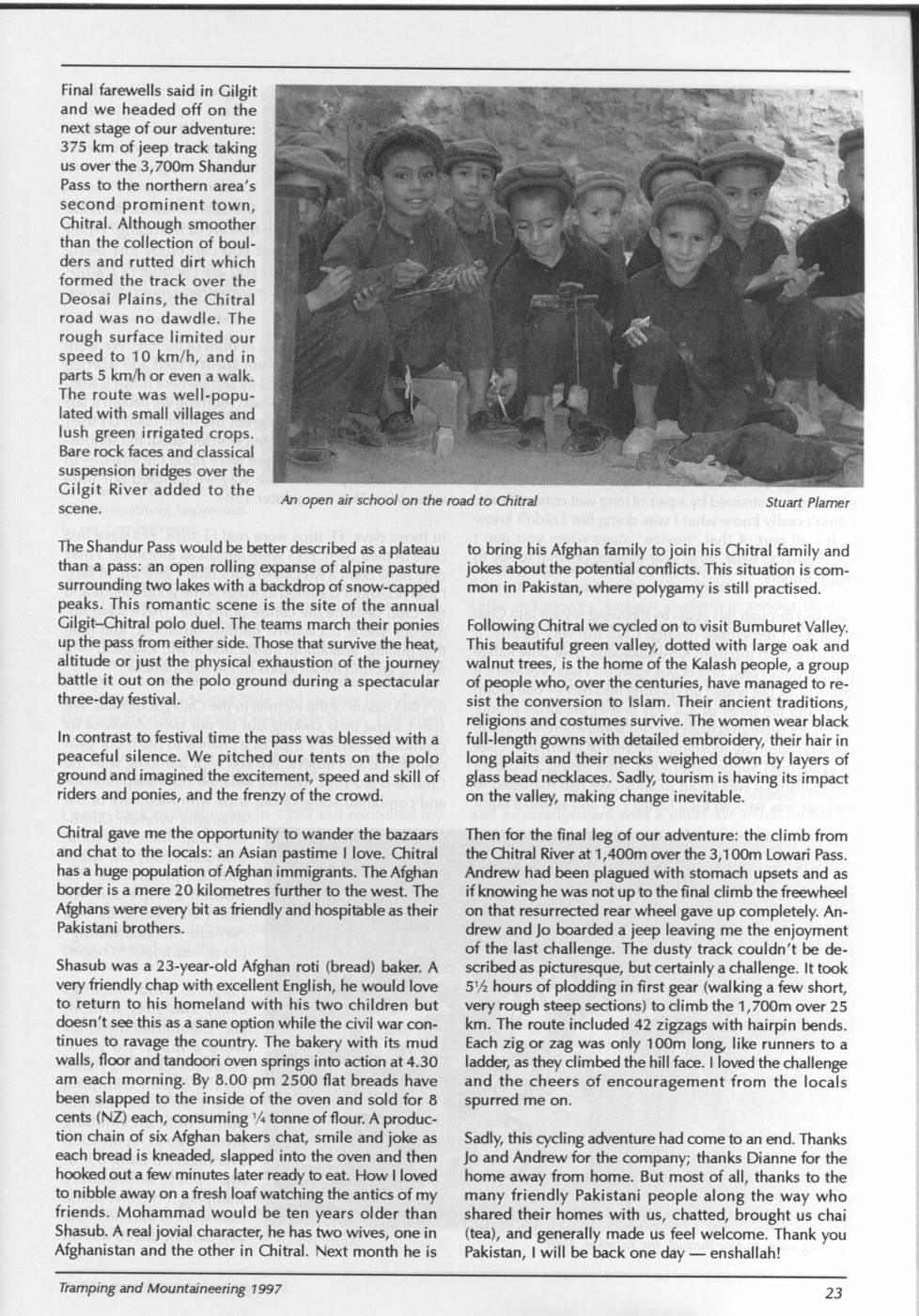
Final farewells said in Gilgit and we headed off on the next stage of our adventure: 375 km of jeep track taking us over the 3,700m Shandur Pass to the northern area's second prominent town, Chitral. Although smoother than the collection of boulders and rutted dirt which formed the track over the Deosai Plains, the Chitral road was no dawdle. The rough surface limited our speed to 10 km/h, and in parts 5 km/h or even a walk. The route was well-populated with small villages and lush green irrigated crops. Bare rock faces and classical suspension bridges over the Gilgit River added to the scene. An open air school on the road to Chitral Stuart Plamer The Shandur Pass would be better described as a plateau to bring his Afghan family to join his Chitral family and than a pass: an open rolling expanse of alpine pasture jokes about the potential conflicts. This situation is comsurrounding two lakes with a backdrop of snow-capped mon in Pakistan, where polygamy is still practised. peaks. This romantic scene is the site of the annual Gilgit-Chitral polo duel. The teams march their ponies Following Chitral we cycled on to visit Bumburet Valley. up the pass from either side. Those that survive the heat, This beautiful green valley, dotted with large oak and altitude or just the physical exhaustion of the journey walnut trees, is the home of the Kalash people, a battle group it out on the polo ground during a spectacular of people who, over the centuries, have managed to rethree-day festival. sist the conversion to Islam. Their ancient traditions, religions and costumes survive. The women wear black In contrast to festival time the pass was blessed with a full-length gowns with detailed embroidery, their hair in peaceful silence. We pitched our tents on the polo long plaits and their necks weighed down by layers of ground and imagined the excitement, speed and skill of glass bead necklaces. Sadly, tourism is having its impact riders and ponies, and the frenzy of the crowd. on the valley, making change inevitable. Chitral gave me the opportunity to wander the bazaars Then for the final leg of our adventure: the climb from and chat to the locals: an Asian pastime I love. Chitral the Chitral River at 1,400m over the 3,100m Lowari Pass. has a huge population of Afghan immigrants. The. Afghan Andrew had been plagued with stomach upsets and as border is a mere 20 kilometres further to the west. The ifknowing he was not up to the final climb the freewheel Afghans were every bit as friendly and hospitable as their on that resurrected rear wheel gave up completely. An- Pakistani brothers. drew and Jo boarded a jeep leaving me the enjoyment of the last challenge. The dusty track couldn't be de- Shasub was a 23-year-old Afghan roti (bread) baker. A scribed as picturesque, but certainly a challenge. It took very friendly chap with excellent English, he would love 5% hours of plodding in first gear (walking a few short, to return to his homeland with his two children but very rough steep sections) to climb the 1,700m over 25 doesn't see this as a sane option while the civil war con- km. The route included 42 zigzags with hairpin bends. tinues to ravage the country. The bakery with its mud Each zig or zag was only 100m long like runners to a walls, floor and tandoori oven springs into action at 4.30 ladder, as they climbed thel hill face. loved the challenge am each morning. By 8.00 pm 2500 flat breads have and the cheers of encouragement from the locals been slapped to the inside of the oven and sold for 8 spurred me on. cents (NZ) each, consuming 14 tonne of flour. A production chain of six Afghan bakers chat, smile and joke as Sadly, this cycling adventure had come to an end. Thanks each bread is kneaded, slapped into the oven and then Jo and Andrew for the company; thanks Dianne for the hooked out a few minutes later ready to eat. How Iloved home away from home. But most of all, thanks to the to nibble away on a fresh loaf watching the antics of my many friendly Pakistani people along the way who friends. Mohammad would be ten years older than shared their homes with us, chatted, brought us chai Shasub. A real jovial character, he has two wives, one in (tea), and generally made us feel welcome. Thank you Afghanistan and the other in Chitral. Next month he is Pakistan, I will be back one day enshallah! Tramping and Mountaineering 1997
Comments
Comments are not open yet.