
Text taken from the club newsletter.
MOUNT COOK IN ONE MONTH
A first ascent by FRANCES BOYSON
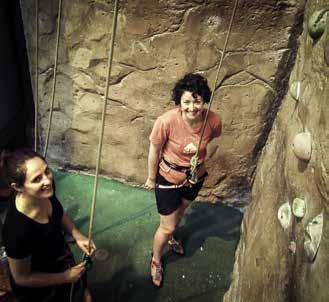
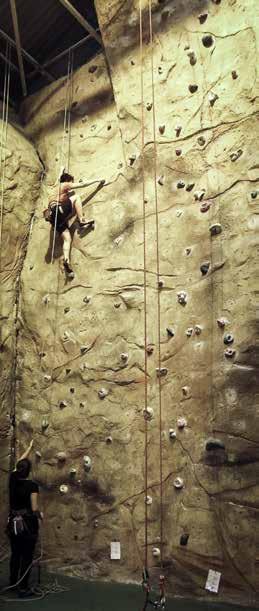
If climbing the treacherous, ice-coated, crevasse-laced slopes and faces of Mt Cook is out of reach, what’s the next best option? Climbing the second highest mountain? The third? The fiftieth? None of these seemed an appropriate alternative. But one morning, an idea emerged, a seed was sown. We found a way to summit that sublime peak after all—we’d just do it indoors. Was this wise? Climbing 3,724 vertical metres indoors, on plastic holds? A month of pumped arms, bruised fingers and aching muscles, with neither fresh air nor expansive alpine views as a reward? No, clearly it was a terrible idea. But Kristy and I were too stubborn to let it go once the thought had taken root. And so it came to be that we began our ascent of Mt Cook—inside a month—at Ferg’s climbing wall.
I’d like to pen a dramatic tale of a first ascent. A story of two mountaineers, bound together by a goal, struggling through adversity with determination and inner strength. But try as I might, there’s little drama to recount from 29 days of repetitive 10 metre ascents. So in place of that, this is a homage to indoor climbing. And a homage in its own way to Aoraki Mt Cook, that majestic peak, atop whose angular frame I will never stand.
What place does a tale of climbing have in a WTMC journal anyway? Worse still, indoor climbing. Well, all good mountaineering begins with good climbing. Learning the physical skills to ascend rock and ice efficiently is one gain, but perhaps more importantly is the skill of moving safely in a pair using ropes and anchors. Well that’s the theory anyway, but it’s not relevant to me, for I already resigned myself to living life below the alpine realm (cf WTMC Journal 2015). But even for those of us who will never traverse those knife-edge ridges, never stand on grand plateaux or walk ahead of our partners carrying Kiwi Coils, climbing does great things for trampers. It improves balance, core strength and stamina for hills. It strengthens arms, shoulders, backs and legs. Steep sections of Tararua tree roots almost become a relief rather than a bane, because shifting effort from legs to arms is easy for those with strong shoulders and backs. It changes scrambling forever—instead of seeing a problematic section of rock that we fear might be insurmountable, when rock climbers scramble we just see giant holds everywhere. Our eyes twinkle with excitement at the rare opportunity to put rock skills into practice.
I started climbing as a result of a poster at a community gym in Brixton, London, headed with the bold statement ‘Anyone Can Climb’. This cannot be true, I thought, for they can’t possibly have factored in me. But something about the audacious claim made me want to call their bluff. If it turned out not to be true, I’d have the Advertising Standards Authority straight on it—I know my rights. Of course they were correct—and if I can climb, anyone can climb. I may not climb with balletic grace, I fall from easy overhangs, I can’t heel hook and I scuff my shoes noisily as I drag my body unnaturally up the wall. But it doesn’t matter one little bit. To climb indoors you don’t need huge upper body strength, or an unnatural ability to balance your body on seemingly nothing. All it takes to climb indoors is to go climbing—to just do it.
So all it took to climb Mt Cook was to just do it. Well, almost. It required us to give up many all other activities, because to achieve our goal, we needed to climb 800 m a week. To put that in context, before we started the challenge, I was climbing twice a week, and doing about 70-90 metres a session, which already felt like a decent effort. I had to more than quadruple this. It required us to concede that, for the month of the ascent, climbing would become a repetitive, monotonous activity. We didn’t have time to try new difficult climbs or we’d never make the summit—instead we had to do tedious repetitions on climbs whose moves we could master easily. We had to put up with pain and injury, and find ways to deal with it. I endured waking nights in a row with aching tendons in my fingers and wrists. I gained new pains in my shoulder that haven’t yet departed, bruised legs from falling onto hard holds when tired, and sore calloused hands.
So when the month was over, would it prove worth it? Pursuing this arbitrary goal with all those costs? I agree with whoever it was that said that one of the great things about climbing is that it has no purpose. You go up, you get to the top, you come down. It demands complete focus and commitment, yet outwardly achieves precisely nothing. At least that’s the case in the gym. For me that is a great pleasure. When I’m climbing or belaying, I can’t do anything else. I can’t obsess about productivity, rewrite my to-do list, or receive messages on my phone. I arrive with a full mind and I leave with an empty one. There’s a reward of new strength, a stronger body, and silent aches and pains the day after that remind me that my life is not all about typing at a desk. The reward of achieving things I didn’t think I would achieve. Of testing myself, of training to the point of failure, but knowing that I tried. And there’s a huge social reward, for while the individual moves are solo, the act is partnership. I couldn’t and wouldn’t spend my evenings doing this if it weren’t for the camaraderie, encouragement, sense of team and sheer fun that I experience from climbing with my friends.
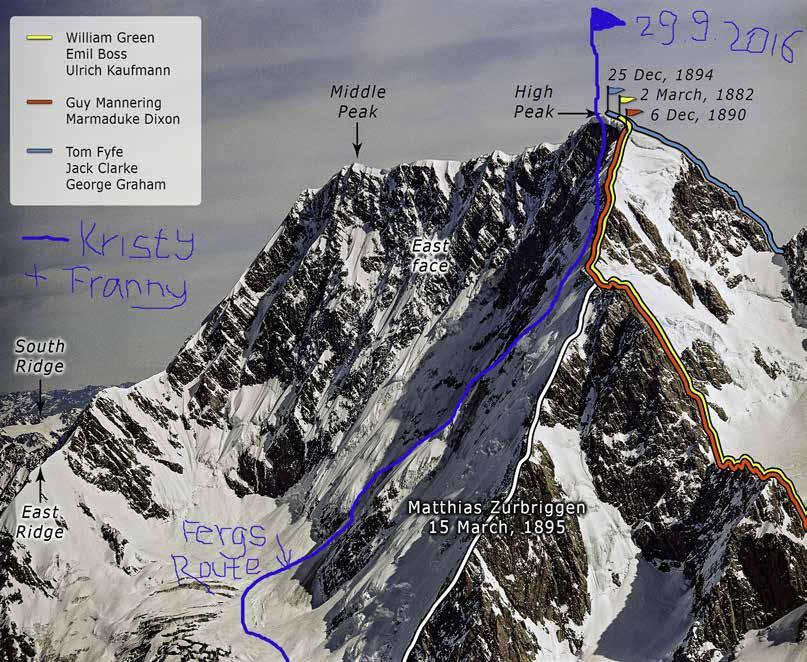
The great thing about climbing a peak indoors is you get to pick the route. We started at sea level, because we didn’t want to be accused of cheating by starting at the village at 700 m. We ascended the Haast Ridge, and had a cuppa at Haast Hut to boot. In week two, out of necessity from exhaustion, I finally heeded the advice my friends had been giving about climbing with my legs rather than my arms. For the first time I felt like I understood how to shift my weight to move efficiently. In week three, we reached Plateau Hut at 2,000 m. We crossed the Grand Plateau and eschewed the Linda Glacier—both because you mountaineers can keep those unpredictable seracs to yourselves but also because what self-respecting Brit born in the 80s wouldn’t choose to travel the Bowie Ridge? By now we were in a rhythm. We cruised up 200 metres in an evening without really noticing it, even 300 metres. We were not doing hard climbs, but we were doing a lot of them, and doing them fast. My movement on the wall started to flow freely; I started to take the time to set my feet properly on the holds. I became stronger than I’ve ever been.
For the final ascent, we cut across the lower East Face to join the North East Rdge. On summit day, for the final pitch, I chose a nasty climb I’ve been working on for months. Maybe that day, with summit fever in my favour, and all the stamina I’d gained, I could finally send this one clean. I felt confident as I ascended the first few metres, the movements so familiar and well within my abilities now. At the crux, I strained for a left foot hold, though I knew there was none. My foot flailed and flagged in uncontrolled ways. I pushed my right hand down behind me on an awkward hold, and twisted my right foot inwards to reach a high ledge. I pushed up, I was almost standing, I had my hand so close to the next hold—and then crash! I fell and bounced on the rope. It wasn’t to be. That elusive clean ascent would stay out of reach a little longer. But I could still make it up the climb, for we were only in the gym after all. After a rest, the moves came easily, and I cruised to the top. And suddenly I was there. I was at the summit. I closed my eyes and imagined I was really there, looking over the Alps, the motionless waves of peaks and ridge lines as far as the eye could see. I had just climbed 3,724 metres. I was standing on the top of Mt Cook. It was every bit as good as I had hoped.
Comments
Comments are not open yet.