
Text taken from the club newsletter.
TRAVELS THROUGH THE GOBI DESERT by KATJA RIEDEL
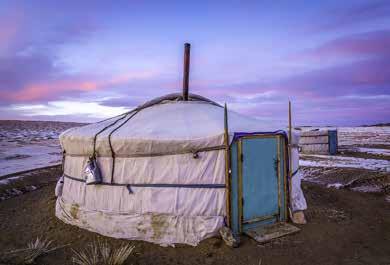
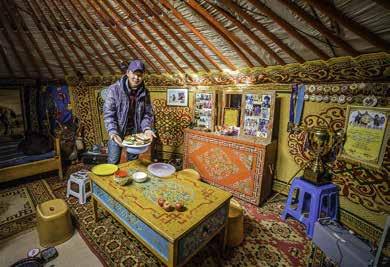
We sat on the carpet in the ger (the round portable tent), dust particles danced in a shaft of light that fell through the roof. A knife changed from hand to hand, cutting pieces of cooked camel meat off the bones that lay in a large bowl between us. With the other hand I tore off bits of thin dough that our host had cooked on top of the camel bones. I rolled it around the meat and stuffed it into my mouth.
We had arrived at the ger just an hour earlier after a long and bumpy ride through the Gobi Desert. We were my driver Bartor, his helper Purevochir and me. I had always wanted to visit the Gobi Desert especially in winter, when there would be snow and when the Bactrian camels would look the most beautiful in their thick winter coats. Now I was here and I felt as if I had stumbled into the pages of a National Geographic magazine. The camel bones were not particularly tasty, but I enjoyed feeling like a real explorer. Our host was a camel racer and many medals, trophies and photos on the small shelf of his ger spoke of his former victories.
A week before my arrival in Mongolia’s capital Ulaanbaatar a snow storm had raged, leading the government to declare a state of national emergency. For some time I wasn’t sure if I could travel to the Gobi, but with an assistant, a young and strong guy that would dig us out of any snow drifts, Bartor was happy to set off. Our route took us from Ulaanbaatar to Mandalgobi and Dalandzadgad, 540 km south of the capital. On the first day travel was easy, the road was good, and though there was snow around the road itself was clear. Our destination was Baga gazriin chuluu, some impressive rock formations that reminded me of giant granite pancakes. The ruins of a 17th century Buddhist monastery are hidden between the rock formations. Not too far away was the ger of a nomadic family with whom we were going to spend the night. In summer there are tourist ger camps, but in winter you can only stay with the nomads. I was a bit nervous to meet my hosts. I knew already that you should not step on the threshold of a ger as it allows evil spirits to enter. Fire is sacred, so don’t throw rubbish into it. The seating inside the ger is strictly determined by gender and hierarchy. When you arrive you will be given a milk tea and something to eat. So far so good. But I needn’t have worried, because Bartor led me gently through the welcome ceremony and once the tea cup was empty everything was relaxed. I ambled out to take pictures of the sunset, but it was cold, probably minus 10 degrees and it got colder as the sun disappeared. I opened the door of the ger and warmth from the camel dung fire welcomed me. Dinner was rice and meat. Luckily I wasn’t offered the sheep’s brain which our host scooped out of the cranium for his young daughter who ate it with glee. Sleeping arrangements were low key, everybody bedded down on the floor of the ger: father, mother, two kids, Bartor, Purevochir, me and a sick goat that was too weak to be left out in the cold.
In Mongolia it is common that the woman is the first one up in the morning. She starts the fire, prepares breakfast, looks after the goats and only when the temperature inside the ger has climbed to a bearable temperature everybody else peels off the blankets. A typical Mongolian breakfast consists of milk tea with pieces of cold meat and bread dipped into it. It is more like a savoury soup.
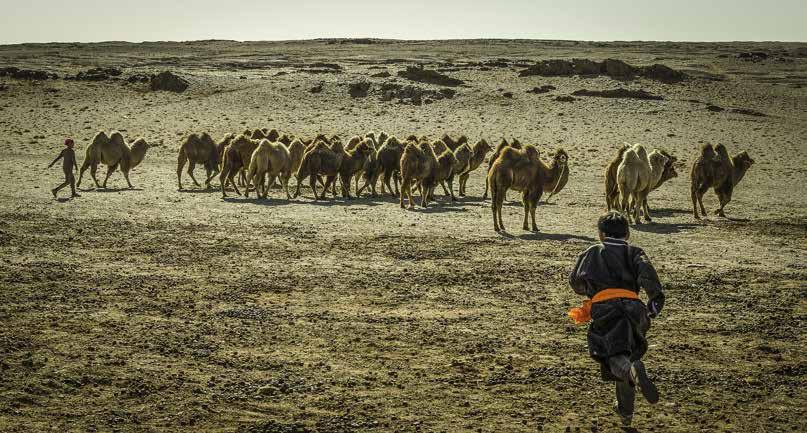
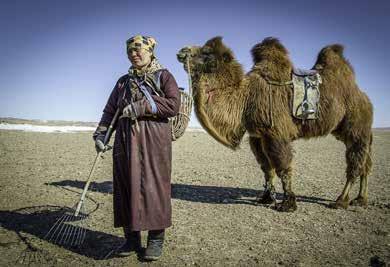
We left the ger. By now there were no more roads, tracks at most, sometimes there was nothing and I wondered how Bartor found his way. Sometimes he didn’t and we had to ask at a ger, Whenever we saw camels I asked him to stop, rushing out of the van to take pictures. They are beautiful, long eyelashes, soft lips, well-padded feet and thick brown-red coats with an air of arrogance about them. Only when they let their lower lip droop they look a little bit fatuous. One day we saw a woman picking up camel dung from the side of the road, another day we met two little boys on a camel, no ger in sight for several kilometres. I never tired of looking out of the window.
One day we walked into Yolyn Am, the Valley of the Vultures, which has a thick blue veined ice field in it. But the main destination of my journey was Bayanzag, the
Flaming Cliffs, a classic desert landscape of rock, red sands, scrub, and awesome emptiness. In 1922 Roy Chapman Andrews found here the first fossil dinosaur eggs. Now they are in a museum but the landscape is still breath-taking. I asked Bartor if we could be here for sunset, because the Flaming Cliffs were named from the red sandstone which glows in the evening light and it was magic. I was surrounded by a landscape on par with the Grand Canyon but I had it all to myself. I wandered up and down the gullies, stepping over thorny saxaul shrubs. As the sun set the colours intensified and like instructed by a secret director a group of camels walked into the scene, directly in front of the cliffs. It was dark by the time we got back to the ger, ideal for some star gazing, mind-bogglingly beautiful in this desert firmament.
Next day we headed to Moltsog Els. In general the landscape of the Gobi is dry and rocky, but here was the cliché of a desert, sand dunes stretching over 20 km, with sharp wind formed ridges and ripple pattern. I don’t know what it is about snow and sand, it wakes the child in everybody and the three of us ran around in the dunes. That was the first time I had been to a sandy desert and I liked it so much, that I suggested to stay here for lunch. Which meant we had another hour to explore the dunes because lunch normally meant a freshly cooked meal by Bartor, sometimes Mongolian dumplings, sometimes stir fried noodles with chicken and vegetables. We agreed that he would drive to a more sheltered spot and I would follow on foot. Once the van disappeared I was alone, I took pictures, listened to the wind, because the Gobi is known for its singing dunes, and let the sand run through my hands. Only when I looked up and couldn’t see the van I realised that I was truly alone. They could have driven off without me; and for a moment I marvelled at this feeling of fear and excitement. I walked on and soon saw the tracks of the van where lunch was waiting for me.
This night we stayed with a more wealthy family that had a large camel herd. When dusk fell the camels came back to the ger. First the two year old camel youngsters arrived, then their mothers. They had spent the day grazing in different areas. As soon as they were reunited the young camels started to suckle. And while they suckled on one teat, the other was milked by the women. Overnight the teenagers were locked into an enclosure, while the mothers stayed close. It took a while till the loud cries of protest quietened down.
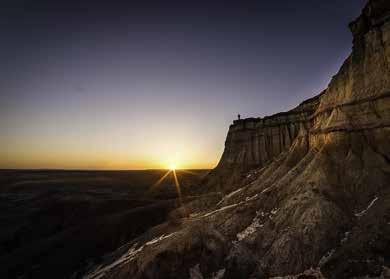
Bartor had told me that we would get up very early to watch the sunrise at White Mountain. I had never heard of it, but was keen to be at a special place for sunrise. We got away late, but Bartor made up for it by racing through the early dawn. When we arrived I saw sandstone cliffs sculpted by erosion to towers and turrets with white, orange, pink and red bands and as Bartor correctly assumed the sun was just about to light up this picture book of earth history. Together with Purevochir I scrambled down the cliffs. Moments later the sun cast its light on the sandstone. I felt like being inside a painting where the artist has gone mad with colours and shapes.
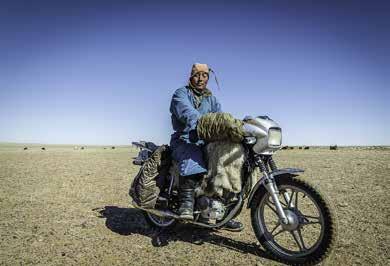
My trip to the Gobi desert was a whirlwind of impressions of an unusual and amazing landscape, seeing wild animals like vultures, black-tailed gazelles and pikas, relatives of our rabbits. Every night I spent with a different nomadic family who eke out a living in the Gobi Desert by herding goats, sheep and camels and who welcomed me into their homes. But like everywhere else modern life is seeping into the traditional lifestyle. Every ger had a TV which would be switched on as soon as we arrived. When there was wired electricity as in one of the villages, the cooking was done in an electric wok, despite the fire burning to provide heat. Most herders today drive their livestock from the seat of their motorbike rather than from the back of a horse. But who am I to deny them the amenities that I take for granted only because I want to indulge in the romantic feeling. I was only a passerby soon to be returning to the luxuries of a western lifestyle.
Comments
Comments are not open yet.