
Text taken from the club newsletter.
YOU ARE GOING TO SIBERIA IN
WINTER?
Ice skating on Lake Baikal by KATJA REIDEL
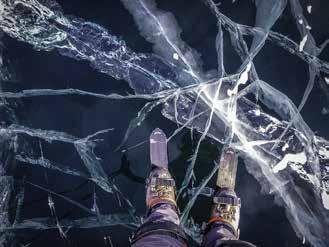
My skates are gliding over the ice of Lake Baikal. It is clear, dark, nearly black and criss-crossed by a spider web of white cracks. Every time I put my skates down I hear new cracks forming. It is like a whisper. I know that these are only hairline cracks, but sometimes there are loud bangs, like rifle shots or thunder. These are big cracks. The ice on the lake is working, it is alive and expands and contracts with temperature changes. The sound is unnerving, but I think I am safe. For three days now I have been on the lake covering between 20 and 40 km each day.
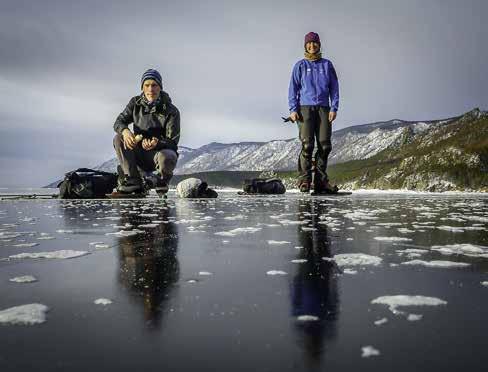
The journey began at Listvyanka in the South where the Angara River leaves Lake Baikal. The first two days we walked on the ice, too much snow, too much wind for the skates. But conditions have improved. We are still battling a headwind but the ice surface is clear of snow. When we are skating close to the shore I can see rocks below the ice. Maksim, my guide, said he even saw a fish swimming. None of my friends thought it was a good idea to ice skate for 250 km on a frozen Siberian lake in winter, so I organised for a guide to join me. Maksim is a PhD student from Irkutsk, a very good ice skater, familiar with the lake and with a nice sense of humour. The best for me is that he also likes to take pictures and sometimes we spent half an hour or more at one spot taking photos.
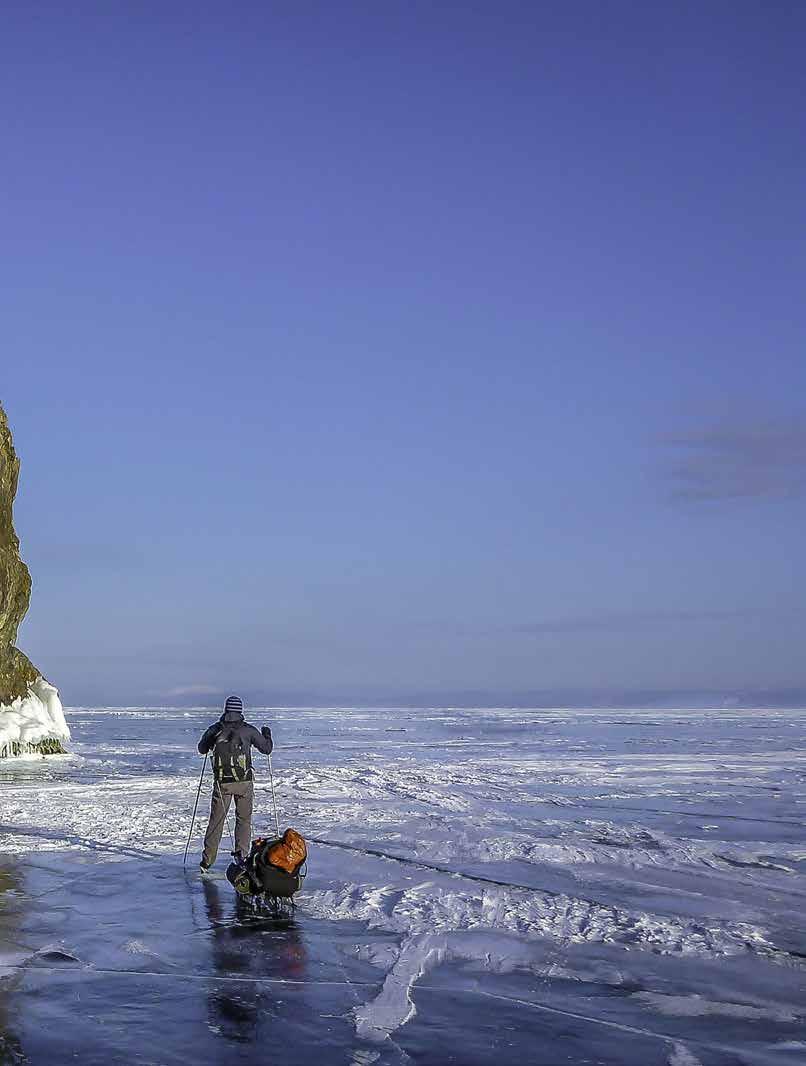
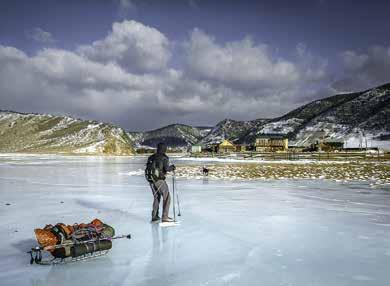
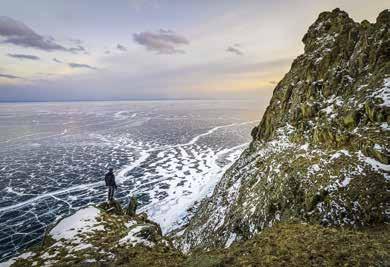
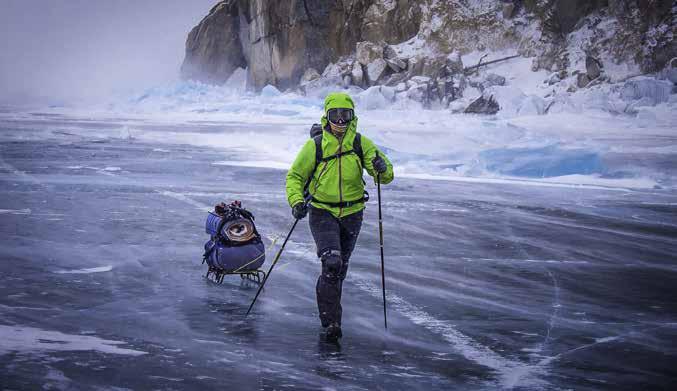
Tonight we are planning to camp at the edge of the lake. From his summer visits here Maksim knows about a bay called Babushka, translated Grandmother Beach. We skate past Bol. Kolokolny, which means Big Belltower and take our skates off. All our gear is packed onto two sledges that we pull behind us on the ice. However, this is not as easy as it sounds because the sledges have a life of their own: they swing, they snag on pieces of ice, they stop when they hit a snowy patch and they take you out from behind if you stop too suddenly. Still, I like the freedom they offer. We have everything with us: tent, sleeping bags, stove, fuel and food. About water we don’t have to worry because we simply harvest clear pieces of ice that stick out like shark fins. But today we have other priorities. The sun is about to set and we race to the high point of the Belltower. While still gulping in big draughts of cold air I embrace the panorama in front of me, Lake Baikal, close to shore is a jumble of ice, but further out the surface is flat, dark and veined by large cracks. Soon the sky takes on pastel colours which are reflected by the ice. As the colours slowly fade we walk down through the snow using the last bit of light to set up our tent under some trees. Pine needles promise a soft bed and some insulation from the cold ground. We light a fire and while I cut vegetables and look after the fire Maksim cooks dinner. Later we sit for a long time at the fire, drink tea, talk and stare into the flames. The fire gives off enough heat, though the night is cold, probably about minus 15 degrees.
Next morning I crawl out of my sleeping bag to see the sunrise over the lake. Some rocks where water has frozen in big sheets attract me. As the early morning sunlight hits the ice it starts to glisten. The whole shore of Lake Baikal has been decorated by an ice artist. There are hanging icicles, frozen splashes of water, frozen waterfalls and every rock or human structure is thickly encrusted with ice, so that it is difficult to tell what is hidden beneath. Ships are frozen in solidly and cars and trucks drive on ice roads that are marked by vertical tree branches.
The surface of the ice is either smooth and flat like a mirror or uneven, with little ice floes of autumn still intact but welded together. In one area large bubbles have risen from the depths and give me an appreciation of the thickness of the ice, it is probably 1-2 m thick. They are opaque, probably methane bubbles from the bottom of the lake, but they look like pearls strung up on a necklace.
On our fourth day we are heading for Bol. Buguldeyka, a small village 3 km upriver. It has been a hard day with strong headwinds. Sometimes so strong that I had to take my skates off because the wind was blowing me backwards. Sometimes the wind came in gusts from the side setting the sledges off on a spin, so that we can only ram our skates into the ice and wait till the gust is over. Once I see Maksim sliding on his bottom for 10 meter driven by the merciless wind before he can stop himself. When my sledge takes me out I find myself in the drifting snow without orientation, a surreal feeling. I am very tired and worried that I won’t make the final 15 km to our farmhouse accommodation, but suddenly we have the wind from behind and we fly along. In these conditions it is no problem to cover 15 km in one hour. We reach the river mouth and the ice changes instantly. The river ice froze while the water was moving. It is opaque and baby blue. Big hummocks have been thrown up and we skate without our sledges just for fun. As the sun disappears behind the mountains we pull up at the farm house where it is warm. Tonight I even get a shower. Dinner is filling, rice and smoked omul, an endemic fish of Lake Baikal out of the salmon family and very tasty. Lake Baikal has another endemic animal, the nerpa, the only fresh water seal in the world. Unfortunately the only nerpa I saw was in the museum at Listvyanka.
When we are not camping we stay in farmhouses and local tourist places and more than once I am happy that
Maksim does the negotiations in Russian while I unload the sledges. One night we meet a group of 12 Russians who have been driving across Lake Baikal from the north to the south, a total distance of 636 km. Another night we have a wooden house to ourselves, no water, no electricity, but warm thanks to a fire somebody has lit for us hours before our arrival. For lunch we normally look for a sheltered spot at the shore, but sometimes we have to crouch behind some large pieces of ice or build a shelter with our snow foam mattresses. We meet other skaters, always Russians, some are only out for the day, some drag sledges behind them like us. Maksim always asks them about the ice conditions ahead. Several times we have to push and lift our sledges over press ice ridges. Once a crack with open water forces us to make a long detour before we can cross it safely. And always, always, the wind. When we enter Maloe More strait, the little sea between Olkhon Island and the western shore of Lake Baikal, at the end of a long and furious wind that pummels us.
Our last day of the trip starts carrying all our gear 100 steps down to the lake, where we have to battle really bad ice. It only gets worse when the wind picks up and the ice turns into broken crockery. I am bone tired, my sledge keeps falling over, I fall over, I curse, I swear, I cry. Maksim has disappeared in the distance and I am furious. Finally I catch up with him in the wind shadow of a little island. We climb to the top to see how much more shitty ice we have to cover. He gives me chocolate which we eat in the sun looking over the lake and suddenly the frustration and anger dissipate—what a treat to be here. The skating from now on improves dramatically and we even have a tailwind. Soon we reach Ogoy Island with a Buddhist Stupa at its highest point. More interesting for me is, however, the southern tip of the island. Here rugged cliffs are surrounded by beautifully cracked ice. I go crazy with my camera and really appreciate my knee protectors that were supposed to save my knees from falls but were most useful when photographing. What then follows is the best skating of the whole trip, smooth ice and tailwind. This is how I had imagined it when I dreamt all those years about Lake Baikal. Instead we battled headwinds most of the way. But we have reached Olkhon Island, the final destination of our trip, 250 km north of Listvyanka our starting point.
We spend two more days on the island skating twinkle- toed and unencumbered by any sledges. The island is also an important place for shamanism which is still very alive in this part of Siberia. A very prominent rock, Shaman rock, is a symbol of Lake Baikal and subject of many myths and rituals. In the past local people believed in the miraculous powers of Shaman Rock. Sacrifices in the form of money, sweets and cigarettes are still made today on the cliffs opposite the rock. As I sat on those cliffs and watched the sun disappear behind Shaman Rock memories of the trip flooded through my mind. Not the moments when the ice was rough and everything seems to conspire against me but the moments when I was flying and a big smile spread over my face.
Comments
Comments are not open yet.