
Text taken from the club newsletter.
WHANGANUI RIVER
A WTMC journey by BRAM MULLING
We can say that this is probably one of the most thoroughly discussed trips of the current schedule. There are several reasons, both positive and negative. The first day definitely did not go as planned, however, good memories were made on this rather unusual type of trip for the tramping club. We can definitely say that many of us learned valuable lessons regarding the management of unexpected situations as well as our own limitations.
A trip like this involves a lot of preparation; besides running the trip you also need to work with a third party for canoe rental and pick-up plans. We decided to do the trip the first week after the ‘Great Walk’ season. The first reason to do so is that the river is less busy. It was a good choice, and besides two jet boats we did not see anybody else on the river or at the huts. The second reason is that out of season we did not have to book the huts and the price for staying in the huts was the serviced hut rate, rather than Great Walk rates. Since this was a five day trip a little bit more food planning was involved, with as examples on the shopping list; 3kg of rice and 12 capsicums. Since, it is harder to stay together on a river compared to tramping we arranged four PLBs and one spot tracker divided over six canoes, so not only the three leader canoes had an emergency device. Beside the personal first aid kits we brought three club first aid kits with us. Tons of food as well as our tents added some volume to our luggage and considering the volume of our barrels we were happy the river would do most of the hard work bringing it all from A to B. We left in the evening for a late arrival at the Raetihi campsite where we had booked some cabins and after a tea quickly went to bed.
Day 1: Taumarunui to Ohinepane
Because we were keen to make the most out of this journey we booked the five day trip starting at Taumarunui. This should have been a short day with the Department of Conservation (DOC) estimating a paddling time of about 3-5 hours which with the current river levels was expected to be shorter. Unfortunately, we never made it to Ohinepane due to unexpected circumstances.
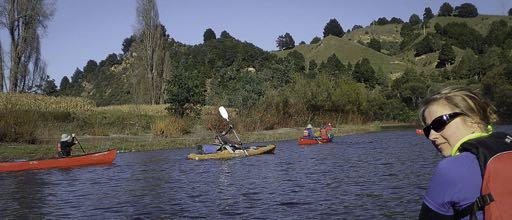
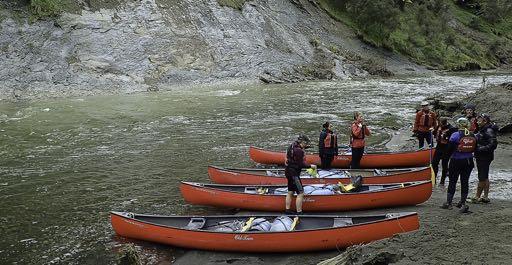
After a 75 minute drive we arrive at our departure spot, Cherry Grove in Taumarunui. We unloaded the five Canadian canoes and one single kayak, formed canoe partners and prepared the boats. Before departure we received instructions on what to do and what not to, paddling techniques, river maps and the spot tracker. After the introductions we set off to travel the upper reaches of the Whanganui River. We passed through a mixture of farmland and patches of native bush. As described by DOC we were in for some excitement because of the rapids on this section on the river. After some capsizes most paddlers were getting the hang of it.
A capsize is not quickly resolved, as the canoes are loaded with all the gear of the paddlers, making them hard to right, and a suitable spot needs to be found to reunite the canoe and the paddlers. With several occurrences on the first day we lost a significant amount of time on canoe capsizes, retrieving canoes and paddlers. Navigating a canoe through a rapid with someone on top is also quite tricky, but the lead canoes became very able at it and avoided capsizing themselves. It should be noted that some in the group had expected a calm river, which highlights the need for trip members to do research for themselves to confirm appropriate capabilities. Signing up for more than you can handle can bring yourself and others into tricky situations.
Unfortunately, one of the members of the group had become too cold and was unable to warm up after their first capsize. When this was mentioned to the group we stopped at a reasonably suitable spot for a change of clothes and continued. After another capsize involving the same person we had a hypothermia problem. After getting everybody out of the water several people were put in charge of the ‘casualty’, another group was handling the spot tracker to request assistance and getting the stove on for hot water. The person’s wet clothes were removed and made sure he was nice and cozy in his sleeping bag and tin foils. At first it seemed to go well so the spot-tracker “help” signal was triggered. But as soon as we noted that the situation was not improving we triggered the “SOS” signal. Quickly we observed a plane circling over us and not long thereafter a jet boat from the ‘Forgotten World Adventures’ arrived. They took in the patient, accompanied by the trip leader as well as a single kayak. It is useful if the number of seats left behind reflects the number of seats of the party left behind, but Richard managed to navigate his 2 person canoe over the rapids on his own. Amazingly he managed to perform another successful river rescue of two people who unfortunately capsized and snagged their canoe under a tree.
So we never made it to Ohinepane but camped in a cow dung spattered field for additional atmosphere. The jetboat driver returned the trip leader, and was so friendly to look after the unfortunate couple that lost their canoe including gear. The next day he would return with them and news from the canoe rental company.
Day 2: How to see Ruapehu during your Whanganui river trip The next day we were picked up by the rental company and showed them the location of the snagged canoe so it could be retrieved later. We were driven back to the Raetihi camp to regroup and to ensure that the unfortunate members
Day 3: Whakahoro to John Coull Hut were able to go home or to the Club Lodge whichever they preferred. Mike was running a working party and took in one of the members. At the same time we were preparing to continue the Whanganui River trip the following day. People without wetsuits decided that they would like to rent some for the next days and successfully rented some flashy ones, boots and also two nice thermos flasks. During sundown the views on pink Ruapehu were stunning and we enjoyed our little walk to the glow worms at night.
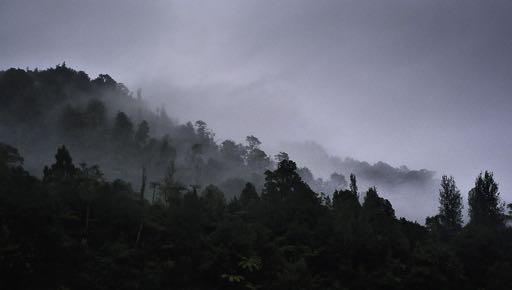
The group remaining were keen to finish the journey so the rental company dropped us off with four canoes at Whakahoro, the start of the 3-day river journey. Pastures and farmlands were replaced by forest, clearly the goats missed the memo indicating that it was a National Park with some threatened plants and grazed peacefully on the steep slopes. We saw numerous waterfalls, a result of the heavy rains the days before. With smaller rapids in this section of the river, everybody stayed in the canoes, making it easier for the lead boats and the worries of the previous days were quickly forgotten. We past the sacred Tamatea’s Cave and reached John Coull Hut. After the canoes and barrels were pulled high up the bank and secured we were able to enjoy the surroundings of the hut to ourselves. We were lucky to be the only occupants of the site; in the great walk season, all 24 bunks and 26 tent sites can be filled! The pekapeka (long-tailed bats) gave us an aerial show we went to bed.
Day 4: Four fantails at the toilet is not a good sign!
Our goal this day was Tīeke Kāinga and we continued our journey down the meandering river through steep gorges with beautiful bush cover. Again many waterfalls added some charm. We paddled to the Mangapurua Landing where when trying to tie the canoe Nick had to save himself falling into a jetboat. It was not highly appreciated by the owner who complained that he made his boat dirty. We walked to the Bridge to Nowhere, which nowadays clearly goes somewhere since the mountain bike and tramping track to Whakahoro is quite evident. Nevertheless, it is impressive to see this old bridge (1936) in the middle of the bush. The bridge was built to access the farms in the Mangapurua Valley, but the connecting road was never built. Although a community was established it did not last, due to difficult terrain with erosion, floods etc. and the people left. It is ironic that the bridge built to facilitate settlement of the area wasn’t originally successful, but now draws thousands of visitors to the area.
After enjoying our lunch we continued our journey to our last hut at Tīeke Kāinga. This facility is run by DOC and the local iwi and beside the hut is also a marae. There was no warden and therefore no pōwhiri which is normal during the main season. Unfortunately, at least unfortunate for us, the toilets were not working optimally and it was quite smelly. This failure however was a blessing for the fantails which gratefully removed any bugs flying out of the toilet.
Day 5: Tīeke Kāinga to Pipiriki
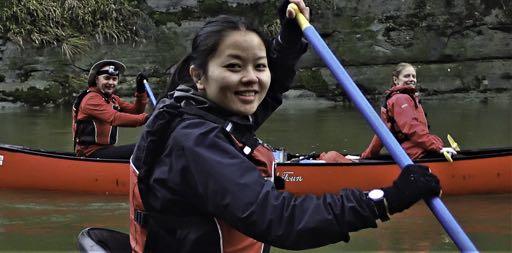
The final day, again alone on the river, the only disturbance was us chatting or just the sound of our canoes gliding through the water. The last part of our journey would bring us back to civilization, the landscape changed from forest to rural. The final kilometers had some final tests for us with some challenging rapids. Only one canoe tipped over in one of the rapids but otherwise we stayed dry. We arrived relatively early at the landing and had some time to change and eat our lunch. It took our driver a while to realize we ended with 3 people less than we started…
When we were back at base camp we learned that the lost canoe as well as all the gear was retrieved from the river. Some of the gear was water logged. Although the barrels provided have seals, not all last well with long term submersion so dry bags are a wise additional layer of protection. Besides our lost canoe, they retrieved another kayak and canoe so apparently losing stuff happens often on the river.
If trips go as planned, well that is great and this is what we all aim for. However, sometimes trips do not go as planned but we can learn valuable lessons. It is shown to be important that everyone determine if the trip is within their physical and skills range. It is unfortunate that the first day of the five day journey has the most challenging sections of river but the three leadership boats were able to ensure everybody was safely retrieved from the river by working together. In dealing with the hypothermic casualty, the medical staff and police indicated that we made the right call pressing the SOS button and providing the initial response. Besides the patient other people had several dunks in the river. During a medical emergency other party members should not be forgotten, in this case they were encouraged to change clothes and tell the other group members if they felt unwell. Pushing forward because this is how you planned the trip might not be the best choice. Taking a day- off to regroup, ensuring that all members are OK and to determine how to continue can be the best option. For our trip and the remaining group members continuing the trip was the best choice. All remaining members were confident in a canoe and keen to continue. By finishing the journey we turned a fraught first day into a great experience.
Comments
Comments are not open yet.