
Text taken from the club newsletter.
RAKIURA
The northwest circuit by REBECCA DAY
Mud, wild remoteness and rare wildlife—the essential ingredients of a classic tramping trip to Stewart Island. Certainly this is what we had been hearing tales of since we moved to NZ three years ago, and a tramp on the North West Circuit track had been added to the list of ‘must-dos’.
With some excitement, we realized that it would fit into our plans for our Christmas and New Year break. This would be the longest continuous tramping trip we had attempted, so we set to work planning our itinerary. The circuit itself is 9-11 days, but there are a couple of side trips to consider too—Rocky Mountain and Mt Anglem (Hananui). We couldn’t resist the opportunity to do some peak bagging, so we planned a 10 day itinerary that included both side trips and trimmed a day or two off the total by way of a water taxi. Itinerary sorted, we dehydrated food, packed and repacked, and finally felt ready for the challenge.
After driving from Picton to Bluff, and ‘enjoying’ a rather lively ferry ride (pretty average according to the skipper) we arrived in Oban. We developed an immediate fondness for the place, with its wonderful ‘end of the world’ feeling, superb seafood in the South Sea Hotel, friendly fishermen propping up the bar, and, of course, it reminded us of a Scottish coastal town we hold dear in our hearts.
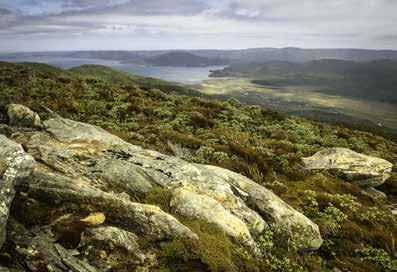
We started our adventure with a water taxi ride to Freshwater Inlet. There is nothing quite like the instant immersion in remoteness that you get when you see your water taxi disappearing off and knowing it will be a ten day walk before you see civilisation again. The water taxi also allowed time for us to start straight away on our first side trip up Rocky Mountain. This was well worth making time for as the unimaginatively named peak provides stunning views over Freshwater Inlet and the whole Northern section of Stewart Island. It was superb to get the view of our intended route and to soak in some of the wild beauty of this fantastic place.
From Rocky Mountain it was an easy few hours to Mason Bay. This section of the track is famous for waist deep water, but our good fortune meant it was bone dry. From Mason Bay hut we went on a night-time kiwi spotting expedition and were lucky enough to see one by the side of the track. With all this good luck, we were feeling upbeat about the trip ahead.
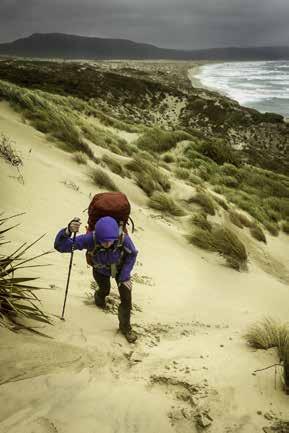
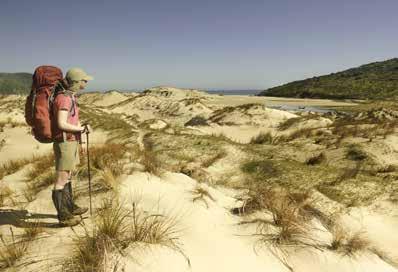
Due to a number of logistical constraints, we were tackling the track in the opposite direction to most North West Circuit trampers which meant that we had the longest days near the beginning coinciding with our packs being at their heaviest. Day two took us along Mason Bay and Hellfire Beach to Big Hell Fire Hut. A wild storm came in and bashed the coastline, which just added to the raw beauty of this dramatic beach. With the stormy weather and a high tide coinciding, we took the strenuous high tide route. This was somewhat more challenging than we anticipated. Carrying very heavy packs over steep sand dunes in a storm can definitely be referred to as ‘character building’. We were subjected to some painful sand blasting/face exfoliation, but the views from the top of some of the sand dunes kind of made it worthwhile. Day three was a little easier as we crossed the Ruggedy Range and managed a carefully timed dash (literally) around the low tide route on West Ruggedy Beach to arrive at East Ruggedy Hut. It was here that a spell of superb weather started the likes of which most Stewart Island trampers can only dream of.
The next two days took us over some superb headlands and through some undulating bush to Long Harry Hut and Yankee River. By this point we’d had a couple of days on our own, so it was a bit of a surprise to start running into the Christmas holiday trampers who were tackling the track in the other direction. Long Harry is a stunningly positioned hut that we shared with a Czech tramper. He was carrying a box of wine that he’d planned to drink with some other trampers on Christmas Eve in Christmas Village Hut. Sadly for him, there was no one else at Christmas Village on Christmas Eve, so he decided to carry the wine onwards around the track until he found someone to share it with—which was us. We certainly hadn’t expected any vino to be provided on our trip, and along with the sunshine and dry conditions which we had been enjoying, we were beginning to wonder if all the stories of Stewart Island were simply invented to keep people away from this heaven on Earth.
One feature of the hut books on the North West Circuit track is the list of rare and amazing creatures that people have sighted on their adventures. Some people happily reported seeing one kiwi while others boasted of three or more. Sightings of seals, sea lions and yellow eyed penguins were also listed. One tramper, in what was perhaps a tounge-in-cheek riposte to some of the more exaggerated claims, reported seeing a moa. So far we had seen kiwi, but we were getting hopeful for sightings of the rest, especially after drinking the Czech wine.
On day five our arrival at Yankee River hut was a bit of shock to the system as we found it pretty full, and with a slightly discordant group. They were having a bit of a row, and that is not what we go tramping for. The hut is in a wonderful spot though, so we spent as much time as the sandflies would let us on the beach and took a little swim in the river. We also managed to get enough phone reception to access a weather forecast and make a plan for the rest of the trip.
The next day was supposed to be nice weather, but less good conditions were forecast to roll in after that. We had Mt Anglem in our sights and were keen to get up it while we could still get a view. In our original plan, the next day would take us the 6 hour walk to Christmas Village Hut, and then the following day could be dedicated to the 6 hour trip up Mt Anglem. Given the forecast, and the fact that we had been consistently faster than the track times, we decided to go for a big day-walk to Christmas Village and get up Mt Anglem the next day, while the good weather remained. This would require an early start as it was a 12 hour track time, but that had the added advantage that we could get out of the hut before the discordant group arose.
Accordingly, we set off just before dawn the next day. After about 10 minutes walking, Gareth stopped suddenly—’look’—he whispered. We stood motionless, and to our wonder and joy a kiwi snuffled out in front of us on the track. In the dim light Gareth quickly tried to take some photos. The kiwi didn’t seem at all bothered by us. In fact it seemed pretty curious coming right up to our boots. After it disappeared back into the bush, we stomped onwards to Christmas Village. The cloud was initially low and we worried about our chances of a view on Mt Anglem, but as we got closer the cloud lifted and we knew we were in for a real treat.
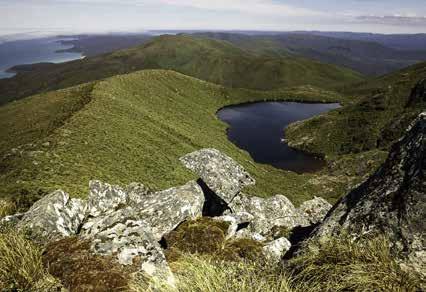
We dumped our packs at Christmas Village Hut and got together a few supplies for the climb up the hill. By this point it had got pretty hot, and we discovered the track up the hill was narly and steep. It was really hard work—pulling ourselves up muddy, twisted sections of roots, through bog that would give way at any moment, and all in sweltering sunshine. We had taken just enough water for the climb and were carefully conserving every sip. As we emerged out of the bush onto the ridge, we knew it had been worth the effort—what a stunning view! The bleak ruggedness of Stewart Island was laid out before us, with the hills rising up out of the dense green bush, and the dark grey interior of the island all foreboding and isolated. The wispy clouds sat static in the clear blue sky, and merged in the distance into the snowy peaks of Fiordland. Exhausted in the heat, Gareth and I both collapsed onto some big flat rocks and soaked it all in, while some of the rare southern dottrell hopped around about us.
That was a 12 hour day, so we were pretty exhausted by the time we got back to Christmas Village. We were also a day ahead of our schedule. We’d heard the next hut, Bungaree, was a nice place, so we decided to stay two days there before heading back into Oban. It was an easy walk to Bungaree, although we discovered the hut a little more crowded than we expected with the DOC ranger and his family, plus about four other groups all in residence. Most of the groups were just starting out on the walk and some were ridiculously underprepared with a lack of gear (e.g. no cookers, no boots), little food (not much more than a couple of loaves of bread) and some crazily over ambitious plans (‘I’m going to do the whole track in 5 days despite never having done anything like this before’).
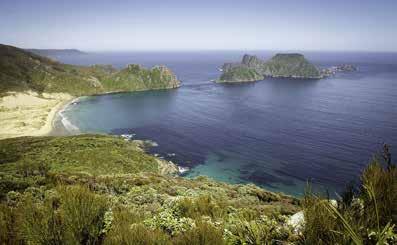
The DOC ranger who was holidaying in the hut with his family was lovely and gave us some tips for day walks with our spare day. The next day we did a little bush-bash into the nearby Golden Bay and hung out for a wee while on the serene and secluded sands. Golden Bay, being well away from the track, is a great place to spot the yellow eyed penguins that nest in the dunes there. We sat still and quiet on the beach for a while until we saw a little head bobbing in the ocean—the little head got closer and then the yellow eyed penguin landed up on the sand and started to waddle up the beach. It was clearly a little nervous and unsure of us, so we kept completely still. It was amazing to see this wonderful creature, so unlike any other bird, so exotic for those from the northern hemisphere. I have a real soft spot for penguins, so this was a highlight of the trip (and year) for me.
Our second night at Bungaree Hut was, thankfully, a little quieter than the first, and we enjoyed the superb views from the hut over the beach. We had only one day’s walking left and were feeling a little sad to be finishing our walk, but also looking forward to the New Year’s Eve celebrations in Oban the next day. The final day was pleasant, although a little strange to emerge out onto the popular great walk track and start interfacing with hordes of people. We must have smelt. And if we didn’t, our remaining block of Camembert certainly did. There were some nice beaches on the way and we took it all at a leisurely pace. Finally, we passed the anchor chain that marks the end of the track, plodded along the road, and passed over the last headland before the bright lights of Oban town.
I can truly recommend finishing a big walk on New Year’s Eve. We tucked into fish and chips at the South Sea Hotel and then headed onto the beach where the Oban New Year’s bonfire took place. The flames danced in the breeze, the boats bobbed in the harbour. We sipped our beers and reflected on the end of our third year in New Zealand. What would the next year bring us? Where would we explore next? Could it possibly get any better?
Comments
Comments are not open yet.