
Text taken from the club newsletter.
WHAT WERE THEY THINKING?
An exploration of Cloudy Peak—with comments by Lindsay Main by MEGAN SETY
‘Don’t you wonder what they were thinking? I mean how did they find this place? What would have made them think “I’ll go climb that”.’
David and I were at the end of five days of climbing at Cloudy Peak. We’d finally thrown in the towel after a grade 14 climb on the Little Wall. David was put off by the rock crumbling into his hands with mud falling out behind it. He called down to me ‘DO NOT lead this route.’ I was put off as soon as I started, by the cracks so filled with lichen I couldn’t get my pro or fingers in them.
Along with the grade 17 route next to it, the climb was meant to be a relaxing wind down from the days before. We topped out on the 35 metre Little Wall, a small crag off to the side of the main feature, the Hourglass and Upper Walls. I gazed up at the myriad of 300 metre routes and asked David, “Don’t you wonder what they were thinking?”
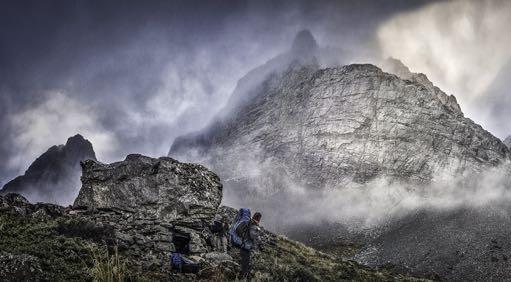
Cloudy Peak is an alpine peak sitting near the confluence of the Havelock and Clyde rivers in the southern alps. Some have compared the quality of the rock to that bastion of solid and brilliant rock in Fiordland, the Darrans. A less romantic description comes from Lindsay Main and Tim Wethey’s 2004 South Island Rock:
“The grades are likely to have some inconsistencies. Some people find the area very intimidating, and the exposure and the unfamiliar rock may take some getting used to. Being an alpine area, there will be some loose rock, and the weather can be severe. Furthermore, some routes involve intricate route-finding. It’s probably best to try a climb with a few grades in reserve for a start.”
For Christmas, we’d decided to spend a day to walk in and set up camp, 5 days to climb, and a day to walk out. We had our sights on the Great Prow, a 350 m, 9 pitch grade 14. It seemed like a long fun day out within the recommended few grades below our comfort zone. Depending on how we found the routes and weather, there were endless other options to fill our spare days.
The Clyde was flowing too high to cross at Erewhon station. So we started from Mesopotamia, adding a few more hours on to the gravel river bash. We’d already left the roadend late, so we arrived at 10 pm, crashing into the first grassy spot we could set up the tent.
The best weather was the next day. But we slept in and didn’t have enough time to attempt the Great Prow. We couldn’t pass up the perfect weather, so we walked to the base of the Hourglass Wall to size up our options. We settled on a friendly looking and somewhat short (at 200 metres) grade 15 climb, Slip-Sliding Away.
David meandered up leading out of sight. As I reached the top of the first pitch at 50 metres, I realised I had not recovered from dehydration and fatigue from the day before. I told David he would have to lead the whole route—I felt just too tired. The route wandered and more than once David back-tracked or down-climbed to find the best line. It varied from thin ledges on slabs to bridging up giant blocks teetering one on top of the other. We took our time with the long daylight hours. It was on 5 pm by the time we finished, snacked and headed for what we thought would be a scramble and scree descent. It took route finding and a few abseils before we were back for dinner at 9 pm. Another late night.
The next day, even more fatigued, we again set aside the Great Prow. We settled on the more relaxed Southwest Ridge. David demanded I lead the first pitch rather than make up more excuses for wimping out. We traded a few pitches, David still taking the brunt of the harder ones. We didn’t find the easy traverse descent and added more time on to the long day with extra scrambles and abseils. Dinner at 9 pm. Again. It was another late night.
We woke to gale winds and rain, relieved to finally have an excuse to rest. We spent the day napping, reading and holding the tent up against the wind. The next day dawned fine. At this point we’d realised that the Great Prow was going to be an epic long day for us and more than we felt like taking on. We decided a mellow day on the short Little Wall would do just fine.
And it was there that I sat back, thinking about how demanding the approaches, climbs and descents had been. When I looked up at the routes we’d climbed, wanted to climb and would never dream of climbing, I wondered how the hell anyone had decided to explore and establish this as a climbing area. The rock faces were massive and intimidating and it’s a bit of mission to access.
Months after our trip, I was more than just curious and I emailed Lindsay Main to ask him just exactly what he had thought. Lindsay was one of the authors of the guidebook that had been essential to our route finding. He, along with several others, put up many of the first ascents at Cloudy Peak.
He told me, they’d initially come on a mountaineering trip to climb the Southwest Ridge:
The area was talked about in the 1970s as you can see the Prow from the Havelock Valley, so a lot of people knew about it. We knew that Jack Hill and Rob Rainsbury had climbed a rock route on the SW Ridge, so around 1976 with a group of friends I went up to repeat that route. It was a good introduction to the climbing style of the area, and well within our abilities; however we viewed it as a mountaineering rather than a rock climbing area initially.
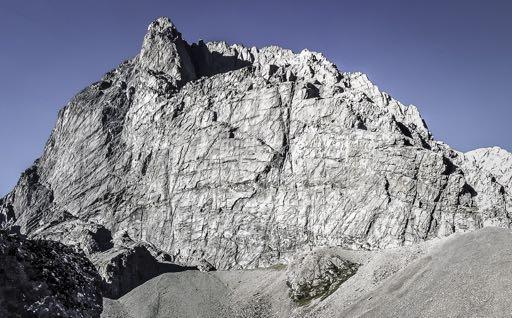
Hourglass Wall, Cloudy Peak. Photos: Peter Laurenson www.occassionalclimber.co.nz
Lindsay was right, we found the Southwest Ridge friendly, interesting and a welcoming intro to long approaches, meandering diverse style of climbs and thoughtful descents. As it turns out, after finishing the Southwest Ridge, Lindsay had wandered up the same valley and stood not far from my vantage point and began looking for routes to climb:
I walked up the valley and was astounded at the amount of steep and intimidating rock there. I stood under the Hourglass Wall and tried to pick out lines that might be feasible.
I felt much the same way on our first day when we were looking for a route to start. I remembering turning to David, saying it felt foreboding.
Lindsay wasn’t put off, but inspired. After his first trip, he returned many times over. He and several others established many of the classic routes at Cloudy Peak between 1980-81:
I came back the following summer with Henry Mares, a capable English climber who was unfortunately killed in a road accident shortly after. We started up Hourglass Left (7 pitches, grade 19), climbing the first pitch and the first part of the second pitch, which was at the limit of our abilities at the time. It had to be left for a few years until standards improved.
In 1979/80 summer I decided that an easier option that would be a notable route was the Great Prow. Hugh Logan and I climbed this in January 1980 in a three-hour push during deteriorating weather, and then walked out. We found out soon after that John Entwisle and Chris Moore had made the first ascent a month earlier, but this renewed my interest in the area.
Then I teamed up with Marty Beare, and by now we had the technical grunt to do the route on the Hourglass. Though it’s hard, this wasn’t a particularly intimidating route as it obviously gets much easier after the first two pitches. The other Hourglass routes are much more committing.
On the second day we did the Needle Direct (5 pitches, grade 16) route as a bonus. I came back with an old friend James Jenkins later in the year and climbed Fiddler On The Roof (9 pitches, grade 20) and Slip-sliding Away, and then in 1981 was back with Marty to do Ytivarg (5 pitches, grade 17) and Mission Impossible (8 pitches, grade 17). These were all done in three-day weekends. We would do the longer climb on the second day, then a shorter one and walk out on the third day.
All my routes have been done ground up and free. I took a fall on the crux of Fiddler, and I think most of the repeats have as well.
What I find astounding is that they took on these 200- 350 metre climbs not knowing how difficult, technical or unstable the route might become. Any alpine multi- pitch route will wander, particularly to stay near some semblance of a similar grade.
But the description from the 2004 South Island Rock was spot on when it described ‘intricate route-finding’. I found the climbing style incredibly particular at Cloudy Peak. The moves on Slip-sliding Away for example, were comfortably grade 15, but the options were finite. Often it was a brief sequence of just one small ledge, a tiny crack and a dainty step before a more substantial hold would appear. The pitch-by-pitch descriptions in South Island Rock made it possible to feel confident in our expectations of the routes and to enjoy the climbs. I cannot imagine having the skill or confidence to have gone up those routes blind, hoping to find something climbable.
In the 1990s, more challenging routes became possible with bolting. And just in the last few years, the crag seems to be finding yet another resurgence of interest. Several groups have made efforts to improve the off track access and a few new routes have appeared. This includes Lindsay and his son Francis’s first ascent of Onslow Buttress in 2015 (9 pitch, grade 16). At least another two routes have been established, one each in 2016 and 2017.
Lindsay told me he is keen to do more routes there. I wasn’t so sure when we first finished the trip. But after reading Lindsay’s perspectives, my own trip report and the route descriptions from the books, I can feel that desire to return and try again, creeping back. I doubt that establishing new routes will be in my climbing bag of tricks, but I’m keen to return to places that have challenged me to see if I can find my own version, in Lindsay’s words, of ‘improved standards’.
Comments
Comments are not open yet.